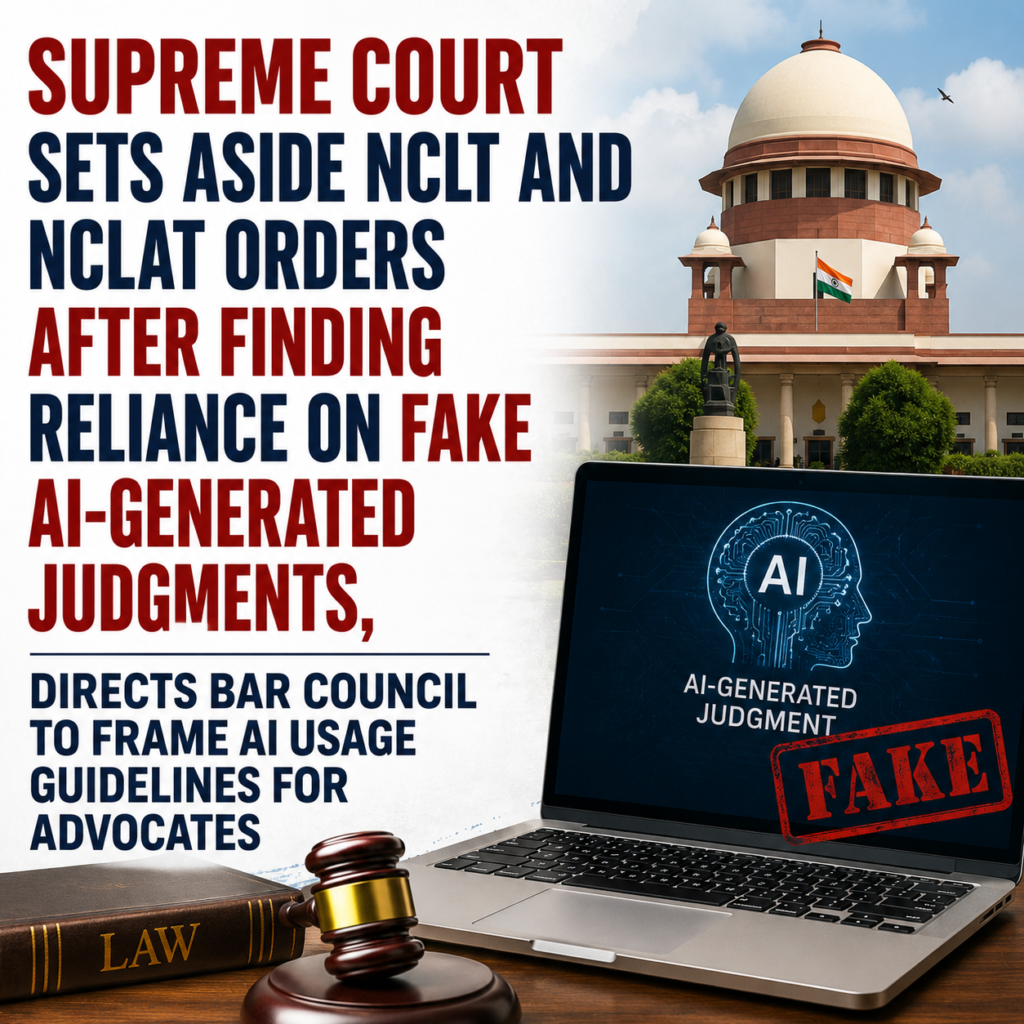
Supreme Court Sets Aside NCLT and NCLAT Orders for Relying on Fake AI-Generated Judgments, Directs Bar Council to Frame Disciplinary Guidelines
Facts
The appellant, Pooja Ramesh Singh, was a suspended director of Essel Infraprojects Limited (“EIL”), which was the corporate guarantor for loan facilities granted by Jammu and Kashmir Bank Limited to Pan India Utilities Distribution Company Limited (“PIUDCL”).
PIUDCL defaulted in repayment, following which its loan accounts were classified as non-performing assets. Jammu and Kashmir Bank thereafter filed an application under Section 7 of the Insolvency and Bankruptcy Code, 2016, seeking commencement of the Corporate Insolvency Resolution Process against EIL as the corporate guarantor.
By an order dated 28 August 2024, the National Company Law Tribunal, Mumbai Bench, admitted the Section 7 application, appointed an Interim Resolution Professional and declared a moratorium under Section 14 of the IBC.
The appellant challenged the admission order before the National Company Law Appellate Tribunal. She contended, among other things, that:
- EIL’s liabilities had been transferred to another entity through a scheme of demerger and subsequent amalgamation; and
- a renewed sanction letter dated 18 November 2017 did not refer to the corporate guarantee, indicating that the guarantee had been relinquished.
The NCLAT dismissed the appeal on 11 September 2025. It held that the corporate guarantee continued despite the demerger or amalgamation because Clause 8 of the Guarantee Deed expressly provided that the guarantee would not be affected by the guarantor company’s absorption or amalgamation.
While affirming the NCLT’s order, the NCLAT also referred to several Supreme Court judgments allegedly relied upon by the NCLT.
Before the Supreme Court, the appellant pointed out that several of these judgments were either completely non-existent or contained fabricated paragraphs attributed to genuine case citations. The material appeared to have been generated through artificial intelligence without verification.
The bank filed an affidavit stating that its advocates had not cited those authorities before the NCLT. According to the affidavit, the purported precedents had been obtained through the Tribunal’s own research.
Issues
- Whether an adjudicatory order can remain valid when the court or tribunal relies upon fake, non-existent or AI-hallucinated judicial precedents.
- Whether reliance on even a small amount of fabricated legal material contaminates the entire decision-making process.
- What duties advocates have when presenting AI-generated legal research before a court or tribunal.
- What responsibility judges and adjudicatory authorities have to verify authorities relied upon in their judgments.
- Whether the NCLAT’s failure to detect the fabricated authorities while affirming the NCLT’s order affected the validity of the appellate judgment.
- Whether the Supreme Court should decide the underlying insolvency dispute on merits or remit it to the NCLT for fresh consideration.
- What institutional measures were required to prevent advocates from submitting AI-generated fabricated judgments as genuine precedents.
Petitioner’s Arguments
The appellant argued that the NCLT’s judgment was fundamentally vitiated because it relied upon authorities that did not exist in law.
Senior Counsel for the appellant demonstrated that:
- certain citations referred to entirely non-existent judgments;
- some citations belonged to genuine reported decisions but the paragraphs attributed to them were not found in the actual judgments; and
- at least one citation belonged to a completely different case under a different cause title.
It was submitted that the NCLT’s conclusions were influenced by fabricated legal material, rendering its decision legally unsustainable.
The appellant also advanced arguments on the merits of the insolvency dispute, including the effect of the demerger, amalgamation and renewed sanction letter on the continued enforceability of the corporate guarantee.
However, the principal challenge before the Supreme Court concerned the integrity of the adjudicatory process and the reliance upon fake AI-generated precedents.
Respondent’s Arguments
The respondents opposed the appellant’s submissions on the merits of the insolvency dispute.
Jammu and Kashmir Bank filed an affidavit clarifying that its counsel had not cited the fake or non-existent judgments before the NCLT.
The affidavit indicated that the precedents referred to by the NCLT had apparently been obtained through the Tribunal’s own research rather than being supplied by the bank’s advocates.
The respondents nevertheless defended the underlying conclusion that the corporate guarantee continued despite the restructuring of the corporate guarantor.
Analysis of the Law
AI may assist adjudication but cannot replace judicial reasoning
The Supreme Court recognised that artificial intelligence has significant potential to improve professional and judicial efficiency.
Courts have historically adopted new technologies and incorporated them into court administration and adjudicatory processes. However, AI differs from conventional technological tools because it has the ability not merely to assist routine functions but also to imitate human thinking, reasoning and decision-making.
The Court cautioned that unrestricted reliance upon AI could result in professionals and adjudicators delegating the very intellectual functions that constitute the foundation of legal reasoning.
AI may therefore be used as an aid, but adjudication must always remain under absolute human control, with a human decision-maker actively involved at every stage.
Human control and verification are indispensable
The Court emphasised that judicial decision-making requires:
- conscious reasoning;
- critical evaluation;
- experience;
- moral and legal judgment;
- distinction between truth and falsehood; and
- balancing competing values and interests.
These functions cannot be surrendered to an automated system.
The Bar and the Bench must consciously determine when and how AI should be used. Every AI-generated legal proposition, citation or excerpt must be independently verified from an authoritative source.
AI hallucinations pose a systemic threat to justice
The Court described AI’s tendency to generate fake, non-existent or hallucinated information as particularly dangerous in law.
A fabricated precedent may appear authentic because it can contain:
- a plausible case title;
- a realistic citation;
- apparently judicial language; and
- seemingly relevant legal reasoning.
However, once such material enters a judgment, it contaminates the adjudicatory process and undermines the rule of law.
The Court compared the introduction of AI-hallucinated precedents into legal adjudication to the release of a dangerous and invisible substance—insidious, difficult to detect and potentially catastrophic.
Zero tolerance for fake AI-generated precedents
The Supreme Court declared a strict zero-tolerance principle.
An advocate who cites an AI-generated judgment without verifying its existence and accuracy commits professional misconduct.
Similarly, a judge or adjudicatory authority commits a serious lapse by relying upon fake or hallucinated legal material as precedent.
The Court held that an adjudicatory decision based upon fabricated precedent is “no decision in the eyes of law.”
It clarified that such a decision must be set aside even if:
- the fabricated authority did not form the sole basis of the result;
- the material had only an indirect bearing on the reasoning; or
- only a small portion of the decision-making process was affected.
Even an “iota” of fake or hallucinated material entering the reasoning process violates the sanctity and integrity of adjudication.
Accountability of the Bar
The Court directed the Bar Council of India to constitute a committee to examine the issue of advocates submitting AI-generated fabricated judgments as genuine legal precedents.
The Bar Council was directed to:
- formulate guiding principles for responsible use of AI by advocates;
- prescribe verification requirements;
- prevent recurrence of such incidents; and
- determine the disciplinary consequences of violating those norms.
The Court emphasised that mere judicial condemnation was insufficient and that enforceable professional accountability was necessary.
Responsibility of appellate forums
The Supreme Court also questioned how the fake precedents escaped examination by the NCLAT.
The first appellate tribunal reproduced and relied upon the NCLT’s discussion without verifying whether the authorities actually existed.
The appellate process is expected to scrutinise the legality and correctness of the original decision. Failure to detect fabricated precedents meant that the appellate judgment could not cure the defect in the NCLT’s order.
Precedent Analysis
The Supreme Court independently verified the six authorities referred to by the NCLT and found the following:
State Bank of India v. M/s Shree Ram Urban Infrastructure Ltd., 2020 SCC OnLine SC 341
The citation belonged to an existing judgment, but the cause title was incorrect.
The correct case corresponding to the citation was M. Subramaniam v. S. Janaki. The paragraph attributed to the purported SBI judgment did not exist.
Everest Kento Cylinders Ltd. v. Union of India, (2015) 2 SCC 1
The citation referred to a genuine reported judgment.
However, the paragraph attributed to it by the NCLT was non-existent and could not be found in the judgment.
ICICI Bank Ltd. v. Urban Infrastructure Real Estate Ltd., (2019) 16 SCC 528
The purported citation and judgment were non-existent.
V.S. Dempo & Co. Ltd. v. Reliance Communications Ltd., (2021) 10 SCC 176
The purported reported judgment did not exist.
Canara Bank v. N.G. Subbaraya Setty, (2018) 16 SCC 228
The citation related to an existing judgment, but the paragraph attributed to it by the NCLT was not contained in the actual judgment.
Sarbjit Singh v. Union Bank of India, (2022) 7 SCC 464
The purported citation and judgment were non-existent.
The verification therefore demonstrated a combination of:
- invented case titles;
- invented citations;
- incorrect cause titles;
- genuine citations paired with fabricated extracts; and
- non-existent judicial paragraphs.
Court’s Reasoning
The Supreme Court held that the integrity of judicial decision-making was the central consideration.
The NCLT had not merely made an incidental typographical or citation error. It had treated fabricated authorities as genuine Supreme Court precedents and used them in support of its legal conclusion.
The bank’s affidavit made the situation more serious because it indicated that the authorities had not been cited by counsel and had apparently entered the judgment through the Tribunal’s own research.
The NCLAT subsequently failed to verify the authorities and affirmed the NCLT’s reasoning.
The Court held that a judicial or quasi-judicial decision must be founded upon:
- facts established on the record;
- authentic statutory provisions;
- genuine judicial precedents; and
- independently applied human reasoning.
Where fabricated material is introduced into that process, the judgment is institutionally compromised, irrespective of whether the ultimate conclusion might independently be capable of justification.
The Court therefore declined to examine whether the NCLT’s final conclusion concerning the corporate guarantee was otherwise correct.
Doing so would risk validating a process that had been contaminated by fabricated legal material. The appropriate course was to set aside both the NCLT and NCLAT decisions and restore the Section 7 application for fresh adjudication.
The Supreme Court expressly clarified that it had not expressed any opinion on:
- the existence of financial debt;
- the occurrence of default;
- the effect of the demerger or amalgamation;
- the interpretation of the renewed sanction letter; or
- the continued enforceability of the corporate guarantee.
Those issues were left entirely open for determination by the NCLT on authentic materials and applicable law.
Conclusion
The Supreme Court set aside:
- the NCLT’s order dated 28 August 2024 admitting the Section 7 IBC application; and
- the NCLAT’s judgment dated 11 September 2025 affirming that order.
The Court held that a judgment relying upon fake, non-existent or AI-hallucinated precedents is no judgment in the eyes of law and must be set aside even where the fabricated material had only a limited bearing on the outcome.
The Section 7 application was restored to its original number before the NCLT. The Tribunal was directed to hear and decide it afresh, preferably within two weeks.
Until disposal of the application, the parties were directed to maintain the existing status quo.
The Bar Council of India was also directed to constitute a committee and frame guiding principles, verification standards and disciplinary consequences concerning advocates’ use of AI-generated legal material.
The Court clarified that it did not prohibit legitimate use of artificial intelligence in legal work. Its ruling was directed against presenting or relying upon unverified, fabricated or hallucinated AI output as genuine judicial precedent.
Case: Pooja Ramesh Singh v. Jammu and Kashmir Bank Limited and Another
Court: Supreme Court of India
Case Number: Civil Appeal No. 11950 of 2025
Judge: Justice Pamidighantam Sri Narasimha and Justice Alok Aradhe
Date: 2 July 2026
Result: Appeal disposed of; NCLT and NCLAT judgments set aside for reliance on fake AI-generated precedents; Section 7 IBC application restored for fresh and expedited adjudication.