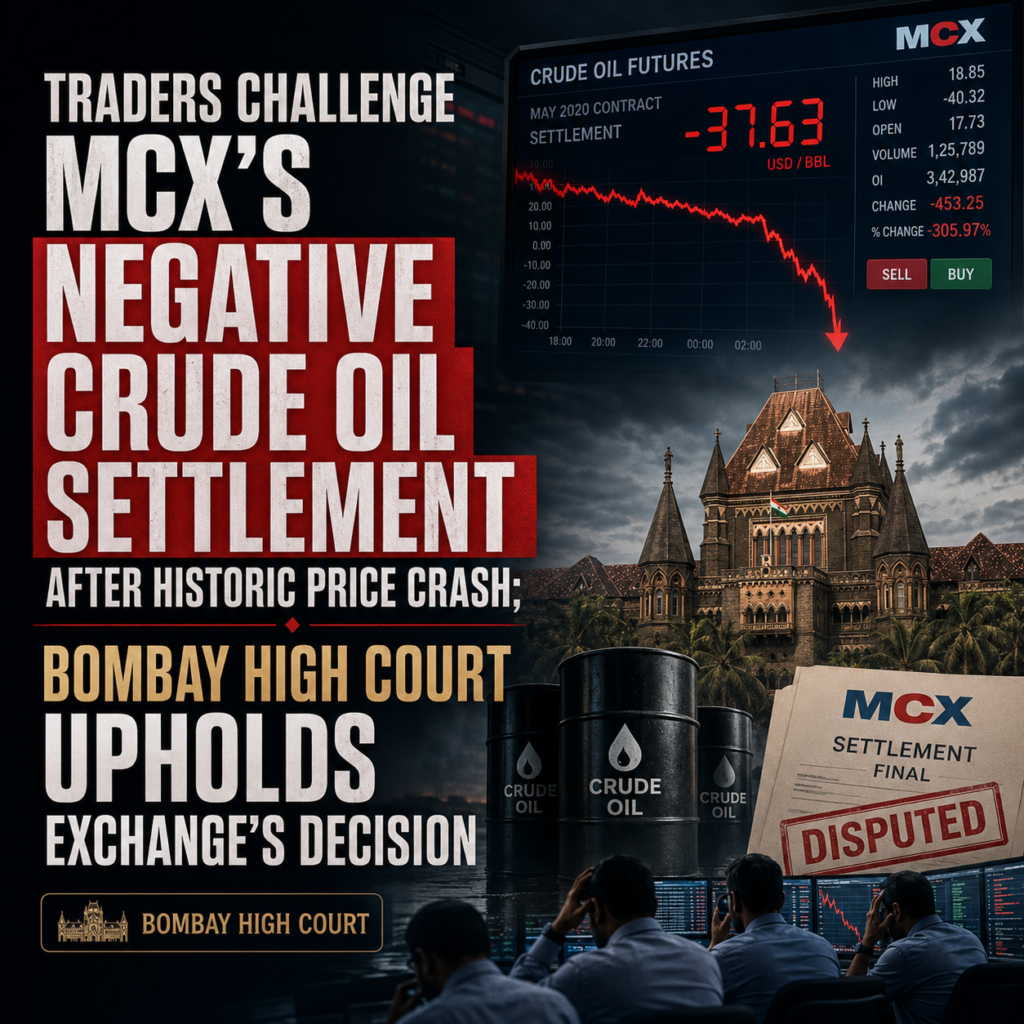
Can Crude Oil Futures Be Settled at a Negative Price? Bombay High Court Says Yes, Dismisses Traders’ Challenge
Facts
The batch of writ petitions before the Bombay High Court arose from the historic collapse of global crude oil prices during the COVID-19 pandemic. The lead petitioner, Dhanera Diamonds, along with several other traders and companies, challenged the validity of a circular issued by the Multi Commodity Exchange of India Ltd. (MCX) and the Multi Commodity Exchange Clearing Corporation Ltd. (MCX-CCL) on 21 April 2020.
The dispute related to MCX Crude Oil Futures Contracts that expired on 20 April 2020. Under the contract specifications, the final settlement price, known as the Due Date Rate (DDR), was linked to the settlement price of the corresponding crude oil futures contract traded on the New York Mercantile Exchange (NYMEX).
During the COVID-19 pandemic, demand for crude oil collapsed worldwide. Simultaneously, storage facilities became scarce. These extraordinary market conditions caused the NYMEX crude oil futures contract to settle at a historically unprecedented negative price of USD -37.63 per barrel on 20 April 2020.
On 21 April 2020, MCX issued a circular fixing the DDR for the expiring crude oil futures contract at negative ₹2,884 per barrel. This resulted in traders holding long positions suffering massive losses and, in many cases, becoming liable to pay substantial sums.
The petitioners contended that the Indian commodity trading system had never previously experienced negative pricing. They argued that MCX’s trading platform did not even have the capability to trade at negative prices before this event and that traders were never warned about such a possibility.
Another significant grievance was that, due to COVID-related restrictions, MCX had reduced trading hours from the original schedule extending up to late night hours to only 5:00 PM. As a result, Indian traders were unable to react to the drastic fall in international crude oil prices that occurred later in the evening when NYMEX trading continued.
The petitioners therefore challenged the validity of the settlement mechanism, the impugned circular, and the failure of the regulators to intervene in what they described as an unprecedented market crisis.
Issues
The Court considered the following principal issues:
- Whether MCX and MCX-CCL were justified in fixing the Due Date Rate (DDR) at a negative value of ₹2,884 per barrel.
- Whether a “price” under the crude oil futures contract could legally be negative.
- Whether the reduction of trading hours deprived traders of a fair opportunity to exit or hedge their positions.
- Whether SEBI, MCX, and MCX-CCL failed to exercise their emergency powers to protect investors.
- Whether the regulators should have annulled the trades or fixed an alternative settlement price.
- Whether the impugned circular retrospectively altered vested contractual rights.
- Whether the High Court could interfere with completed settlements in exercise of its writ jurisdiction.
Petitioners’ Arguments
The petitioners mounted a comprehensive challenge to the settlement process.
Negative Pricing Was Legally Impermissible
The petitioners argued that the concept of “price” necessarily implies consideration payable by a buyer to a seller. According to them, a negative price turns this concept upside down because it requires the seller to pay the buyer.
They submitted that neither the contract specifications nor the market participants contemplated a situation where crude oil prices could become negative.
Trading Hours Were Arbitrarily Reduced
The petitioners emphasized that MCX had reduced trading hours during the pandemic and closed trading at 5:00 PM.
However, the NYMEX market continued trading long after Indian markets had closed. The drastic price collapse into negative territory occurred during those additional hours.
The petitioners argued that they were effectively trapped because they could neither trade nor exit their positions when the market was collapsing internationally.
Regulators Failed To Exercise Emergency Powers
The petitioners relied upon various provisions in the MCX and MCX-CCL bye-laws granting emergency powers to the regulators.
According to them, the negative pricing event was:
- Unprecedented,
- Unforeseeable,
- Extraordinary,
- Adverse to market integrity.
Therefore, SEBI and MCX should have exercised their emergency powers to:
- Suspend settlement,
- Annul trades,
- Close out positions,
- Fix a fair settlement price.
The petitioners argued that when a statutory authority possesses discretionary power to deal with emergencies, it has a corresponding duty to exercise that power when circumstances warrant intervention.
Failure To Protect Investors
The petitioners contended that SEBI’s statutory role is not merely supervisory.
According to them, SEBI exists to:
- Protect investors,
- Maintain fair markets,
- Prevent market distortions,
- Ensure orderly trading.
They argued that SEBI remained a passive spectator despite a once-in-history market event.
Circuit Breakers Were Ignored
The petitioners pointed out that the regulatory framework contained circuit-breaker mechanisms designed to deal with excessive volatility.
They argued that regulators were willing to intervene when prices moved by 6% or 9%, yet they failed to intervene when the market experienced an unprecedented collapse far exceeding those limits.
Failure To Warn Traders
The petitioners highlighted that the Chicago Mercantile Exchange (CME) had issued advisories warning market participants about the possibility of negative oil prices.
MCX was aware of these advisories but allegedly failed to issue similar warnings to Indian traders.
According to the petitioners, this deprived investors of critical information needed to assess risks.
Retrospective Alteration Of Contractual Rights
The petitioners argued that the impugned circular fundamentally altered existing contractual rights after the contracts had already been entered into.
According to them:
- Negative pricing was never contemplated.
- The settlement mechanism was effectively changed retrospectively.
- The time gap between trading closure and settlement expanded dramatically.
- The practical protection offered by price limits disappeared.
They contended that such retrospective changes were arbitrary, excessive, and unconstitutional.
Respondents’ Arguments
SEBI, MCX, and MCX-CCL opposed the petitions.
Futures Contracts Are Risk-Based Instruments
The respondents argued that crude oil futures are sophisticated derivative products.
Market participants voluntarily assume the risk of price fluctuations, including extreme volatility.
The petitioners were experienced traders who knowingly participated in the derivatives market.
Contract Specifications Clearly Governed Settlement
The respondents argued that the contract specifications expressly linked the Due Date Rate to the settlement price of the corresponding NYMEX crude oil contract.
Since the NYMEX settlement price became negative, MCX merely applied the agreed formula.
According to the respondents, no deviation from the contract occurred.
Negative Pricing Reflected Genuine Market Forces
The respondents submitted that the negative price was not the result of manipulation, fraud, technical failure, or regulatory error.
It was caused by genuine global market conditions arising from:
- COVID-19 lockdowns,
- Collapse in demand,
- Storage shortages,
- Excess supply.
Therefore, there was no justification for regulatory intervention.
No Obligation To Annul Trades
The respondents argued that powers to annul trades are exceptional powers.
They are intended for situations involving:
- Fraud,
- Market abuse,
- Technical breakdowns,
- Trading errors.
The negative settlement price resulted from legitimate market discovery and therefore did not justify cancellation of trades.
Judicial Review Is Limited
The respondents contended that courts should not substitute their views for those of specialized market regulators.
Questions relating to commodity derivatives, settlement mechanisms, and risk management are highly technical matters best left to regulatory authorities.
Analysis of the Law
The Court analyzed the statutory framework governing securities and commodity derivatives markets.
Securities Contracts (Regulation) Act, 1956
The Court observed that derivatives traded on recognized exchanges derive legal validity from the Securities Contracts (Regulation) Act.
Such contracts operate within a specialized statutory framework distinct from ordinary commercial transactions.
Nature of Derivative Contracts
The Court emphasized that futures contracts are not conventional agreements for physical delivery of goods.
Instead, they are financial instruments designed for:
- Hedging,
- Risk management,
- Speculation,
- Price discovery.
Therefore, concepts applicable to ordinary sale contracts cannot always be mechanically applied to derivatives.
Regulatory Powers
The Court examined the bye-laws and regulations relied upon by the petitioners.
While the regulators possessed emergency powers, the Court held that the existence of a power does not automatically mean it must be exercised in every unusual circumstance.
The decision whether to intervene is primarily a matter for expert regulatory judgment.
Finality of Settlements
The Court emphasized that exchange settlements must achieve finality.
Allowing completed settlements to be reopened years later would undermine confidence and stability in financial markets.
Precedent Analysis
The petitioners relied on several decisions relating to:
- Exercise of discretionary powers by statutory authorities,
- Investor protection,
- Contractual rights,
- Judicial review of regulatory actions.
They cited authorities emphasizing that a statutory power coupled with a duty must be exercised when circumstances require intervention.
The respondents relied upon precedents recognizing:
- Limited judicial interference in economic and regulatory matters,
- Deference to expert regulators,
- Finality of exchange settlements,
- Specialized nature of securities regulation.
The Court ultimately found the respondents’ authorities more applicable because the dispute concerned complex derivative markets rather than ordinary contractual transactions.
Court’s Reasoning
The Court rejected the petitioners’ challenge.
First, it held that the contract specifications clearly linked the settlement mechanism to the NYMEX settlement price.
The Court found that traders voluntarily entered into contracts governed by that formula.
Second, the Court rejected the argument that negative pricing was legally impossible.
The Court observed that derivative markets function differently from ordinary sale transactions and that the settlement mechanism did not prohibit negative values.
Third, the Court held that the unprecedented nature of the event alone did not render the settlement unlawful.
Extraordinary market movements do not automatically justify regulatory intervention.
Fourth, the Court found no evidence of:
- Fraud,
- Manipulation,
- Technical malfunction,
- Bad faith,
- Regulatory arbitrariness.
The negative settlement resulted from genuine market conditions.
Fifth, the Court held that decisions regarding emergency intervention and annulment of trades fall within the specialized expertise of market regulators.
The Court declined to substitute its own assessment for that of SEBI and the exchanges.
Finally, the Court observed that reopening settled transactions years after their completion would create significant uncertainty in commodity and derivatives markets.
Such interference could have far-reaching consequences for market integrity and investor confidence.
Conclusion
The Bombay High Court dismissed the batch of writ petitions challenging the negative settlement price of MCX crude oil futures contracts.
The Court held that:
- The Due Date Rate was determined in accordance with the contract specifications.
- Negative pricing was not prohibited by law.
- The regulators were not legally required to annul trades.
- No arbitrariness or illegality was established against SEBI, MCX, or MCX-CCL.
- Judicial review could not be used to rewrite completed derivative transactions.
- The final settlement remained valid and binding.
Accordingly, the challenge to the impugned circular dated 21 April 2020 was rejected.
Case Details
Case: Dhanera Diamonds v. Securities and Exchange Board of India & Ors. (Lead Matter) and connected petitions
Court: High Court of Judicature at Bombay
Case Number: Writ Petition No. 4930 of 2024 and connected matters
Judges: Justice M. S. Sonak and Justice R. I. Chagla
Date: 24 June 2026
Result: Writ Petitions Dismissed; Bombay High Court upheld the negative settlement price fixed by MCX for crude oil futures contracts and refused to interfere with the completed settlements.