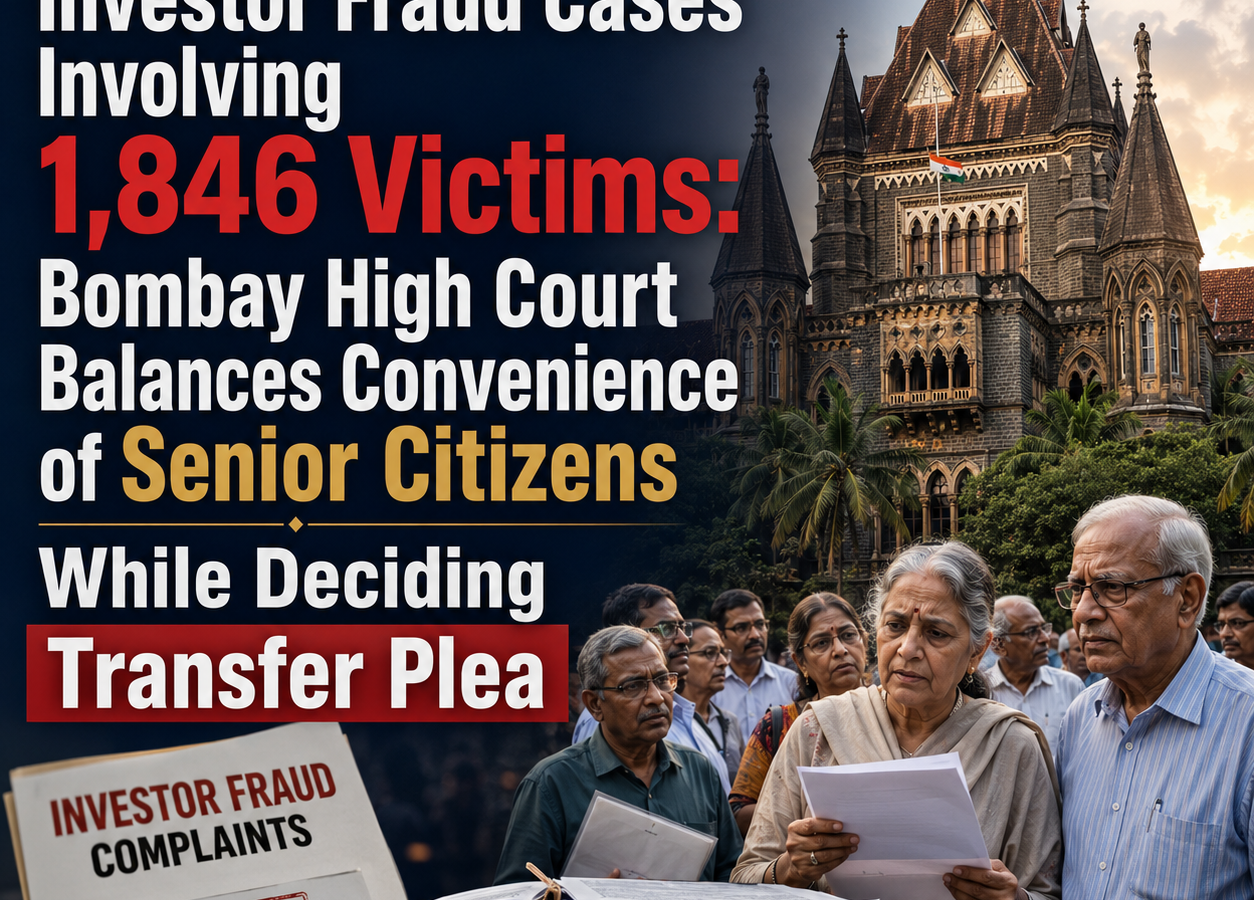
Investor Fraud Cases Involving 1,846 Victims: Bombay High Court Balances Convenience of Senior Citizens While Deciding Transfer Plea

Accused Offered to Bear Witness Expenses for Case Transfer; Bombay High Court Says Financial Assistance Cannot Remove Hardship to Elderly Victims
Facts
The petition was filed by Markas Yohan Thorat and another accused seeking consolidation of three criminal cases registered under the Maharashtra Protection of Interest of Depositors (MPID) Act. The petitioners requested that all three cases be clubbed and tried together before a single Special MPID Court at Mumbai.
The three criminal cases originated from allegations of financial fraud involving investors and depositors. One case was registered by the Economic Offences Wing (EOW), Mumbai, and was being tried as MPID Special Case No. 12 of 2018 before the Special MPID Court at Mumbai. The other two cases were registered at Lashkar Police Station, Pune, and Chaturshrungi Police Station, Pune, and were pending before Special MPID Courts in Pune.
According to the petitioners, all three cases arose from substantially similar transactions and involved allegations that investors had been induced to invest money with promises of returns and were subsequently defrauded. Because the accused persons and the nature of allegations were largely interconnected, the petitioners contended that separate trials would lead to duplication of evidence, multiple appearances by witnesses, inconsistent findings, and unnecessary expenditure of judicial resources.
The petitioners therefore sought a direction that all three cases be transferred and jointly tried before the Special MPID Court at Mumbai where the EOW case was already pending.
The State opposed the request for complete consolidation and highlighted the practical difficulties involved. The State pointed out that the three cases collectively involved 1,846 investors and victims, including approximately 502 senior citizens. A large number of these victims resided in Pune and surrounding areas. The State argued that transferring all proceedings to Mumbai would create substantial hardship for elderly victims and witnesses who would be required to travel repeatedly to Mumbai for trial.
The petitioners attempted to address this concern by filing an affidavit undertaking to bear the travel expenses and meal costs of witnesses travelling from Pune to Mumbai if the cases were transferred.
Issues
The Bombay High Court was required to determine:
- Whether all three MPID cases arising from similar alleged financial fraud transactions should be clubbed and tried before a single Special MPID Court.
- Whether the principles laid down by the Supreme Court and the Bombay High Court regarding consolidation of FIRs and criminal proceedings were applicable to the facts of the present case.
- Whether the convenience of victims and witnesses, particularly senior citizens, should outweigh the convenience of the accused seeking a joint trial.
- Whether the two Pune cases alone should be clubbed together while permitting the Mumbai case to continue separately.
Petitioner’s Arguments
The petitioners argued that the allegations in all three criminal cases arose from a common scheme involving similar transactions and substantially identical facts.
They relied heavily upon the Bombay High Court’s decision in Pramod Bhaichand Raisoni v. State of Maharashtra, where the Court had transferred 77 criminal cases involving more than 42,000 witnesses to a single MPID Court. According to the petitioners, that judgment recognized the importance of avoiding fragmented trials and ensuring consistent adjudication.
The petitioners further relied upon the Supreme Court’s decision in Radhey Shyam v. State of Haryana, where multiple FIRs were clubbed together in exercise of powers under Article 142 of the Constitution. They argued that multiplicity of proceedings served no useful purpose and that a consolidated trial promoted judicial efficiency.
The petitioners also cited Abhishek Singh Chauhan v. Union of India, where the Supreme Court directed that subsequent FIRs be treated as statements under Section 161 CrPC and transferred proceedings to the court having jurisdiction over the first offence.
Reliance was additionally placed upon Odela Satyam v. State of Telangana, in which the Supreme Court directed that various criminal cases be tried together before the court where the first offence had been registered.
The petitioners submitted that the present case was governed by the same principles. They argued that a common trial would:
- Prevent contradictory findings by different courts.
- Reduce duplication of evidence.
- Avoid repetitive examination of witnesses.
- Save judicial time.
- Ensure consistency in the prosecution of the accused.
To demonstrate their bona fides, the petitioners filed an undertaking agreeing to bear the travel and meal expenses of witnesses travelling from Pune to Mumbai for trial.
Respondent’s Arguments
The State opposed the transfer of all three cases to Mumbai.
The State relied upon affidavits filed by the Special Inspector General of Police and the Additional Chief Secretary of the Home Department.
The State submitted that it had no objection to the clubbing of the two Pune cases because they were geographically connected and involved victims residing largely within Pune.
However, the State strongly opposed transferring the Mumbai case or moving all proceedings to Mumbai.
The State emphasized that:
- The three cases involved a total of 1,846 investors and victims.
- Approximately 502 victims were senior citizens.
- The Mumbai case alone involved 567 investors, including 275 senior citizens.
- The Chaturshrungi case involved 1,231 investors, including 221 senior citizens.
- The Lashkar case involved 48 investors, including 6 senior citizens.
According to the State, transferring all proceedings to Mumbai would force a large number of elderly victims residing in Pune to repeatedly travel to Mumbai for trial.
The State argued that financial compensation for travel expenses could not eliminate the physical hardship, inconvenience, and health concerns faced by elderly witnesses.
The State therefore suggested a balanced solution by clubbing the two Pune cases together while allowing the Mumbai case to continue before the Special MPID Court at Mumbai.
Analysis of the Law
The Court examined the principles governing joinder of charges and joint trials under the Code of Criminal Procedure.
The Court considered the provisions relied upon in earlier judgments, including Sections 219, 220, 221, and 223 CrPC, which permit consolidation of offences and accused persons in appropriate circumstances.
The Court acknowledged that Indian criminal law recognizes situations where multiple cases involving similar transactions may be tried together to avoid multiplicity of proceedings and conflicting judgments.
However, the Court observed that consolidation is not an automatic right. The decision must balance:
- Judicial efficiency.
- Fair trial considerations.
- Convenience of witnesses.
- Interests of victims.
- Practical realities of conducting the trial.
The Court further noted that proceedings under the MPID Act involve large numbers of investors and depositors who are themselves victims of the alleged fraud. Their convenience cannot be ignored while deciding questions relating to transfer and consolidation of cases.
The Court held that while the law permits consolidation in appropriate cases, the exercise of that power must be guided by the facts of each case.
Precedent Analysis
Pramod Bhaichand Raisoni v. State of Maharashtra
The petitioners relied upon this decision where the Bombay High Court transferred 77 MPID cases involving more than 42,000 witnesses to a single Special MPID Court.
The Court acknowledged the principle laid down in that case but observed that each transfer request must be examined on its own facts.
Radhey Shyam v. State of Haryana
The Supreme Court exercised powers under Article 142 to direct clubbing of FIRs where multiple proceedings would not serve the larger public interest.
The High Court noted that the decision was based on the Supreme Court’s extraordinary constitutional powers and depended upon the particular facts before it.
Abhishek Singh Chauhan v. Union of India
The Supreme Court directed consolidation of proceedings and treated subsequent FIRs as statements under Section 161 CrPC.
The Court considered the principle but found that practical concerns relating to thousands of investors and senior citizens were significant in the present case.
Odela Satyam v. State of Telangana
The petitioners relied upon this judgment where multiple cases were directed to be tried together.
The High Court observed that the Supreme Court had also required the accused to bear witness expenses in that case. However, the Court found that payment of expenses alone would not sufficiently address the physical hardship faced by elderly victims in the present matter.
Court’s Reasoning
The Court accepted that the cases arose from related transactions and that there was merit in the petitioners’ argument regarding avoidance of multiplicity of proceedings.
However, the Court emphasized that consolidation cannot be viewed solely from the perspective of the accused.
The Court gave considerable weight to the fact that:
- The proceedings involved 1,846 investors and victims.
- More than 500 victims were senior citizens.
- Many victims resided in Pune and nearby areas.
- Requiring them to travel repeatedly to Mumbai would create significant hardship.
The Court observed that while the petitioners had offered to bear travel expenses, financial reimbursement could not eliminate the inconvenience, physical strain, and practical difficulties faced by elderly witnesses.
The Court therefore attempted to strike a balance between judicial efficiency and the convenience of victims.
After examining the number of investors involved in each case, the Court concluded that the two Pune cases should be clubbed together because they shared territorial proximity and involved a large number of common victims from Pune.
At the same time, the Court found no justification for transferring the Mumbai case away from Mumbai, especially when that case itself involved hundreds of investors and a substantial number of senior citizens.
The Court held that this approach would:
- Reduce duplication of proceedings.
- Minimize hardship to victims.
- Promote speedy disposal.
- Advance the objectives of the MPID Act.
Conclusion
The Bombay High Court partly allowed the writ petition.
The Court directed that:
- MPID Case No. 3 of 2018 arising from C.R. No. 60 of 2017 (Lashkar Police Station, Pune) and MPID Case No. 14 of 2017 arising from C.R. No. 275 of 2017 (Chaturshrungi Police Station, Pune) be clubbed together and tried jointly before the Special MPID Court at Pune.
- The proceedings in MPID Case No. 3 of 2018 be transferred to the court handling MPID Case No. 14 of 2017.
- MPID Case No. 12 of 2018 arising from C.R. No. 11 of 2017 registered by EOW Mumbai continue before the Special MPID Court at Mumbai.
The Court held that this arrangement appropriately balanced the interests of the accused, victims, and the administration of justice while minimizing hardship to hundreds of senior citizen investors.
Case Details
Case: Markas Yohan Thorat & Anr. v. State of Maharashtra & Ors.
Court: High Court of Judicature at Bombay
Case Number: Writ Petition No. 5811 of 2021
Judge: Justice A. S. Gadkari and Justice Kamal Khata
Date: 24 June 2026
Result: Writ Petition Partly Allowed. Two Pune MPID cases were clubbed and transferred for joint trial before the Special MPID Court at Pune, while the Mumbai MPID case was directed to continue separately before the Special MPID Court at Mumbai.
Investor Fraud Cases Involving 1,846 Victims: Bombay High Court Balances Convenience of Senior Citizens While Deciding Transfer Plea
Accused Offered to Bear Witness Expenses for Case Transfer; Bombay High Court Says Financial Assistance Cannot Remove Hardship to Elderly Victims
Facts
The petition was filed by Markas Yohan Thorat and another accused seeking consolidation of three criminal cases registered under the Maharashtra Protection of Interest of Depositors (MPID) Act. The petitioners requested that all three cases be clubbed and tried together before a single Special MPID Court at Mumbai.
The three criminal cases originated from allegations of financial fraud involving investors and depositors. One case was registered by the Economic Offences Wing (EOW), Mumbai, and was being tried as MPID Special Case No. 12 of 2018 before the Special MPID Court at Mumbai. The other two cases were registered at Lashkar Police Station, Pune, and Chaturshrungi Police Station, Pune, and were pending before Special MPID Courts in Pune.
According to the petitioners, all three cases arose from substantially similar transactions and involved allegations that investors had been induced to invest money with promises of returns and were subsequently defrauded. Because the accused persons and the nature of allegations were largely interconnected, the petitioners contended that separate trials would lead to duplication of evidence, multiple appearances by witnesses, inconsistent findings, and unnecessary expenditure of judicial resources.
The petitioners therefore sought a direction that all three cases be transferred and jointly tried before the Special MPID Court at Mumbai where the EOW case was already pending.
The State opposed the request for complete consolidation and highlighted the practical difficulties involved. The State pointed out that the three cases collectively involved 1,846 investors and victims, including approximately 502 senior citizens. A large number of these victims resided in Pune and surrounding areas. The State argued that transferring all proceedings to Mumbai would create substantial hardship for elderly victims and witnesses who would be required to travel repeatedly to Mumbai for trial.
The petitioners attempted to address this concern by filing an affidavit undertaking to bear the travel expenses and meal costs of witnesses travelling from Pune to Mumbai if the cases were transferred.
Issues
The Bombay High Court was required to determine:
- Whether all three MPID cases arising from similar alleged financial fraud transactions should be clubbed and tried before a single Special MPID Court.
- Whether the principles laid down by the Supreme Court and the Bombay High Court regarding consolidation of FIRs and criminal proceedings were applicable to the facts of the present case.
- Whether the convenience of victims and witnesses, particularly senior citizens, should outweigh the convenience of the accused seeking a joint trial.
- Whether the two Pune cases alone should be clubbed together while permitting the Mumbai case to continue separately.
Petitioner’s Arguments
The petitioners argued that the allegations in all three criminal cases arose from a common scheme involving similar transactions and substantially identical facts.
They relied heavily upon the Bombay High Court’s decision in Pramod Bhaichand Raisoni v. State of Maharashtra, where the Court had transferred 77 criminal cases involving more than 42,000 witnesses to a single MPID Court. According to the petitioners, that judgment recognized the importance of avoiding fragmented trials and ensuring consistent adjudication.
The petitioners further relied upon the Supreme Court’s decision in Radhey Shyam v. State of Haryana, where multiple FIRs were clubbed together in exercise of powers under Article 142 of the Constitution. They argued that multiplicity of proceedings served no useful purpose and that a consolidated trial promoted judicial efficiency.
The petitioners also cited Abhishek Singh Chauhan v. Union of India, where the Supreme Court directed that subsequent FIRs be treated as statements under Section 161 CrPC and transferred proceedings to the court having jurisdiction over the first offence.
Reliance was additionally placed upon Odela Satyam v. State of Telangana, in which the Supreme Court directed that various criminal cases be tried together before the court where the first offence had been registered.
The petitioners submitted that the present case was governed by the same principles. They argued that a common trial would:
- Prevent contradictory findings by different courts.
- Reduce duplication of evidence.
- Avoid repetitive examination of witnesses.
- Save judicial time.
- Ensure consistency in the prosecution of the accused.
To demonstrate their bona fides, the petitioners filed an undertaking agreeing to bear the travel and meal expenses of witnesses travelling from Pune to Mumbai for trial.
Respondent’s Arguments
The State opposed the transfer of all three cases to Mumbai.
The State relied upon affidavits filed by the Special Inspector General of Police and the Additional Chief Secretary of the Home Department.
The State submitted that it had no objection to the clubbing of the two Pune cases because they were geographically connected and involved victims residing largely within Pune.
However, the State strongly opposed transferring the Mumbai case or moving all proceedings to Mumbai.
The State emphasized that:
- The three cases involved a total of 1,846 investors and victims.
- Approximately 502 victims were senior citizens.
- The Mumbai case alone involved 567 investors, including 275 senior citizens.
- The Chaturshrungi case involved 1,231 investors, including 221 senior citizens.
- The Lashkar case involved 48 investors, including 6 senior citizens.
According to the State, transferring all proceedings to Mumbai would force a large number of elderly victims residing in Pune to repeatedly travel to Mumbai for trial.
The State argued that financial compensation for travel expenses could not eliminate the physical hardship, inconvenience, and health concerns faced by elderly witnesses.
The State therefore suggested a balanced solution by clubbing the two Pune cases together while allowing the Mumbai case to continue before the Special MPID Court at Mumbai.
Analysis of the Law
The Court examined the principles governing joinder of charges and joint trials under the Code of Criminal Procedure.
The Court considered the provisions relied upon in earlier judgments, including Sections 219, 220, 221, and 223 CrPC, which permit consolidation of offences and accused persons in appropriate circumstances.
The Court acknowledged that Indian criminal law recognizes situations where multiple cases involving similar transactions may be tried together to avoid multiplicity of proceedings and conflicting judgments.
However, the Court observed that consolidation is not an automatic right. The decision must balance:
- Judicial efficiency.
- Fair trial considerations.
- Convenience of witnesses.
- Interests of victims.
- Practical realities of conducting the trial.
The Court further noted that proceedings under the MPID Act involve large numbers of investors and depositors who are themselves victims of the alleged fraud. Their convenience cannot be ignored while deciding questions relating to transfer and consolidation of cases.
The Court held that while the law permits consolidation in appropriate cases, the exercise of that power must be guided by the facts of each case.
Precedent Analysis
Pramod Bhaichand Raisoni v. State of Maharashtra
The petitioners relied upon this decision where the Bombay High Court transferred 77 MPID cases involving more than 42,000 witnesses to a single Special MPID Court.
The Court acknowledged the principle laid down in that case but observed that each transfer request must be examined on its own facts.
Radhey Shyam v. State of Haryana
The Supreme Court exercised powers under Article 142 to direct clubbing of FIRs where multiple proceedings would not serve the larger public interest.
The High Court noted that the decision was based on the Supreme Court’s extraordinary constitutional powers and depended upon the particular facts before it.
Abhishek Singh Chauhan v. Union of India
The Supreme Court directed consolidation of proceedings and treated subsequent FIRs as statements under Section 161 CrPC.
The Court considered the principle but found that practical concerns relating to thousands of investors and senior citizens were significant in the present case.
Odela Satyam v. State of Telangana
The petitioners relied upon this judgment where multiple cases were directed to be tried together.
The High Court observed that the Supreme Court had also required the accused to bear witness expenses in that case. However, the Court found that payment of expenses alone would not sufficiently address the physical hardship faced by elderly victims in the present matter.
Court’s Reasoning
The Court accepted that the cases arose from related transactions and that there was merit in the petitioners’ argument regarding avoidance of multiplicity of proceedings.
However, the Court emphasized that consolidation cannot be viewed solely from the perspective of the accused.
The Court gave considerable weight to the fact that:
- The proceedings involved 1,846 investors and victims.
- More than 500 victims were senior citizens.
- Many victims resided in Pune and nearby areas.
- Requiring them to travel repeatedly to Mumbai would create significant hardship.
The Court observed that while the petitioners had offered to bear travel expenses, financial reimbursement could not eliminate the inconvenience, physical strain, and practical difficulties faced by elderly witnesses.
The Court therefore attempted to strike a balance between judicial efficiency and the convenience of victims.
After examining the number of investors involved in each case, the Court concluded that the two Pune cases should be clubbed together because they shared territorial proximity and involved a large number of common victims from Pune.
At the same time, the Court found no justification for transferring the Mumbai case away from Mumbai, especially when that case itself involved hundreds of investors and a substantial number of senior citizens.
The Court held that this approach would:
- Reduce duplication of proceedings.
- Minimize hardship to victims.
- Promote speedy disposal.
- Advance the objectives of the MPID Act.
Conclusion
The Bombay High Court partly allowed the writ petition.
The Court directed that:
- MPID Case No. 3 of 2018 arising from C.R. No. 60 of 2017 (Lashkar Police Station, Pune) and MPID Case No. 14 of 2017 arising from C.R. No. 275 of 2017 (Chaturshrungi Police Station, Pune) be clubbed together and tried jointly before the Special MPID Court at Pune.
- The proceedings in MPID Case No. 3 of 2018 be transferred to the court handling MPID Case No. 14 of 2017.
- MPID Case No. 12 of 2018 arising from C.R. No. 11 of 2017 registered by EOW Mumbai continue before the Special MPID Court at Mumbai.
The Court held that this arrangement appropriately balanced the interests of the accused, victims, and the administration of justice while minimizing hardship to hundreds of senior citizen investors.
Case Details
Case: Markas Yohan Thorat & Anr. v. State of Maharashtra & Ors.
Court: High Court of Judicature at Bombay
Case Number: Writ Petition No. 5811 of 2021
Judge: Justice A. S. Gadkari and Justice Kamal Khata
Date: 24 June 2026
Result: Writ Petition Partly Allowed. Two Pune MPID cases were clubbed and transferred for joint trial before the Special MPID Court at Pune, while the Mumbai MPID case was directed to continue separately before the Special MPID Court at Mumbai.