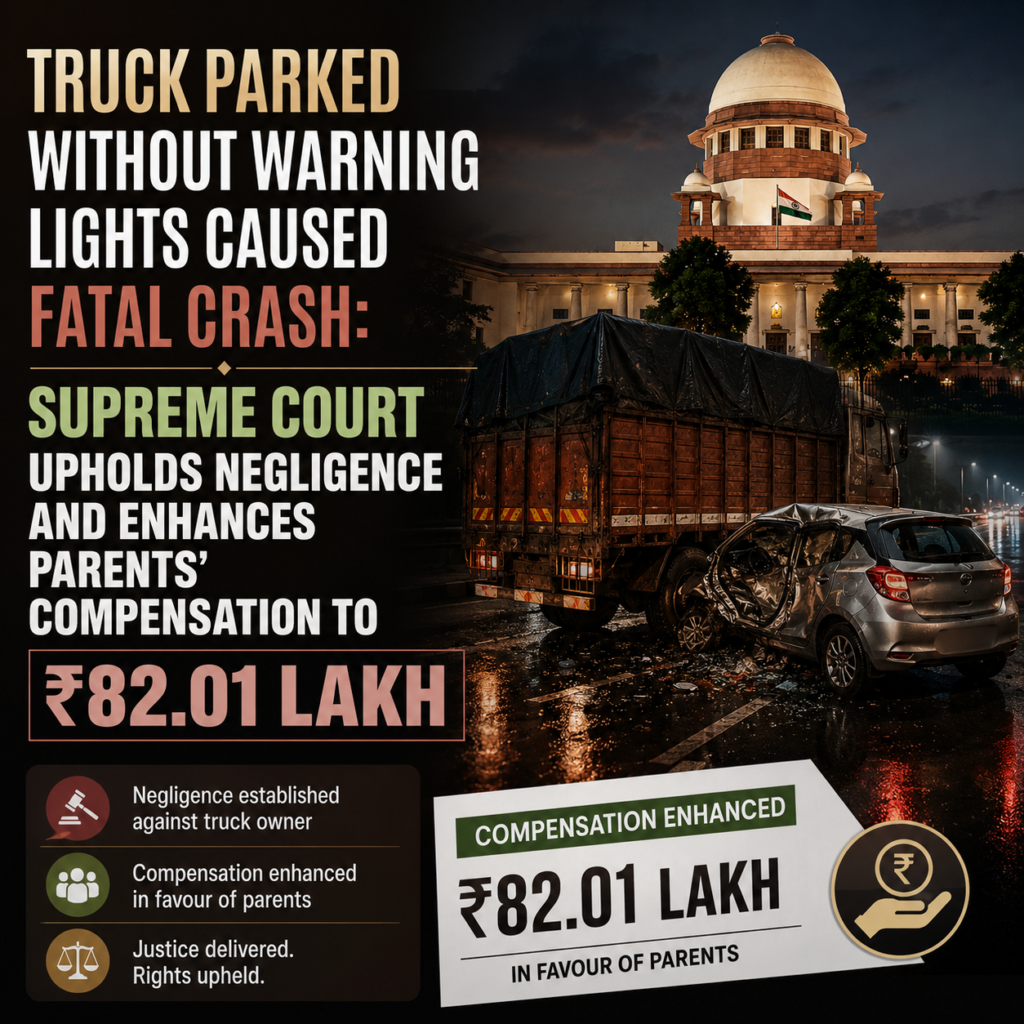
Insurer Cannot Blame Car Driver Merely Because He Hit Stationary Truck from Behind: Supreme Court Rejects Contributory Negligence Plea
Facts
The case arose from a fatal motor accident that occurred at approximately 3:00 a.m. on 11 June 2013 near the Andrews Ganj Bus Stop on the BRT Corridor in Delhi.
Akash Kumar, aged about 20 years, was travelling in a Wagon-R driven by his roommate, Nikhil Kumar Jain. The car collided with a truck insured by Oriental Insurance Company Limited.
According to the claimants, the truck had been left stationary on the road without parking lights, indicators, reflectors or warning signs. The streetlights were also not functioning, making the truck difficult to notice in the darkness. Akash Kumar suffered fatal injuries, while the car’s driver was injured.
The deceased’s parents filed a claim under Sections 166 and 140 of the Motor Vehicles Act, 1988. They stated that their son was pursuing the Chartered Accountancy Final course, undergoing articleship and earning a stipend. They also claimed that he earned additional income through private tuition and had strong future professional prospects.
The Motor Accident Claims Tribunal held the truck driver negligent and rejected the allegation of contributory negligence against the Wagon-R driver. While the deceased’s actual articleship stipend ranged between ₹3,595 and ₹14,410 per month, the Tribunal assessed his monthly income at ₹55,500 based on his professional progress and likely future earnings.
After deducting income tax and personal expenses, adding 50% future prospects and applying a multiplier of 18, the Tribunal awarded ₹81,21,900 with interest at 9% per annum.
The insurer challenged both negligence and the quantum of compensation. The parents filed a separate appeal seeking enhancement. The Delhi High Court dismissed both appeals and upheld the Tribunal’s award. Both sides thereafter approached the Supreme Court through cross-appeals.
Issues
- Whether the truck driver was negligent in leaving the vehicle stationary on the road without adequate lights, reflectors or warning signs.
- Whether the Wagon-R driver was contributorily negligent merely because the car struck the stationary truck from behind.
- Whether the Tribunal had awarded excessive compensation by assessing the deceased’s income at ₹55,500 per month despite a substantially lower proven articleship stipend.
- Whether adding 50% towards future prospects after already adopting a forward-looking monthly income resulted in duplication.
- Whether the compensation should be further enhanced based on the deceased’s expected qualification and future earnings as a Chartered Accountant.
- Whether the deceased’s parents were entitled to compensation for filial consortium, which had not been awarded by the Tribunal or the High Court.
Petitioner’s Arguments
Oriental Insurance Company Limited argued that the accident occurred because of the rash and negligent driving of the Wagon-R.
It contended that the truck had suffered punctures in its rear tyres and had been parked on the extreme left side of the road. Since the car struck the truck from behind, the insurer argued that negligence, or at least contributory negligence, should have been attributed to the Wagon-R driver.
The insurer further challenged the quantum of compensation. It argued that the Tribunal had assessed the deceased’s income on hypothetical assumptions rather than on his proven earnings.
Although the deceased was pursuing Chartered Accountancy and undergoing articleship, his actual stipend was much lower than the monthly income of ₹55,500 adopted by the Tribunal. The insurer submitted that the assessment based on the salary of an entry-level Group-A officer was speculative.
It also argued that the Tribunal had already considered the deceased’s future professional advancement while fixing his monthly income at ₹55,500. A further addition of 50% for future prospects therefore amounted to double counting and resulted in an excessive award.
Respondent’s Arguments
The parents of the deceased relied upon the testimony of Nikhil Kumar Jain, the injured eyewitness and driver of the Wagon-R.
They submitted that the truck had been left on the road in complete darkness without parking lights, indicators, reflectors or any warning signs. The absence of functional streetlights made the truck practically invisible.
They argued that the truck driver and owner did not enter the witness box to establish their claim that the truck had been safely parked on the extreme left after suffering tyre punctures.
On compensation, the claimants submitted that the deceased was not an ordinary student with uncertain prospects. He had reached the Final stage of the Chartered Accountancy course and was undergoing professional articleship.
They relied upon evidence concerning the salaries earned by newly qualified Chartered Accountants and contended that the Tribunal had still underestimated the deceased’s future income.
The claimants therefore sought enhancement of compensation to properly account for his professional potential and the loss suffered by his parents.
Analysis of the Law
Negligence and contributory negligence
The Supreme Court held that the fact that one vehicle collides with another from behind does not automatically establish negligence on the part of the rear vehicle.
Negligence must be determined from the complete factual circumstances. A heavy vehicle left stationary on a public road at 3:00 a.m. without parking lights, indicators, reflectors or cautionary signs creates a serious danger for other road users.
The injured eyewitness’s testimony supported the claimants’ case and remained materially unshaken. In contrast, the truck driver and owner did not testify to prove that the truck had been parked safely after suffering tyre punctures.
The Court therefore held that no reliable evidence supported the plea of contributory negligence.
Interference with concurrent factual findings
The Tribunal and the High Court had concurrently found the truck driver negligent. The Supreme Court reiterated that it ordinarily does not interfere with concurrent findings under Article 136 unless they are perverse, manifestly erroneous or unsupported by evidence.
Since the findings were supported by eyewitness testimony, site photographs and the surrounding circumstances, no interference was warranted.
Assessment of future income
Compensation under the Motor Vehicles Act must be “just compensation.” It should neither be artificially low nor based upon remote speculation.
The Tribunal was entitled to consider the deceased’s education, professional progress and proximity to entering a skilled profession. It was not required to confine the assessment entirely to the temporary stipend earned during articleship.
However, future professional success cannot be assumed with certainty. Claims that the deceased would definitely qualify as a Chartered Accountant and earn salaries comparable to successful professionals remained uncertain.
The Tribunal had already taken an exceptionally liberal approach by assessing monthly income at ₹55,500, far above the proved stipend, to account for his career prospects.
Possible overlap in future prospects
The Supreme Court observed that the Tribunal had first adopted a forward-looking income based upon the deceased’s expected professional advancement and had then added another 50% towards future prospects.
This involved a technical overlap because future prospects are ordinarily added to established income to account for normal future increases.
Nevertheless, the Court declined to reduce the compensation. It held that motor accident compensation cannot be treated as a purely mathematical exercise divorced from the human loss involved.
The award had remained undisturbed for nearly a decade, the deceased was a young student on the threshold of a professional career, and his parents had suffered an irreparable loss. Viewed holistically, the award did not exceed the bounds of just compensation.
Filial consortium
The Tribunal and High Court had not awarded any amount for loss of consortium.
The Supreme Court held that the parents of an unmarried deceased child are entitled to filial consortium. This head compensates them for the loss of their child’s care, affection, companionship and assistance.
Accordingly, each parent was awarded ₹40,000, resulting in an additional amount of ₹80,000.
Precedent Analysis
National Insurance Company Limited v. Pranay Sethi, (2017) 16 SCC 680
The Constitution Bench standardised the principles governing future prospects and conventional heads in death compensation cases.
The Supreme Court noted that future prospects are ordinarily added to the deceased’s established income to account for the likely increase in earnings over time.
In the present case, the Tribunal had already enhanced the deceased’s income by considering his future professional career and then added 50% future prospects. Although this created some methodological overlap, the Court refused to reduce the award because the final amount remained within the range of just compensation.
The Court also relied upon Pranay Sethi to award compensation under the omitted conventional head of consortium.
Magma General Insurance Company Limited v. Nanu Ram alias Chuhru Ram, (2018) 18 SCC 130
This judgment explained that consortium is not confined to the spouse of a deceased person. Parents are entitled to filial consortium when an unmarried son or daughter dies.
Applying this precedent, the Court held that both parents were entitled to ₹40,000 each for loss of filial consortium.
Court’s Reasoning
The Court accepted the injured eyewitness’s evidence that the truck had been left stationary on the road without lights, reflectors or cautionary signs.
The accident occurred during the early hours of the morning, when visibility was poor. A stationary truck occupying the road in those circumstances constituted an evident hazard.
Neither the truck driver nor its owner entered the witness box to substantiate their defence that the vehicle had been safely parked on the extreme left due to tyre punctures. The Tribunal was therefore justified in drawing an adverse inference against them.
The Court rejected the argument that a rear-end collision necessarily established negligence by the Wagon-R driver. No independent or cogent evidence proved contributory negligence.
On compensation, the Court recognised that assessing the deceased’s income at ₹55,500 and then adding 50% future prospects technically involved an overlap. However, reducing the compensation after nearly a decade would not advance substantive justice.
The deceased was pursuing CA Final and had already entered professional training. Although his eventual qualification and income could not be treated as certain, his demonstrated educational progress justified an assessment higher than his temporary stipend.
At the same time, the Tribunal’s liberal assessment had already sufficiently accounted for his professional promise. Any further increase in the loss of dependency would enter the field of speculation.
The only legal omission was the failure to award filial consortium. The Court therefore added ₹40,000 for each parent while leaving the remainder of the compensation undisturbed.
Conclusion
The Supreme Court upheld the concurrent finding that the truck driver was solely negligent in leaving the vehicle stationary on the road at night without lights, reflectors or warning signs.
The insurer’s plea of contributory negligence was rejected because the rear-end collision alone did not prove negligence by the Wagon-R driver, and no supporting evidence was produced.
The Court declined to reduce the compensation despite a technical overlap in the calculation of future income and future prospects. It also refused further enhancement of loss of dependency because the Tribunal had already adopted a liberal assessment of the deceased’s professional potential.
However, the parents were awarded an additional ₹80,000 as filial consortium—₹40,000 each.
The total compensation was enhanced from ₹81,21,900 to ₹82,01,900, together with interest at the rate fixed by the Tribunal. The insurer was directed to deposit the enhanced amount within four weeks.
Case Details
Case: The Oriental Insurance Company Limited v. Kalu Ram and Others
Court: Supreme Court of India
Case Numbers: Civil Appeal Nos.8706 and 8707 of 2026, arising out of SLP (Civil) Nos.2360 and 14094 of 2023
Neutral Citation: 2026 INSC 653
Judges: Justice Prashant Kumar Mishra and Justice N.V. Anjaria
Date: 23 June 2026
Result: The insurer’s appeal was dismissed. The claimants’ appeal was partly allowed by granting an additional ₹80,000 for filial consortium, enhancing total compensation from ₹81,21,900 to ₹82,01,900 with interest.