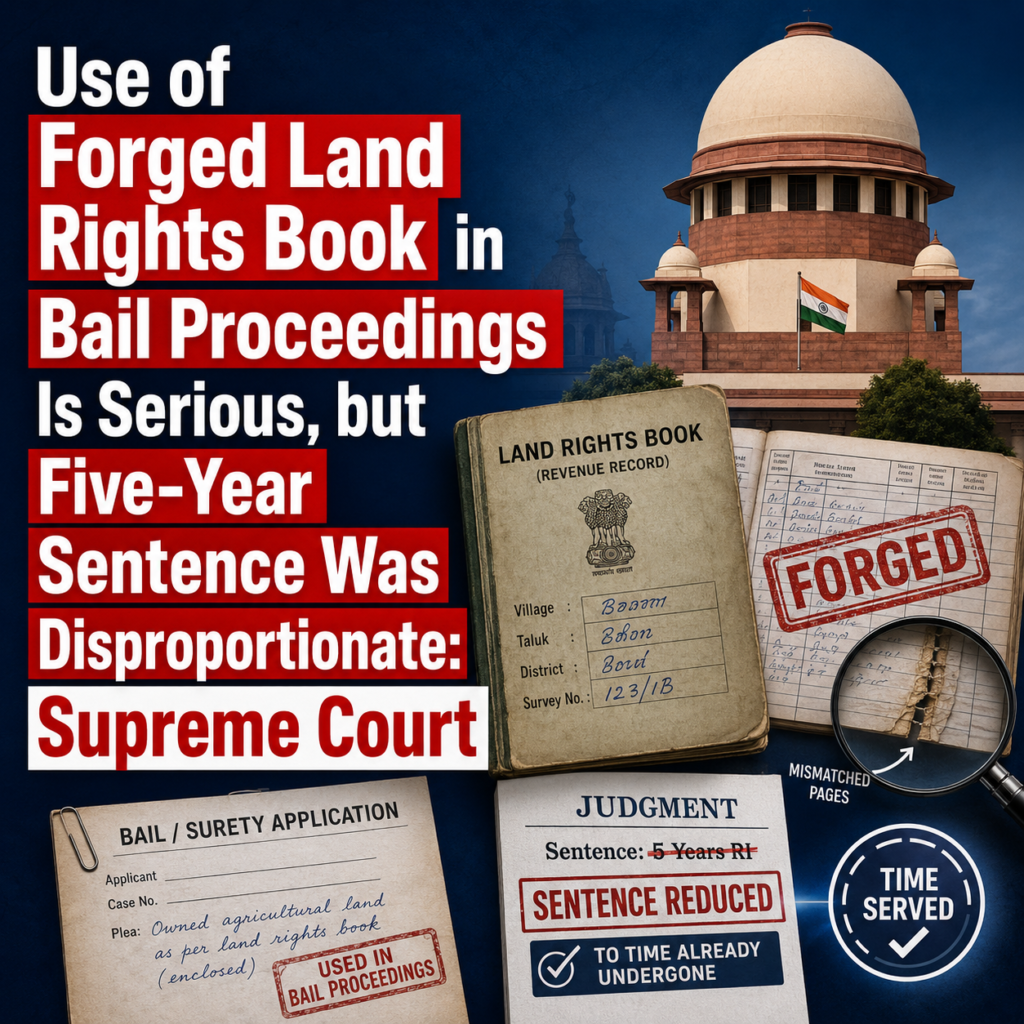
Man Used Forged Land Record to Furnish Bail Surety; Supreme Court Upholds Conviction but Orders Release
Facts
The appellant, Israfil alias Pappu alias Naimuddin Khan, appeared before the Judicial Magistrate First Class, Rewa, on 15 September 2014 to furnish surety for an accused named Mukesh Dahiya.
For that purpose, he produced a Bhu Adhikar Rin Pustika—a Land Rights and Loan Book—purportedly relating to agricultural land situated in Village Amirati, Tehsil Gurh, District Rewa. During scrutiny, the Magistrate noticed irregularities in the sequence and pagination of the document, including page No.10 appearing immediately after page No.2.
As the appellant could not satisfactorily explain the irregularities, the Magistrate directed the police to conduct an inquiry. FIR No.562 of 2014 was thereafter registered at Police Station Civil Lines, Rewa, for offences relating to cheating, forgery and use of a forged document.
The prosecution alleged that the appellant had knowingly produced a forged revenue document before the Court to secure bail for another accused. After trial, the Fifth Additional Sessions Judge, Rewa, convicted him under Sections 420, 467, 468 and 471 of the Indian Penal Code and sentenced him to five years’ rigorous imprisonment on each count, with all substantive sentences running concurrently. A fine of ₹1,000 was also imposed under each offence.
The Madhya Pradesh High Court dismissed his criminal appeal and affirmed both the conviction and sentence. Before the Supreme Court, notice was issued only on the question of sentence. The conviction was therefore not reopened.
Issues
- Whether the sentence of five years’ rigorous imprisonment was disproportionate in the circumstances of the case.
- Whether the passage of more than ten years since the offence, absence of subsequent criminal antecedents and the period of incarceration already undergone justified reduction of the sentence.
- Whether the seriousness of using a forged revenue document in judicial proceedings outweighed the mitigating circumstances relied upon by the appellant.
Petitioner’s Arguments
The appellant argued that the alleged incident occurred in 2014 and that he had faced criminal proceedings for more than a decade.
He submitted that he was not a habitual offender and that no subsequent criminal antecedents or similar offences had been brought to the Court’s notice.
Although he did not seek reconsideration of the conviction at this stage, he contended that the five-year sentence was excessive when viewed against the specific facts of the case.
The appellant therefore requested the Court to reduce the substantive sentence by considering:
- The age of the criminal proceedings;
- The absence of repeated criminal conduct;
- The custody already undergone; and
- The limited consequences of the attempted use of the document.
Respondent’s Arguments
The State opposed any reduction in sentence and emphasised the seriousness of the offence.
It argued that the appellant had used a forged revenue document before a court of law to furnish surety and secure bail for another accused.
According to the State, forgery and the use of forged documents in judicial proceedings directly undermine the integrity, purity and credibility of the administration of justice.
The State therefore contended that the offence did not warrant undue leniency and that the sentence imposed by the Trial Court and affirmed by the High Court should be maintained.
Analysis of the Law
The Supreme Court recognised that offences under Sections 467, 468 and 471 IPC are serious because they affect the authenticity and sanctity of public and legal documents. The use of a forged document before a court cannot be treated casually.
At the same time, sentencing must not become a purely retributive exercise. The Court must apply the principle of proportionality by balancing the gravity of the offence against the surrounding facts and mitigating circumstances relating to the offender.
Relevant sentencing considerations include:
- The precise nature and scale of the offence;
- The accused’s role;
- The actual consequences of the conduct;
- The period of imprisonment already undergone;
- The passage of time since the offence;
- Criminal antecedents or their absence; and
- Whether the conduct formed part of organised or repeated criminal activity.
The Court noted that the disputed document was detected at the threshold during the bail proceedings. Its use did not result in any irreversible pecuniary or proprietary consequence.
The case also did not involve organised forgery, systematic fraud against public institutions, large-scale economic loss or recurring acts of deception. These circumstances did not erase the seriousness of the offence but were relevant to determining a proportionate sentence.
Precedent Analysis
Padum Kumar v. State of Uttar Pradesh, (2020) 3 SCC 35
The Supreme Court referred to Padum Kumar, where the conviction for offences including Sections 467 and 468 IPC was maintained, but the substantive sentence was reduced after considering the age of the case, the imprisonment already undergone and the peculiar circumstances.
The precedent supported the principle that the Court may reduce the sentence without disturbing the conviction where:
- A substantial period has elapsed since the offence;
- The accused has already undergone significant imprisonment;
- There is no evidence of repeated similar conduct; and
- The interests of justice can be met through a lesser sentence.
Applying this approach, the Court found that the appellant’s conviction could remain intact while the sentence was modified.
Court’s Reasoning
The Court first clarified that the conviction was not open for reconsideration because notice had been issued only on the question of sentence.
It acknowledged that producing a forged land record in judicial proceedings was a grave act affecting the administration of justice.
However, the Court identified several mitigating circumstances:
- The incident occurred in 2014;
- The appellant had faced criminal proceedings for more than ten years;
- No material showed that he was a habitual offender;
- No prior or subsequent similar criminal conduct was brought on record;
- The forged document was detected before it produced an irreversible consequence;
- The case did not involve organised or large-scale economic fraud; and
- The appellant had already undergone more than two years of imprisonment.
The custody certificate showed that the appellant had remained in custody from 19 September 2014 to 1 December 2014 and again from 6 January 2024 onwards.
The Court held that, while the offence could not be treated lightly, continuation of the five-year sentence was unnecessary in the overall circumstances. The ends of justice would be adequately served by reducing the substantive sentence to the imprisonment already undergone.
Conclusion
The Supreme Court maintained the appellant’s conviction under Sections 420, 467, 468 and 471 IPC for using a forged land-rights document in court to furnish surety.
However, applying the principle of proportionality, the Court reduced the sentence of five years’ rigorous imprisonment to the period already undergone.
The fine imposed by the Trial Court remained unchanged. The Court directed that the appellant be released immediately, provided he was not required in any other case and had deposited the fine.
The criminal appeal was accordingly partly allowed.
Case Details
Case: Israfil @ Pappu @ Naimuddin Khan v. State of Madhya Pradesh
Court: Supreme Court of India
Case Number: Criminal Appeal No.3081 of 2026, arising out of SLP (Criminal) No.19486 of 2025
Neutral Citation: 2026 INSC 654
Judges: Justice Prashant Kumar Mishra and Justice N.V. Anjaria
Date: 23 June 2026
Result: Appeal partly allowed. Conviction under Sections 420, 467, 468 and 471 IPC was maintained, but the five-year sentence was reduced to the period already undergone; immediate release was directed subject to payment of fine and the appellant not being required in any other case.