


Court’s Decision
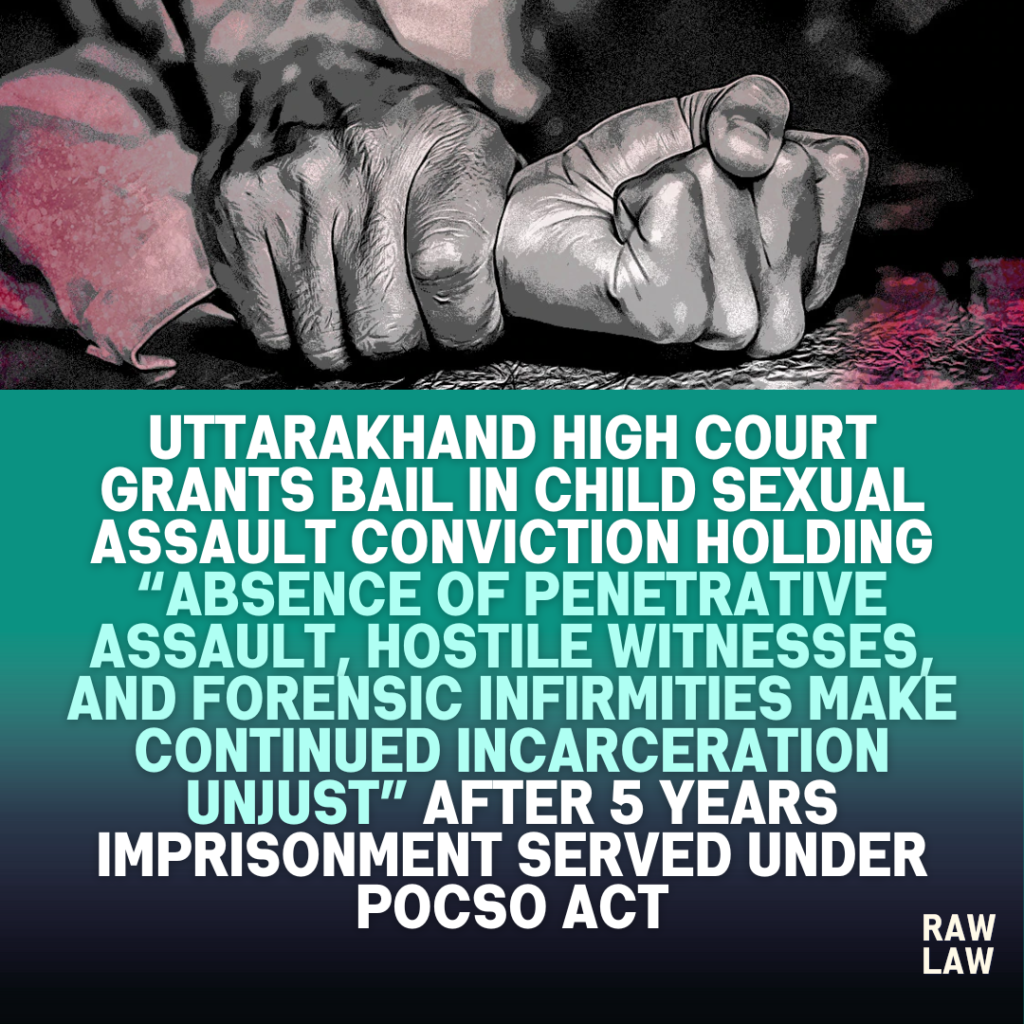
The Uttarakhand High Court allowed the second bail application, directing the appellant’s release on bail after serving five years imprisonment under POCSO Act, noting that the evidence failed to establish penetrative sexual assault, the victim turned hostile, and forensic and medical evidence did not corroborate prosecution claims. The Court held that, at most, the allegations may constitute sexual assault under Section 7 punishable under Section 8 of the POCSO Act, and since the appellant had already undergone the maximum sentence of five years, further incarceration was unwarranted.
Facts
The appellant was convicted by the Trial Court for offences under Section 376 IPC and Sections 3 and 4 of POCSO, and sentenced to 15 years imprisonment for allegedly enticing and sexually assaulting a 13-year-old victim. The incident was alleged to have occurred on 20 November 2017, and an FIR was lodged on the same day. The victim was medically examined on 21 November 2017, and forensic samples were collected and analysed, leading to the appellant’s conviction. After serving five years in prison, the appellant filed a second bail application citing inconsistencies in the evidence and procedural irregularities.
Issues
- Whether the conviction under Sections 376 IPC and Sections 3/4 of POCSO was sustainable in the absence of clear evidence of penetrative sexual assault.
- Whether the prolonged incarceration of five years despite infirmities in evidence warranted bail.
- Whether forensic, medical, and testimonial contradictions invalidated the Trial Court’s finding of guilt beyond reasonable doubt.
Petitioner’s Arguments
The appellant argued:
- The victim turned hostile during trial, denying any incident and refusing to identify the appellant.
- The medical examination and supplementary report showed no evidence of rape or presence of spermatozoa, and the FSL report did not conclusively match DNA from the victim’s vaginal swabs with the accused.
- The case was based on stale and contradictory evidence, with the parents also turning hostile, and the appellant had already undergone five years imprisonment.
- Reliance was placed on Selvi v. State of Karnataka (2010) regarding forced extraction of bodily samples without consent being unconstitutional, rendering the forensic evidence unreliable.
- In the absence of proof of penetrative sexual assault, at most, the offence under Section 7 punishable under Section 8 of the POCSO Act could be attracted.
Respondent’s Arguments
The State argued:
- The appellant was convicted after a fair trial, and the forensic report indicated matching DNA on the victim’s clothing and the accused’s samples.
- The gravity of the offence under POCSO and the need to protect children warranted continued incarceration of the appellant.
- The DNA evidence was sufficient to link the appellant to the incident despite the victim turning hostile.
However, the State could not address the contradictions in medical and forensic reports or the legal issues regarding forced extraction of samples.
Analysis of the Law
The Court examined:
- The Selvi v. State of Karnataka (2010) ruling that forced extraction of bodily samples violates Article 20(3) and 21, and such evidence must be scrutinised strictly.
- The need for evidence of penetrative sexual assault under Section 3 of POCSO for a conviction under Section 4.
- The jurisprudence requiring corroboration between victim testimony, medical evidence, and forensic evidence for conviction, especially under stringent offences like POCSO and Section 376 IPC.
- The principles under Dr. Ram Manohar Lohia v. State of Bihar (1966) regarding procedural fairness and safeguarding liberty.
Precedent Analysis
- Selvi v. State of Karnataka (2010) – Held that forcible extraction of bodily samples without consent violates fundamental rights and impacts admissibility and reliability of evidence.
- Dr. Ram Manohar Lohia (1966) – Emphasised procedural safeguards and the necessity of live evidence for curtailing liberty.
- The ruling referenced earlier Uttarakhand HC decisions emphasizing that medical and forensic inconsistencies, along with hostile witnesses, undermine the sustainability of convictions under POCSO.
These precedents reinforced the view that evidence must be scrutinised rigorously before sustaining severe punishment under POCSO and IPC.
Court’s Reasoning
The Court noted:
- The victim turned hostile, denying any incident or identifying the appellant, and her parents also denied the occurrence of the offence.
- Medical reports did not show signs of rape, spermatozoa, or injuries, and the supplementary report confirmed negative findings for spermatozoa.
- The forensic report did not conclusively link the appellant’s DNA to the victim’s swabs, raising doubts about the occurrence of penetrative sexual assault.
- Even if the phrase “physical relationship” in evidence was accepted, it would amount to sexual assault under Section 7 punishable under Section 8 of the POCSO Act.
- Since the maximum punishment under Section 8 is five years, which the appellant had already undergone, continued incarceration was unjustified.
Conclusion
- The High Court allowed the bail application and ordered the appellant’s release on bail with conditions, unless required in another case.
- Held that continued incarceration after five years was unwarranted given the evidence and the legal maximum under Section 8 POCSO.
- Directed execution of a personal bond of ₹20,000 with one surety before the jurisdictional Magistrate.
Implications
- Reinforces scrutiny of medical, forensic, and testimonial evidence in POCSO cases before sustaining convictions.
- Protects against prolonged incarceration where evidence does not establish penetrative assault.
- Clarifies that Article 20(3) and 21 violations render forcibly extracted forensic evidence suspect, impacting conviction sustainability.
Short Note on Referred Cases
- Selvi v. State of Karnataka (2010) – Forced bodily sample extraction violates fundamental rights.
- Dr. Ram Manohar Lohia (1966) – Emphasized strict procedural safeguards for liberty deprivation.
These precedents shaped the Court’s approach in granting relief in the present case.
FAQs
- Can an accused get bail under POCSO if evidence does not establish penetrative sexual assault?
Yes, if evidence fails to prove penetrative sexual assault, bail may be granted, especially when the maximum sentence under Section 8 is already served.
- Does turning hostile by the victim and parents affect POCSO conviction?
Yes, if the victim and parents turn hostile, and there is no corroborative medical or forensic evidence, the conviction under severe charges may not sustain.
- What did the Uttarakhand High Court decide regarding prolonged incarceration under POCSO?
The Court granted bail, holding that continued incarceration was unjust when the evidence did not establish rape, and the maximum sentence under Section 8 POCSO was already served.