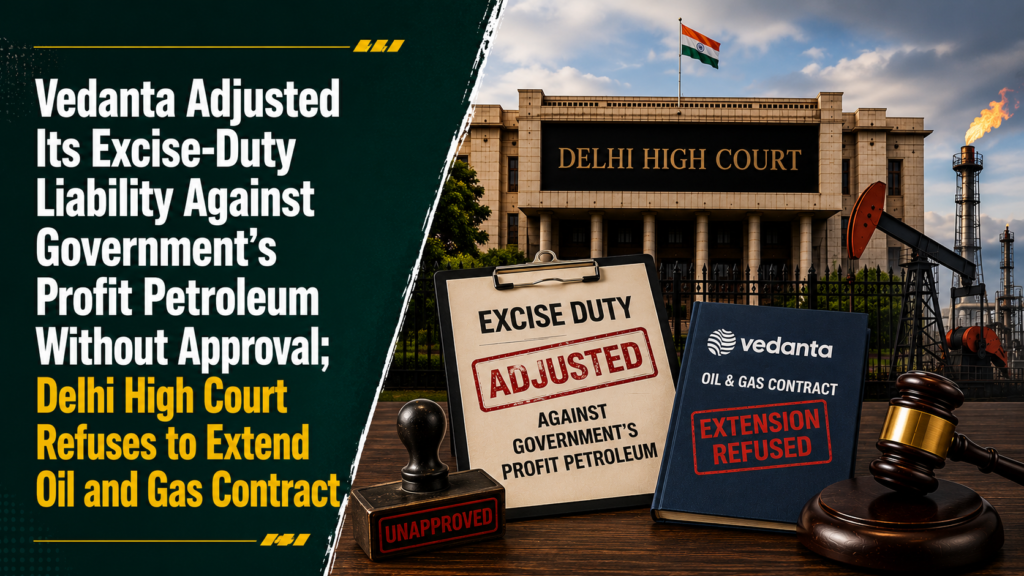
Paying Back Deducted Government Revenue Seven Days Before Rejection Did Not Erase Misconduct: Delhi High Court Dismisses Vedanta’s Extension Plea
Facts
- In 1998, the Government of India awarded an offshore petroleum block known as CB/OS-2, situated off Suvali, Gujarat, to a consortium through international competitive bidding.
- A Production Sharing Contract (“PSC”) dated 20 June 1998 was executed between the Government and the consortium members.
- Vedanta Limited, through its Cairn Oil and Gas Division, subsequently became the designated operator of the Block.
- The participating interests were:
- Vedanta: 40%;
- Invenire Petrodyne Limited: 10%; and
- Oil and Natural Gas Corporation Limited (“ONGC”): 50%.
- The Block contained two petroleum fields, namely the Gauri Gas Field and the Lakshmi Gas Field.
- Under the PSC, petroleum produced from the Block was first allocated towards recovery of operating costs, known as “Cost Petroleum”. The remaining “Profit Petroleum” was divided between the Government and the contractor parties.
- The original term of the PSC ran from 30 June 1998 to 29 June 2023. Since commercial production of non-associated natural gas had commenced, the contract was capable of being extended by up to ten years, subject to the Government’s decision.
- On 7 April 2017, the Ministry of Petroleum and Natural Gas (“MoPNG”) issued a policy governing extension of Production Sharing Contracts for specified Pre-NELP blocks.
- On 28 June 2021, Vedanta and the other contractor parties applied for a ten-year extension, from 30 June 2023 to 29 June 2033.
- The application remained pending beyond the timeline prescribed in the Extension Policy.
- After expiry of the PSC, the Government granted five interim extensions or working permissions to enable petroleum operations to continue. The final interim extension expired on 29 September 2024.
- While the extension application was pending, the Government imposed Special Additional Excise Duty (“SAED”) on petroleum crude with effect from 1 July 2022.
- Vedanta claimed that the new duty reduced its expected economic benefits under Article 16.7 of the PSC.
- Vedanta proposed that its SAED liability should be adjusted against the Government’s share of Profit Petroleum.
- On 28 September 2022, MoPNG categorically rejected this proposal and informed Vedanta that:
- Article 16.7 did not authorise unilateral adjustment;
- SAED had to be paid separately to the Central Excise Department; and
- Any deduction from the Government’s Profit Petroleum would breach the PSC.
- Despite this direction, Vedanta deducted amounts from the Government’s share of Profit Petroleum from the second quarter of FY 2022-23 until the second quarter of FY 2024-25.
- According to Vedanta, the amount deducted was approximately USD 9.33 million, equivalent to about ₹88 crore at the prevailing exchange rate.
- On 28 January 2025, the Directorate General of Hydrocarbons (“DGH”) demanded payment of the shortfall, quantified in its communication as USD 10.13 million with applicable interest, within seven days.
- Vedanta ultimately repaid the principal amount on 12 September 2025, without interest and under protest.
- On 19 September 2025, seven days after repayment, MoPNG rejected the application for extension of the PSC.
- MoPNG also directed ONGC to immediately take over the assets and operations of the Block.
- Vedanta challenged both decisions before the Delhi High Court.
Issues
- Whether Vedanta had a vested or automatic right to extension of the Production Sharing Contract.
- Whether a writ petition challenging the Government’s contractual decision was maintainable under Article 226.
- Whether the Government’s failure to decide the application within the Extension Policy’s timeline resulted in deemed or automatic approval.
- Whether Vedanta’s eligibility had to be examined only according to the facts existing on the date of its application.
- Whether MoPNG could consider Vedanta’s subsequent conduct while deciding the pending extension application.
- Whether Clause 5 of the Extension Policy contained an exhaustive list of grounds for rejecting an extension application.
- Whether Clause 9(b) gave the Government a wider power to reject an application on grounds concerning the applicant’s conduct.
- Whether Article 16.7 of the PSC permitted Vedanta to unilaterally deduct its excise-duty liability from the Government’s share of Profit Petroleum.
- Whether Vedanta’s subsequent repayment cured the misconduct arising from the earlier unilateral deduction.
- Whether the five interim operating extensions created a legitimate expectation that the final extension would be granted.
- Whether MoPNG’s decision was arbitrary, contrary to Article 14 or violative of natural justice.
Petitioner’s Arguments
- Vedanta accepted that it did not possess an indefeasible right to extension. However, it claimed a right to have its application considered strictly under the Extension Policy.
- The Extension Policy had the force of law and bound the Government.
- MoPNG could not reject the application on grounds outside the policy or on considerations unrelated to the conditions existing when the application was submitted.
- Clause 1 required DGH and MoPNG to act within specified timelines. Vedanta argued that these timelines were mandatory.
- Vedanta’s eligibility should have been “frozen” as of 28 June 2021, when the extension application was filed.
- The SAED dispute arose after the application and therefore could not be used to reject it.
- Clause 5 identified failures under Clauses 3 and 4 as grounds for rejection. Vedanta argued that those grounds were exhaustive.
- Clause 9(b), which reserved the Government’s right not to extend the PSC without assigning reasons, could not confer arbitrary or uncontrolled discretion.
- Such an interpretation would defeat the Extension Policy’s stated purpose of providing a transparent and defined framework.
- Vedanta argued that Article 16.7 protected the contractor’s expected economic benefits against changes in Indian tax laws.
- Since the Government allegedly failed to engage in good-faith consultations, Vedanta claimed that the deduction was a legitimate contractual adjustment.
- The dispute over SAED was, according to Vedanta, a bona fide commercial disagreement suitable for arbitration and not a ground to deny extension.
- Vedanta had returned the deducted amount before MoPNG rejected the application.
- Five interim permissions to continue operations and DGH’s earlier communications created a legitimate expectation that the extension would be granted.
- Vedanta alleged that it was not given an adequate personal hearing and that the Government had acted as judge, jury and executioner.
- It also argued that MoPNG had not filed its own counter-affidavit and that DGH could not subsequently improve or supplement MoPNG’s rejection order.
Respondents’ Arguments
- The Union of India argued that Vedanta had no vested right to an extension of the PSC.
- The Government had acted in public interest and in discharge of its obligations as trustee of India’s natural resources.
- The writ petition was argued to be non-maintainable because the dispute arose from a commercial contract and Vedanta was seeking renewal of an expired contractual privilege.
- Alternatively, the Government submitted that its decision could be examined only on the limited ground of fairness.
- An applicant was required to remain eligible not merely on the date of application but until the Government finally decided the application.
- MoPNG was entitled to consider Vedanta’s conduct occurring while the extension request remained pending.
- Vedanta had been expressly informed that Article 16.7 did not authorise deduction from the Government’s Profit Petroleum.
- Vedanta nevertheless withheld approximately ₹88 crore from the Government’s share, causing loss to the public exchequer and committing a serious breach of the PSC.
- The subsequent repayment did not erase the earlier breach of trust.
- The Extension Policy did not restrict rejection only to technical failures under Clauses 3 and 4.
- Clause 9 preserved the Government’s wider authority to refuse extension, particularly where the applicant’s conduct made it unsuitable to continue exploiting public natural resources.
- A personal hearing was not contemplated by the Extension Policy, and Vedanta had already received sufficient notice of its default through the Government’s communications.
Analysis of the Law
No vested right to extension
- A contractor ordinarily has no vested or indefeasible right to renewal or extension of an expired government contract.
- The PSC used discretionary language and permitted the Government to extend the contract. It did not require extension merely because natural gas production had commenced.
- Vedanta could therefore claim a lawful and non-arbitrary consideration of its application, but not an order compelling extension.
Maintainability and judicial review
- The Court rejected the Government’s argument that contractual extension decisions are entirely beyond judicial review.
- State action remains subject to Article 14 even in contractual and commercial matters.
- A writ petition can examine whether the Government:
- Followed the applicable policy;
- Considered relevant material;
- Acted for a rational purpose;
- Avoided arbitrariness; and
- Discharged its public obligations fairly.
- However, every contractual disagreement cannot be converted into an Article 14 challenge. The impugned State action must be palpably unreasonable, irrational, mala fide or unsupported by any discernible principle.
- The petition was therefore maintainable, but Vedanta was required to establish that MoPNG’s decision was arbitrary or contrary to the Extension Policy.
Public Trust Doctrine
- Petroleum and natural gas are public resources vested in the Union under Article 297 of the Constitution.
- The Government holds these resources in trust for the people and must ensure their lawful, transparent and beneficial exploitation.
- The Public Trust Doctrine also affects private entities entrusted with extracting public natural resources.
- A private contractor handling the Government’s share of petroleum must act with heightened responsibility and cannot use control over public revenue to protect its private economic interests.
- The Extension Policy therefore had to be interpreted in a manner balancing:
- The interests of the applicant;
- The Government’s contractual interests;
- The need for efficient production; and
- The public’s ownership of the natural resource.
Extension Policy and Clause 5
- Clause 5 dealt with rejection for failure to fulfil the technical and efficiency-related requirements in Clauses 3 and 4.
- The Court rejected Vedanta’s argument that Clause 5 was the sole source of the Government’s power to refuse extension.
- Clause 9(b) preserved the Government’s residuary authority not to extend a PSC.
- Clause 9(b) could not be understood as permitting rejection based on whim or caprice. The decision remained subject to Article 14 and judicial review.
- However, the Government could consider relevant factors beyond technical eligibility, particularly the applicant’s conduct in dealing with public resources.
- The grounds under Clauses 3 and 4 were therefore not exhaustive.
Delay did not produce automatic extension
- The Extension Policy required:
- DGH to make its recommendation within six months; and
- MoPNG to decide the request within three months thereafter.
- On that calculation, Vedanta’s application ought to have been decided by 29 March 2022.
- The Government did breach the prescribed timeline.
- However, the Extension Policy contained no deemed-approval or automatic-extension provision.
- Courts cannot insert such a provision where the policy-makers did not provide one.
- The most Vedanta could have claimed after expiry of the timeline was a direction requiring the Government to decide its application within a reasonable period.
- Vedanta did not approach the Court at that stage. Its first recorded communication demanding a decision was sent only on 10 January 2023.
Subsequent events could be considered
- Filing an extension application did not freeze Vedanta’s eligibility as of 28 June 2021.
- An applicant must remain suitable until the application is finally decided.
- Because Vedanta had no vested right to renewal, MoPNG could examine material developments occurring after the application.
- Vedanta’s deduction of the Government’s Profit Petroleum between 2022 and 2024 was therefore a relevant subsequent event.
Article 16.7 did not permit self-help
- Article 16.7 required the parties to consult in good faith if a change in law materially altered their expected economic benefits.
- If the dispute remained unresolved, Vedanta could invoke the detailed dispute-resolution mechanism under Article 33, including adjudication by a sole expert or arbitration.
- Article 16.7 did not authorise Vedanta to:
- Decide for itself that a material change had occurred;
- Determine the necessary contractual adjustment;
- Deduct that amount from the Government’s revenue; and
- Require the Government to challenge the deduction afterward.
- Any adjustment had to protect the economic benefits of all parties, including the Government.
- Until an agreed or adjudicated revision was made, Vedanta remained obligated to pay the Government its full Profit Petroleum share.
Subsequent repayment
- The misconduct considered by MoPNG was the unilateral deduction itself, not merely the continued existence of an unpaid amount.
- Repaying the principal amount seven days before the rejection did not retrospectively make the earlier deduction lawful.
- MoPNG was entitled to conclude that repayment did not cure the defect in Vedanta’s candidature for extension.
Precedent Analysis
- Shreelekha Vidyarthi v. State of Uttar Pradesh, (1991) 1 SCC 212
- The Supreme Court held that Article 14 applies to State action even in contractual matters.
- The State cannot adopt one personality while entering a contract and then behave like an unrestricted private party during its performance.
- Every State action must remain fair, just, reasonable and informed by a discernible principle.
- The precedent supported the maintainability of Vedanta’s challenge, although the Court ultimately found MoPNG’s decision rational.
- Food Corporation of India v. Kamdhenu Cattle Feed Industries, (1993) 1 SCC 71
- Public authorities possess discretion only for public purposes and must act fairly.
- Legitimate expectations of affected parties form part of the decision-making process.
- Discretion is not unfettered and remains subject to judicial review for arbitrariness.
- Vedanta was entitled to fair consideration, but not to an automatic or favourable decision.
- MP Power Management Company Ltd. v. Sky Power Southeast Solar India Pvt. Ltd., (2023) 2 SCC 703
- A writ petition may be maintainable even in relation to a non-statutory government contract where State action is per se arbitrary.
- However, a routine breach of contract cannot be disguised as a constitutional claim.
- The challenged action must be palpably unreasonable, irrational, mala fide or bereft of principle.
- MoPNG’s decision satisfied the rationality test because it was based on Vedanta’s conduct concerning public revenue.
- Bharti Airtel Limited v. Union of India, (2015) 12 SCC 1
- The Supreme Court held that the Union cannot act whimsically while granting or extending licences concerning natural resources.
- The State must ensure that the people are adequately compensated for private access to public resources.
- Its procedure must also be just, transparent and non-discriminatory towards private applicants.
- The judgment supported judicial review but also reinforced the Government’s duty to protect public revenue.
- Centre for Public Interest Litigation v. Union of India, (2012) 3 SCC 1 – the 2G Case
- Natural resources are public goods.
- Equality requires both fair treatment of private applicants and protection of the public’s financial interest in the resource.
- The Court applied this principle while interpreting the Extension Policy and examining Vedanta’s handling of Government Profit Petroleum.
- Reliance Natural Resources Ltd. v. Reliance Industries Ltd., (2010) 7 SCC 1
- Natural resources must be exploited in the national interest rather than for private benefit.
- Constitutional limitations applicable to the Government can also extend to private companies participating in the extraction of public resources.
- This precedent was applied to hold that Vedanta could not use control over petroleum revenue to protect its own economic position.
- State of Tamil Nadu v. Hind Stone, (1981) 2 SCC 205
- No person has a vested right to the grant or renewal of a mining lease merely because an application is pending.
- Delay in deciding an application does not entitle the applicant to have it decided only according to the circumstances existing when it was filed.
- This supported the Court’s conclusion that later events could be considered and that delay did not create automatic renewal.
- State of Rajasthan v. Sharwan Kumar Kumawat, (2023) 20 SCC 747
- Filing an application for government land or mineral rights does not itself create a vested right.
- A right must have statutory recognition before it can be treated as accrued.
- Vedanta’s pending application therefore did not create an enforceable entitlement to extension.
- Tinsukhia Electric Supply Co. Ltd. v. State of Assam, (1989) 3 SCC 709
- A statutory or policy provision should be interpreted to make it effective rather than futile.
- The Court relied on this principle while declining to treat Clause 9(b) as a dead letter.
- Clause 9(b) was construed as preserving a genuine residuary power, subject to constitutional safeguards.
- National Highways Authority of India v. Madhukar Kumar, AIR OnLine 2021 SC 762
- An administrative authority may not always be required to communicate detailed reasons in the operative order.
- Nevertheless, reasons must exist in the official decision-making record and can be produced before the Court.
- Clause 9(b) could not authorise a reasonless decision; it only affected whether reasons had to be communicated in the order itself.
- All India Railway Recruitment Board v. K. Shyam Kumar, (2010) 6 SCC 614
- In matters involving larger public interest, subsequent material may be considered to support an administrative decision.
- The general rule in Mohinder Singh Gill restricting supplementation of reasons is not absolute in such cases.
- Since petroleum resources and public revenue were involved, DGH’s supporting material could be examined.
- Sivanandan C.T. v. High Court of Kerala, 2023 INSC 709
- Substantive legitimate expectation may arise from an existing promise or consistent practice of a public authority.
- Vedanta’s five interim extensions expressly stated that they were temporary and would not amount to final extension of the PSC.
- They therefore created no legitimate expectation of a favourable decision.
- Canara Bank v. V.K. Awasthy, (2005) 6 SCC 321
- A writ court may refuse relief where an alleged procedural defect would make no difference to the ultimate result on admitted and indisputable facts.
- Vedanta’s unilateral deduction was undisputed and sufficient to justify rejection.
- A remand or fresh hearing would therefore have served no useful purpose.
- State of Maharashtra v. Babulal Kriparam Takkamore, AIR 1967 SC 1353
- An administrative order based on several grounds can survive if one valid ground independently supports the decision.
- The Court was satisfied that MoPNG would have rejected Vedanta’s application solely because of the unilateral deduction.
- It was consequently unnecessary to rule upon every other ground mentioned in the rejection order.
Court’s Reasoning
- Vedanta had a right to have its application considered lawfully, but no right to insist that the PSC be extended.
- The Government’s failure to comply with the policy timeline was improper but did not result in automatic renewal.
- The interim permissions expressly stated that they were temporary and would not be treated as extension of the PSC.
- DGH’s 2021 communication was not a positive recommendation for extension. It instead identified outstanding dues and recommended that the contractor be directed to clear them.
- MoPNG was not bound by DGH’s recommendation and was required to independently assess the application.
- Vedanta was expressly informed in September 2022 that Article 16.7 did not permit adjustment of SAED against the Government’s Profit Petroleum.
- Despite that warning, Vedanta continued making deductions for approximately two years.
- The Court held that Vedanta had acted as “judge, jury and executioner” by:
- Deciding that SAED materially changed its economic benefits;
- Determining the adjustment it considered appropriate; and
- Implementing that adjustment against the Government’s share without agreement or adjudication.
- If Vedanta believed that the Government failed to consult in good faith, its remedy was to invoke Article 33’s dispute-resolution process.
- The private contractor’s control over the Government’s share placed it in a position of responsibility. The Government could not be held hostage to unilateral deductions based on the company’s preferred contractual interpretation.
- The deduction was not a minor commercial disagreement. It concerned public revenue generated from exploitation of India’s natural resources.
- The later repayment did not operate as a “dry-cleaning” of Vedanta’s earlier conduct.
- MoPNG was entitled to consider the misconduct when deciding whether Vedanta remained suitable to operate the Block for another ten years.
- That conduct alone was sufficient to sustain the rejection. The Court therefore did not need to decide whether every other reason cited by MoPNG was valid.
Conclusion
The Delhi High Court held that Vedanta’s petition was maintainable because even contractual decisions of the Government are reviewable for arbitrariness under Article 14.
However, Vedanta had no vested or automatic right to extension of the Production Sharing Contract. The Government’s delay and the five interim operating permissions did not amount to deemed renewal.
Vedanta’s unilateral deduction of approximately ₹88 crore from the Government’s share of Profit Petroleum, despite an express direction prohibiting such adjustment, was a valid and sufficient ground to reject the extension application. Article 16.7 required consultation and lawful adjudication; it did not permit unilateral self-help.
The Court accordingly upheld MoPNG’s decision dated 19 September 2025 and dismissed Vedanta’s writ petition along with all pending applications. The direction requiring ONGC to take over the Block’s assets and operations remained undisturbed.
Case Details
Case: Vedanta Limited (Division: Cairn Oil and Gas) v. Union of India and Others
Court: High Court of Delhi at New Delhi
Case Number: W.P.(C) 14738 of 2025 with CM Applications Nos. 60479/2025, 60480/2025, 77491/2025 and 18128/2026
Judge: Justice Purushaindra Kumar Kaurav
Reserved on: 18 May 2026
Pronounced on: 22 July 2026
Result: Writ petition and all pending applications dismissed; rejection of the PSC extension application upheld; ONGC takeover direction left undisturbed.