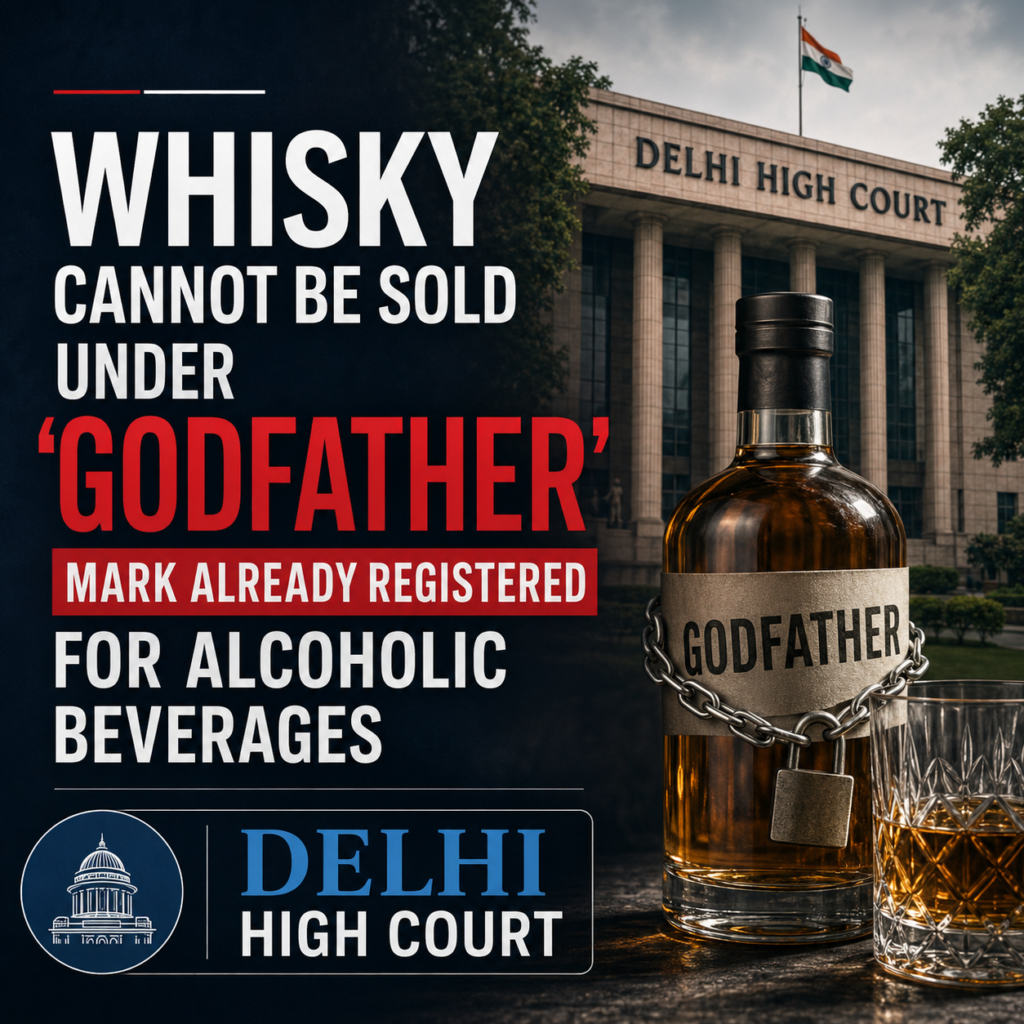
Delhi High Court Restrains Whisky Brand From Using “GODFATHER” Mark, Protects Devans Modern Breweries’ Registered Trademark
Facts
Devans Modern Breweries Limited filed a commercial suit seeking an interim injunction against Cartel Bros Private Limited and another defendant over the proposed use of the trademark “GODFATHER” for whisky.
Devans claimed that it had adopted the mark “GODFATHER” in 1984 for beer and had used it continuously for more than four decades.
The company held trademark registrations for “GODFATHER” in:
- Class 32 for beer; and
- Class 33 for alcoholic beverages other than beer, including whisky and rum.
Devans stated that it discovered social-media posts announcing the proposed launch of whisky by the defendants under the “GODFATHER” mark. It also found several trademark applications filed by the defendants in Class 33 containing the same expression.
The defendants later proposed using a revised composite mark, “THE GLENWALK GODFATHER’S BY SANJAY DUTT,” and offered to withdraw their application for the standalone mark “THE GODFATHER” if permitted to use the revised branding.
Devans argued that the word “GODFATHER” remained the dominant and memorable part of the defendants’ mark and that its use for whisky infringed Devans’ registered rights and took unfair advantage of its goodwill.
The company therefore sought an interim order restraining the defendants from manufacturing, advertising or selling whisky using “GODFATHER,” “GODFATHER’S” or any deceptively similar mark.
Issues
- Whether Devans could enforce its registered “GODFATHER” trademark for whisky and rum despite the defendants’ allegation that the mark had not been substantially used in Class 33 for several years.
- Whether beer and whisky are allied or cognate goods for the purpose of trademark infringement.
- Whether the word “GODFATHER’S” remained a prominent and infringing feature of the defendants’ composite mark.
- Whether the anti-dissection rule prevented the Court from separately examining the word “GODFATHER’S” within the defendants’ composite label.
- Whether the additional expressions “THE GLENWALK” and “BY SANJAY DUTT,” along with differences in packaging and price, sufficiently removed the likelihood of confusion.
- Whether the defendants’ use of the mark could dilute Devans’ trademark or provide an unfair commercial advantage.
- Whether Devans had established a prima facie case, balance of convenience and irreparable injury for grant of an interim injunction.
Petitioner’s Arguments
Devans argued that it was the prior adopter, prior user and registered proprietor of the “GODFATHER” trademark.
It described “GODFATHER” as an arbitrary mark having no natural connection with alcoholic beverages and therefore entitled to a high degree of legal protection.
The company claimed that it had used the mark for beer since the 1980s and had also used it for whisky and rum.
It relied upon:
- trademark registrations in Classes 32 and 33;
- sales invoices relating to beer, rum and whisky;
- excise declarations;
- Chartered Accountant certificates;
- foreign trademark registrations;
- copyright registrations for its labels;
- promotional expenditure; and
- annual sales of approximately ₹746 crore during the financial year 2024–25.
Devans argued that the defendants had been incorporated only in 2022 and filed their trademark applications in 2026 on a “proposed to be used” basis.
According to Devans, the defendants had full knowledge of its registrations because the Trademark Registry had cited the plaintiff’s marks while examining the defendants’ applications.
The plaintiff submitted that adding “THE” before “GODFATHER” or using the expression as part of “THE GLENWALK GODFATHER’S BY SANJAY DUTT” did not remove the infringement.
It argued that “GODFATHER” remained the dominant and eye-catching feature of the defendants’ branding.
Devans further contended that beer and whisky were allied and cognate goods because:
- both were alcoholic beverages;
- they were purchased by overlapping consumers;
- they were sold through the same liquor stores, bars and restaurants;
- they shared distribution channels; and
- both were governed by similar excise regulations.
The plaintiff maintained that use of the same mark for whisky could lead consumers to believe that the defendants’ product was manufactured, licensed or endorsed by Devans.
It also argued that the defendants would unfairly benefit from the goodwill generated by Devans over four decades and that the distinctiveness of the “GODFATHER” mark would be diluted.
Respondent’s Arguments
The defendants argued that they did not intend to use “THE GODFATHER” as a standalone trademark.
They proposed using the composite mark “THE GLENWALK GODFATHER’S BY SANJAY DUTT” and submitted that the mark had to be examined as a whole.
They relied on the anti-dissection rule, under which a composite trademark should ordinarily not be divided into separate elements while assessing similarity.
According to the defendants:
- “THE GLENWALK” was the prominent house mark;
- “GODFATHER’S” appeared in a smaller font;
- “BY SANJAY DUTT” acted as a distinct source identifier; and
- the overall marks were visually, structurally and phonetically different.
They argued that “GODFATHER” was a dictionary word and that Devans could not claim monopoly over it without proving that it had acquired secondary meaning specifically for whisky.
The defendants also questioned whether Devans had genuinely used the mark for whisky after 2013.
They contended that:
- the plaintiff had no recent excise approvals for “GODFATHER” whisky;
- its website did not presently display whisky or rum under that mark;
- its invoices showed only limited institutional sales;
- its present whisky products were marketed under other brands; and
- a rectification petition had been filed against Devans’ Class 33 registration.
They further argued that beer and whisky were not allied goods because they differed in:
- alcoholic strength;
- manufacturing process;
- price;
- manner of consumption;
- storage requirements;
- shelf placement;
- trade dress; and
- consumer purchasing behaviour.
The defendants submitted that purchasers of premium Scotch whisky were discerning consumers who would not confuse a ₹1,750 whisky bottle with comparatively inexpensive beer.
They also relied on the different bottle designs, logos, labels and celebrity association as additional matter sufficient to distinguish the rival products.
Analysis of the Law
The Court examined Sections 18, 28 and 29 of the Trade Marks Act, 1999.
Rights Arising From Registration
Section 28 grants the registered proprietor the exclusive right to use a trademark for the goods or services covered by the registration and to seek relief against infringement.
The Court held that non-use of a registered mark does not automatically extinguish those statutory rights.
Unless the registration is successfully cancelled or rectified through proceedings under the Trade Marks Act, it remains valid and enforceable.
The mere filing of a rectification petition does not create a presumption that the registered mark is invalid.
Infringement and Similarity
Sections 29(1) and 29(2) apply where an identical or deceptively similar mark is used for identical or similar goods.
Section 29(4) extends protection to a reputed registered mark even where the impugned mark is used for different goods, provided such use:
- is without due cause;
- takes unfair advantage of the registered mark; or
- damages its distinctive character or reputation.
Allied and Cognate Goods
The classification of goods in different trademark classes is not conclusive.
The Court must apply a commercial-reality test and examine:
- the nature and intended use of the goods;
- the consumers;
- the trade and distribution channels;
- the regulatory environment;
- the commercial relationship between the products; and
- the likelihood that consumers may associate them with the same source.
Anti-Dissection Rule and Dominant Features
A composite mark is ordinarily compared as a whole.
However, the rule does not prevent the Court from identifying an essential, dominant or prominent feature, particularly where the plaintiff owns a registered word mark and that word remains clearly noticeable in the defendant’s composite label.
A defendant cannot escape infringement merely by adding other words or design elements around the registered mark.
Interim Injunction
For interim relief, the Court considered whether Devans had established:
- a prima facie case;
- balance of convenience in its favour; and
- the likelihood of irreparable injury if the defendants were permitted to launch the product during the suit.
Precedent Analysis
Gujarat Bottling Co. Ltd. v. Coca-Cola Co.
The Supreme Court held that statutory rights arising from trademark registration can be enforced against infringement irrespective of whether the mark is presently in use.
The Delhi High Court relied on this principle to reject the argument that alleged non-use automatically prevented Devans from protecting its Class 33 registration.
Automatic Electric Limited v. R.K. Dhawan
This decision was relied upon for the proposition that a party which has itself sought registration of a mark may face difficulty in simultaneously arguing that the same mark is incapable of protection.
FDC Limited v. Docsuggest Healthcare Services
The Court relied upon the commercial test for deciding whether goods or services are allied and cognate.
Relevant factors include the nature of the goods, their purpose, consumers, market sector and trade channels. Classification under separate trademark classes is not determinative.
Radico Khaitan Ltd. v. Devans Modern Breweries Ltd.
The Court referred to this judgment while considering the protection of registered alcoholic-beverage trademarks and the relationship between products within the liquor industry.
South India Beverages v. General Mills Marketing
The decision explains the dominant-mark principle and permits courts to examine whether a prominent element of a composite mark creates deceptive similarity.
Kaviraj Pandit Durga Dutt Sharma v. Navaratna Pharmaceutical Laboratories
The Supreme Court distinguished infringement from passing off and explained that additional matter may sometimes distinguish products in a passing-off claim.
However, once the essential feature of a registered trademark is copied, added material may not defeat a statutory infringement claim.
Pernod Ricard India Private Limited v. Karamveer Singh Chhabra
The defendants relied on this judgment to argue that composite marks must be compared as a whole.
The Court accepted the general principle but found it inapplicable because “GODFATHER’S” continued to remain a prominent and eye-catching feature of the defendants’ proposed mark.
Laxmikant V. Patel v. Chetanbhai Shah
The judgment reinforces that courts may intervene at an early stage to prevent misrepresentation and diversion of business where continued use of an impugned mark is likely to cause lasting injury to goodwill.
Court’s Reasoning
The Court found that Devans’ registrations for “GODFATHER” in Classes 32 and 33 remained valid and enforceable.
The defendants’ rectification petition had not yet been decided. Therefore, the Court could not presume that the Class 33 registration was invalid merely because its present commercial use was disputed.
Devans had also produced invoices and a Chartered Accountant certificate showing prima facie use of the mark for whisky and rum between 2007 and 2013.
The authenticity and probative value of those documents could not be finally determined at the interim stage because that would require a full trial.
The Court held that beer and whisky were prima facie allied and cognate goods.
Although they differed in alcoholic content, price, storage and manner of consumption, both:
- were alcoholic intoxicants;
- were intended for broadly similar consumption purposes;
- passed through overlapping trade channels;
- were sold at liquor outlets, bars and restaurants; and
- were governed by the excise regime.
Their placement in different trademark classes did not prevent the Court from treating them as commercially related products.
On comparison of the marks, the Court observed that the defendants’ revised label continued to prominently contain “GODFATHER’S.”
The addition of “THE GLENWALK” and “BY SANJAY DUTT,” or the use of a smaller font, did not remove the essential feature of Devans’ registered word mark.
The Court rejected the anti-dissection defence because “GODFATHER’S” remained visually striking and capable of being independently remembered by consumers.
The Court also found substantial prima facie evidence of Devans’ goodwill.
The company had used “GODFATHER” for beer for approximately 40 years, reported sales of around ₹746 crore in 2024–25 and incurred substantial promotional expenditure.
Even assuming that the defendants had not acted dishonestly, consumers could still believe that their whisky was associated with, licensed by or commercially connected to Devans.
Continued use could therefore:
- dilute the distinctive character of the plaintiff’s mark;
- cause consumer association or confusion;
- provide the defendants an unfair advantage; and
- cause injury that could not be adequately compensated through damages.
The Court consequently found the prima facie case, balance of convenience and irreparable injury requirements in Devans’ favour.
Conclusion
The Delhi High Court granted an interim injunction in favour of Devans Modern Breweries Limited.
During the pendency of the suit, the defendants were restrained from:
- manufacturing;
- bottling;
- marketing;
- selling;
- offering for sale;
- advertising;
- exporting; or
- otherwise using
the marks “GODFATHER,” “GODFATHER’S” or any deceptively similar expression as part of any trademark, label, carton, packaging, trade dress or representation for whisky.
The defendants were also directed to remove all online listings, advertisements, posts and other content containing “GODFATHER” or any deceptively similar mark in relation to whisky or other alcoholic beverages.
They were required to issue takedown requests to third-party websites, e-commerce services, mobile applications and social-media platforms where such content had been published.
The ruling is an interim determination and does not finally decide the validity of the rival registrations or the merits of the infringement and passing-off claims, which remain subject to trial.
Case Details
Case: Devans Modern Breweries Limited v. Cartel Bros Private Limited & Another
Court: Delhi High Court
Case Number: CS(COMM) 346 of 2026
Judge: Justice Tushar Rao Gedela
Date: 22 June 2026
Result: Interim injunction granted; defendants restrained from using “GODFATHER” or “GODFATHER’S” for whisky and directed to remove related promotional content