

Magistrate Cannot Reassess Surrogacy Eligibility Certificate Issued by Appropriate Authority: Madras High Court
Facts
Petitioners 1 and 2 were a married couple who had a son born in 2008. Their son died from cardiac arrest on 6 November 2024. The couple thereafter wished to have another child.
The first petitioner had undergone removal of her uterus and was medically incapable of carrying a pregnancy. The couple therefore decided to pursue altruistic surrogacy under the Surrogacy (Regulation) Act, 2021.
They approached a fertility hospital at Salem, which initiated the statutory process. After scrutiny of their medical and age-related documents, the Appropriate Authority issued an eligibility certificate to the intending couple on 23 May 2025.
The third petitioner, a relative of the intending couple, agreed to act as the surrogate mother. She submitted the required documents along with her husband’s consent, and the competent authority issued her an eligibility certificate on 22 December 2025.
The petitioners then approached the Judicial Magistrate No. I, Namakkal, under Section 4(iii)(a)(II) of the Surrogacy Act, seeking an order concerning the parentage and custody of the child to be born through surrogacy.
The Magistrate dismissed the application on two principal grounds:
- the first petitioner was 50 years, nine months and three days old and had allegedly exceeded the maximum age of 50 years prescribed for an intending mother; and
- the surrogate mother’s husband had neither been made a party nor examined before the court.
The petitioners challenged the dismissal before the Madras High Court through a criminal revision petition. During the proceedings, the intending couple’s eligibility certificate expired because of the time consumed before the Magistrate and the High Court.
Issues
- Whether a Magistrate deciding an application for parentage and custody under Section 4(iii)(a)(II) of the Surrogacy Act can reassess the validity of an eligibility certificate issued by the Appropriate Authority.
- Whether the Magistrate functions as an appellate authority over the medical and eligibility determinations made by statutory authorities.
- Whether the failure to make the surrogate mother’s husband a party or examine him as a witness is fatal to a parentage application.
- Whether the statutory expression “between the age of 23 to 50 years” includes an intending mother who has completed 50 years but has not yet attained 51 years.
- Whether the High Court should itself issue the parentage and custody order or remit the matter to the Magistrate.
- Whether the intending couple’s eligibility certificate, which expired during litigation, should be extended.
Petitioner’s Arguments
The petitioners argued that the first petitioner remained within the permitted age bracket because a woman who has completed 50 years continues to be 50 until she reaches 51.
They submitted that the Appropriate Authority had already examined the medical and age-related records and issued a valid eligibility certificate. The Magistrate had no jurisdiction to sit in appeal over that statutory determination.
According to the petitioners, the Magistrate’s role under Section 4(iii)(a)(II) was confined to passing an order concerning the parentage and custody of the child to be born through surrogacy. The Magistrate could not reopen matters assigned by the Act to the Appropriate Authority or District Medical Board.
The petitioners further argued that the Surrogacy Act did not require the surrogate mother’s husband to be made a party or personally examined. His written consent had already been considered by the Appropriate Authority while issuing the surrogate mother’s eligibility certificate.
It was submitted that the Magistrate had adopted an excessively technical approach and frustrated the object of a beneficial legislation intended to regulate and facilitate lawful altruistic surrogacy.
The petitioners also sought extension of their eligibility certificate for one year because it had expired solely during the pendency of the judicial proceedings.
Respondent’s Arguments
The State substantially supported the petitioners’ position.
It submitted that the Appropriate Authority had issued the eligibility certificates only after completing the necessary statutory formalities.
The State acknowledged that the Surrogacy Act did not require the surrogate mother’s husband to be examined by the Magistrate in a proceeding concerning parentage and custody.
It was argued that the Magistrate’s conclusion on non-examination of the surrogate mother’s husband appeared to have been reached without proper application of mind.
The Amicus Curiae similarly submitted that the Magistrate had exceeded the limited jurisdiction assigned under the Act. He maintained that the expression “between 23 to 50 years” included the entire fiftieth year and that the intending mother remained eligible until she attained 51 years.
Analysis of the Law
Statutory Division of Functions
The Surrogacy Act establishes separate and specialised functions for different authorities.
The District Medical Board determines whether there is a medical indication necessitating surrogacy.
The Appropriate Authority issues eligibility certificates to:
- the intending couple or intending woman; and
- the surrogate mother.
A Magistrate of the first class or above passes an order concerning the parentage and custody of the child to be born.
The High Court held that these functions are distinct. One authority cannot assume the jurisdiction expressly assigned to another.
The Magistrate’s role is not to reassess medical eligibility, age-related certification or the merits of a certificate already issued by the Appropriate Authority.
Presumption of Validity of Eligibility Certificates
Certificates issued by the District Medical Board and the Appropriate Authority carry a presumption of validity.
Unless such a certificate:
- has been set aside by a competent appellate forum;
- is ex facie illegal;
- has been obtained through fraud; or
- was issued without jurisdiction,
the Magistrate ordinarily cannot disregard or re-evaluate it.
The Surrogacy Act provides a separate appellate mechanism for challenging the rejection, suspension or cancellation of certificates. The Magistrate is not designated as that appellate authority.
Scope of Parentage and Custody Proceedings
An order under Section 4(iii)(a)(II) concerns the legal parentage and custody of the child to be born through surrogacy.
The Magistrate must principally protect the interests and future legal status of the child. The order serves as the birth affidavit for the surrogate child.
The Magistrate may verify compliance with matters relevant to parentage and custody, but cannot conduct a fresh trial into statutory eligibility already certified by competent authorities.
Age Limit for an Intending Mother
Section 4(iii)(c)(I) requires the intending female to be “between the age of 23 to 50 years” on the date of certification.
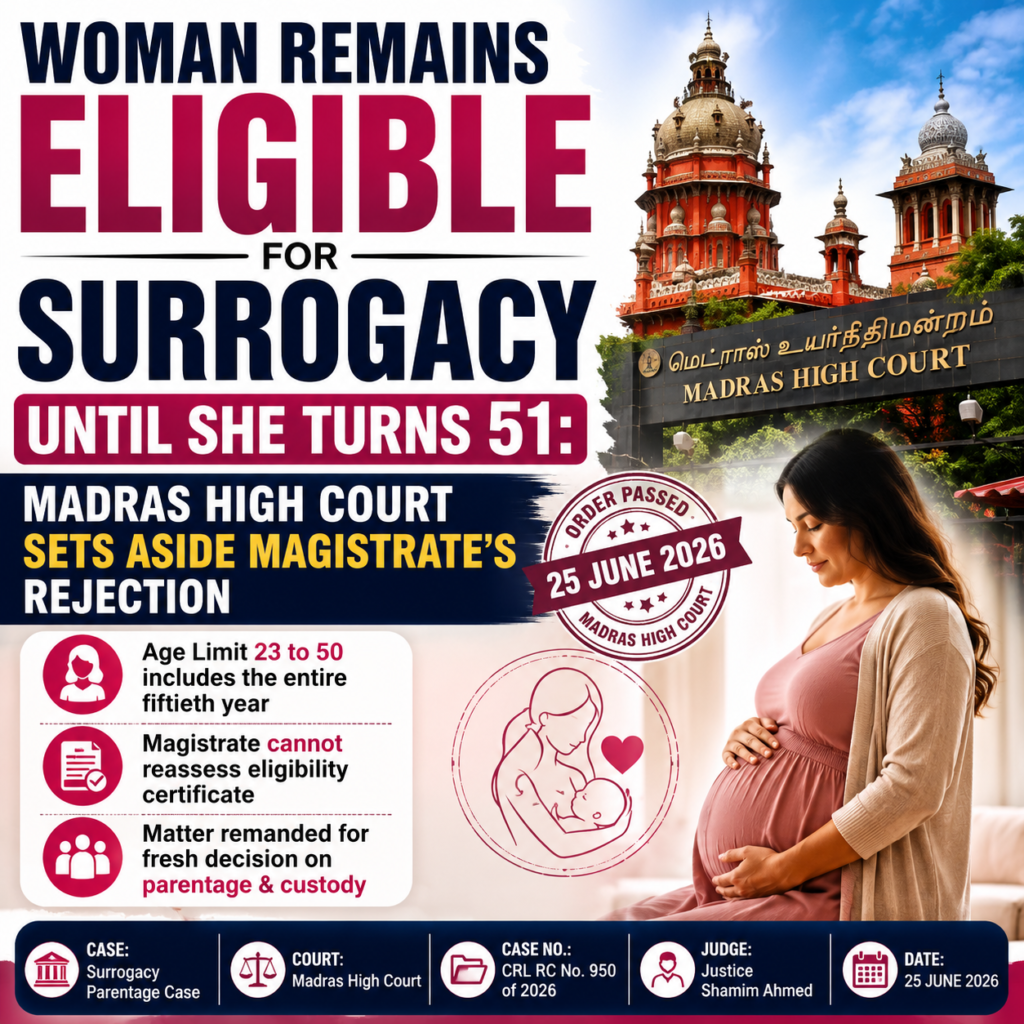
The Court held that the upper age of 50 is inclusive. A woman who has completed 50 years but has not yet attained 51 remains within the statutory range.
The Court reasoned that:
- the word “to” ordinarily includes the final figure in a statutory range;
- common understanding of an age range from 23 to 50 includes the entire fiftieth year;
- if Parliament intended to exclude women after their fiftieth birthday, it could have used language such as “below 50 years” or “not having attained 50 years”; and
- a purposive interpretation was appropriate because an unnecessarily restrictive reading would permanently deny the opportunity of motherhood.
Therefore, the first petitioner, who was 50 years and 11 months old on the date of certification, had not become ineligible.
Surrogate Mother’s Husband
The Surrogacy Act requires the application for parentage and custody to be made by the intending couple or intending woman together with the surrogate mother.
It does not require the surrogate mother’s husband:
- to be impleaded as a party;
- to file a separate application; or
- to personally appear and give evidence.
His consent is considered by the Appropriate Authority while assessing the surrogate mother’s eligibility.
The Magistrate therefore could not reject the application merely because the surrogate mother’s husband had not been examined.
Precedent Analysis
Baby Manji Yamada v. Union of India, (2008) 13 SCC 518
The Supreme Court explained the nature of surrogacy and identified the intending parents as those who intend to raise the child after birth.
The Madras High Court referred to this decision while outlining the concept and categories of surrogacy.
Vijaya Kumari v. Union of India, 2025 INSC 1209
This decision examined the evolution of surrogacy regulation in India and the concerns that led Parliament to prohibit commercial surrogacy while permitting regulated altruistic surrogacy.
The precedent supported a purposive reading of the 2021 Act aimed at preventing exploitation without creating unnecessary barriers for otherwise eligible intending parents.
Rajitha P.V. v. Union of India, 2025 SCC OnLine Ker 1624
This was the principal authority on the age-limit issue.
The Kerala High Court held that the statutory range of 23 to 50 years includes the full fiftieth year and that eligibility ceases only when the intending woman attains 51.
The Madras High Court adopted this interpretation and held that the first petitioner remained eligible on the date of certification.
Prabhu Dayal Sesma v. State of Rajasthan, (1986) 4 SCC 59
The Supreme Court considered legal principles governing the computation of age.
The Madras High Court discussed this authority while examining the distinction between attaining a specified age and remaining within an inclusive statutory age range.
The Court ultimately gave effect to the wording, object and beneficial purpose of the Surrogacy Act rather than adopting an interpretation that prematurely closed the eligibility window.
Court’s Reasoning
The High Court held that the Magistrate had exceeded the jurisdiction conferred under Section 4(iii)(a)(II).
The Appropriate Authority had already scrutinised the couple’s records and issued an eligibility certificate. The Magistrate could not act as an appellate forum and independently declare the certificate invalid merely because the intending mother was more than 50 years old but had not attained 51.
The Court found that the first petitioner was 50 years, nine months and three days old when she applied and approximately 50 years and 11 months old when the certificate was issued. She had not completed 51 years and was therefore eligible.
The Court also found the insistence upon examination of the surrogate mother’s husband to be legally unfounded. The statutory application had been made by the persons specifically identified under the Act—the intending couple and the surrogate mother.
The surrogate mother’s husband had already provided consent, which formed part of the scrutiny undertaken by the Appropriate Authority. The Act did not require him to participate in the Magistrate’s proceedings.
The High Court declined to issue the parentage and custody order directly. It considered it appropriate to remit the matter to the Magistrate so that the statutory authority could reconsider the application within its proper jurisdiction and in accordance with the legal principles laid down.
Since the eligibility certificate had expired during the litigation, the Court also issued time-bound directions for its extension so that the petitioners would not lose their opportunity because of judicial delay.
Conclusion
The Madras High Court allowed the criminal revision petition and set aside the Magistrate’s order dated 18 March 2026.
The Court held that:
- an intending mother remains eligible throughout her fiftieth year and becomes ineligible only upon attaining 51 years;
- a Magistrate cannot function as an appellate authority over an eligibility certificate issued by the Appropriate Authority;
- the Magistrate’s role is confined to deciding parentage and custody under Section 4(iii)(a)(II);
- examination or impleadment of the surrogate mother’s husband is not mandatory; and
- the application could not have been rejected on either of the grounds adopted by the Magistrate.
The matter was remanded to Judicial Magistrate No. I, Namakkal, for fresh consideration.
The petitioners were directed to apply within two weeks for extension of their eligibility certificate from 23 May 2026 to 22 May 2027. The Appropriate Authority was directed to issue the extended certificate within two weeks of receiving the application.
After the extended certificate is placed on record, the Magistrate must decide the application within four weeks in accordance with the High Court’s observations.
The Registrar General was also requested to circulate the judgment to all Principal District Judges for information and compliance.
Case Details
Case: Names of the petitioners are redacted in the uploaded judgment v. State of Tamil Nadu & Others
Court: High Court of Judicature at Madras
Case Number: Criminal Revision Case No. 950 of 2026
Judge: Hon’ble Mr. Justice Shamim Ahmed
Date: 25 June 2026
Result: Criminal revision allowed; Magistrate’s rejection of the surrogacy parentage application set aside, eligibility certificate directed to be extended for one year, and matter remanded for fresh decision within four weeks.

Read Also: Kerala High Court Upholds Divorce After Wife Remarries but Orders Fresh Decision on ₹20 Lakh Alimony