

Court’s decision
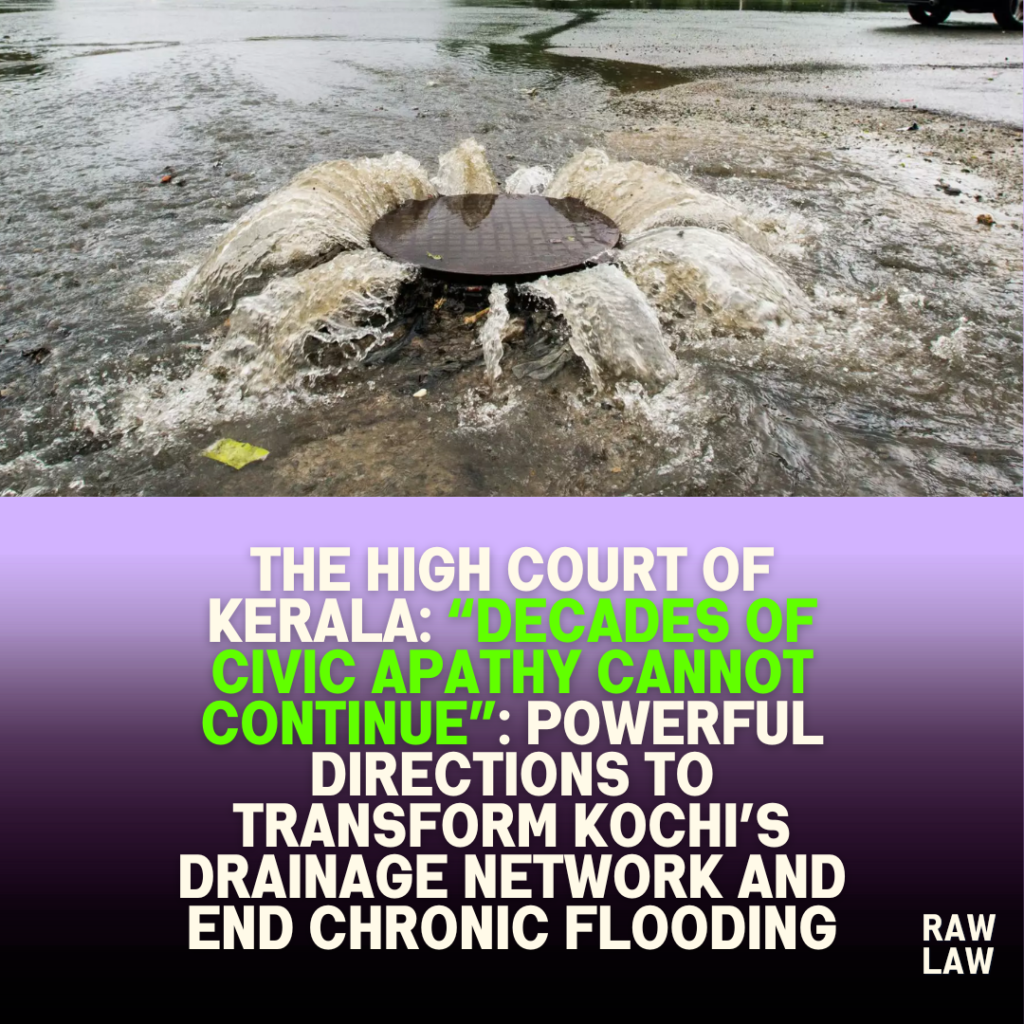
The High Court of Kerala delivered a landmark judgment in a long-running public interest litigation concerning the recurring waterlogging in Kochi city. The Court held that the city’s drainage network, including the Perandoor Canal and its feeder canals, had suffered decades of neglect, unscientific constructions, encroachments, and failures of civic bodies. It directed a comprehensive, time-bound operational framework involving the District Collector, Kochi Corporation, GCDA, Railways, KWA, KSEB, and other agencies. The Court ordered strict monitoring, mandated progress reports, endorsed “Operation Breakthrough” with modifications, and sustained judicial supervision until demonstrable improvements in Kochi’s flood management were achieved.
Facts
The case arose from repeated monsoon flooding across Kochi, particularly severe after the 2018 floods. The PIL highlighted blocked canals, broken drains, inadequate culverts, encroachments, and lack of coordination among civic agencies. Perandoor Canal, one of Kochi’s most critical flood-carrying channels, remained clogged and constricted. Repeated complaints from residents, local bodies, environmental groups, and officials led to the Court’s intervention. Over seven years, the Court passed numerous interim orders, appointed committees, directed mapping exercises, required cleaning operations, and monitored infrastructure projects. However, the city continued to suffer waterlogging, compelling the High Court to craft a consolidated, enforceable framework.
Issues
The principal issues were whether civic bodies had failed in their statutory duties to maintain the drainage system and whether long-term, coordinated, multi-agency intervention was required to prevent recurring flooding. The Court also examined whether existing mechanisms such as Operation Breakthrough were implemented effectively, whether encroachments were removed, whether crucial stretches of Perandoor Canal were widened, and whether culverts and drains under various departments were properly designed. Another issue was the extent to which judicial monitoring should continue to ensure compliance with environmental and municipal obligations.
Petitioner’s arguments
The petitioner submitted that Kochi’s drainage system had collapsed due to years of administrative indifference. It was argued that Perandoor Canal and feeder canals were heavily silted, illegally narrowed, and obstructed by unscientific constructions. The petitioner pointed to failed coordination between GCDA, Kochi Corporation, Railways, NH authorities, and KWA, resulting in mismatched culverts and disjointed drains. The petitioner argued that Operation Breakthrough had not been fully implemented and that residents continued to face severe hardship during rains. It was contended that statutory bodies lacked the willingness to execute long-term solutions, thus requiring the Court’s continuing supervision.
Respondent’s arguments
The Government and agencies submitted multiple reports detailing ongoing cleaning works, desilting, CCTV surveys, mapping of drains, preparation of drainage master plans, and removal of certain obstructions. They highlighted the role of Operation Breakthrough, which identified bottlenecks in the network and sought to clear them. Agencies argued that rainfall intensity, sudden cloudbursts, and ageing infrastructure had aggravated flooding. They claimed substantial compliance with earlier Court directions, including formation of a High-Level Committee under the District Collector, and submitted that several stretches of Perandoor Canal had been cleaned periodically. They sought reasonable timeframes for executing remaining tasks and coordinating interdepartmental approvals.
Analysis of the law
The Court emphasised that municipal bodies are statutorily responsible for maintaining drainage systems, removing blockages, and preventing flooding. It reiterated that constitutional obligations under Articles 21 and 47 require the State to safeguard health and living conditions. The Court held that environmental regulation and flood management are continuous duties, not seasonal responses. It noted that persistent flooding demonstrated systemic failure and that fragmented actions by multiple agencies could not substitute a unified drainage strategy. The Court thus invoked its jurisdiction to ensure accountability, transparency, and coordination, holding that judicial monitoring is warranted when public authorities repeatedly fail to perform essential civic functions.
Precedent analysis (internal precedents)
The Court relied on its own series of interim orders issued since 2018, which collectively functioned as internal precedents guiding the final directions. Earlier orders mandated mapping drains, identifying choke points, creating a coordination committee, and initiating Operation Breakthrough. These orders demonstrated the Court’s long-term engagement and iterative assessment of compliance gaps. By reviewing progress reports submitted pursuant to these internal precedents, the Court found that while certain works were completed, major issues persisted. These internal precedents justified the continuation of judicial monitoring and informed the final framework of responsibilities allocated among agencies.
Court’s reasoning
The Court found that the fundamental reason for Kochi’s flooding was not extraordinary rainfall but failure of civic systems—blocked canals, inadequate drains, mismatched culverts, and chronic administrative fragmentation. It held that every agency had contributed to the problem: KSEB’s cables obstructed drains, KWA’s pipelines narrowed canals, Railways’ culverts were insufficient, GCDA failed to maintain canal stretches, and Kochi Corporation lacked periodic desilting. The Court reasoned that these independent failures created a combined civic collapse. It concluded that without Court-mandated coordination, Kochi would face repeated humanitarian and environmental disasters, making judicial intervention indispensable.
Conclusion
The Court issued a comprehensive operational blueprint: strengthening the High-Level Committee under the District Collector; mandating periodic progress reports; directing removal of encroachments; restructuring culverts; synchronising drains under each department; ensuring scientific widening of Perandoor Canal; compelling KSEB, KWA, and Railways to redesign utilities; and requiring GCDA and Kochi Corporation to execute desilting and maintenance throughout the year. The Court made clear that flooding in Kochi is a governance failure requiring coordinated, measurable, and enforceable action. Judicial monitoring will continue until substantial improvement is achieved.
Implications
This judgment stands as one of the most important civic-governance rulings for Kochi. It reshapes the city’s drainage governance and enforces accountability across multiple agencies. The judgment compels scientific planning, technical coordination, and continuous monitoring, preventing civic bodies from treating flooding as a seasonal inconvenience. It establishes that environmental infrastructure failures implicate constitutional rights and justify sustained judicial supervision. Most significantly, it provides residents with a structured, enforceable framework requiring clear timelines, transparency, and interdepartmental responsibility.


