

Court’s decision
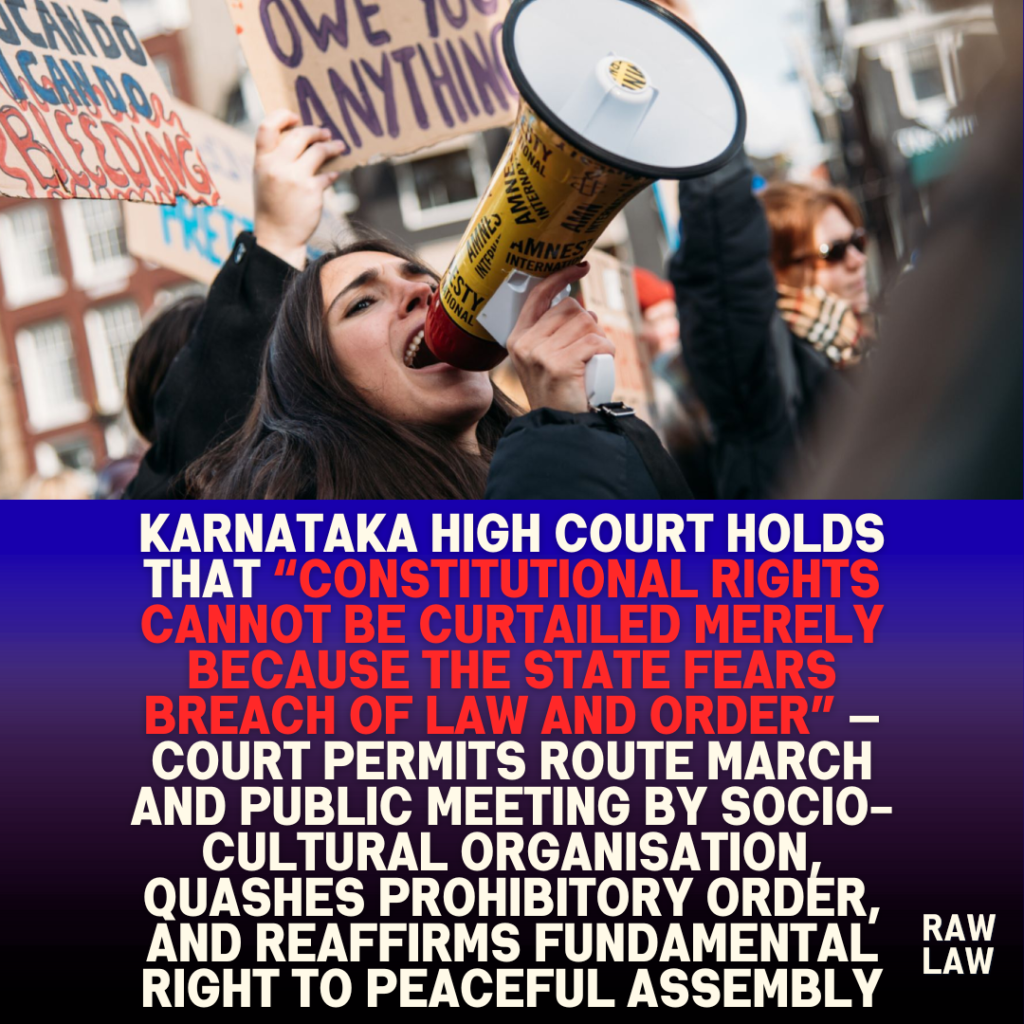
The Karnataka High Court set aside the prohibitory order issued by the Respondent authority denying permission for a proposed route march and public meeting organised by the Petitioner, a socio-cultural body seeking to conduct its annual programme. The Court held that the Respondent had mechanically rejected the request by citing “law-and-order issues” without providing specific material or concrete intelligence inputs. Emphasising that freedom of expression and peaceful assembly are inseparable elements of democratic participation, the Court declared that any restriction under Section 31 of the Police Act or Article 19(3) of the Constitution must be reasonable, proportionate, and supported by detailed justification.
After evaluating the parade route, traffic arrangements, police reports, and the absence of adverse intelligence, the Court directed the authorities to grant permission subject to reasonable conditions such as designated timings, sound restrictions, compliance with local traffic advisories, and adherence to peaceful conduct. The Court relied on constitutional jurisprudence affirming that the State’s obligation is not to prohibit peaceful gatherings but to facilitate them by ensuring adequate security and crowd management. The impugned order dated 30.01.2024 was quashed, and the authorities were directed to issue fresh permission within a prescribed timeframe.
Facts
The Petitioner submitted a written request for permission to conduct a route march and a concluding public meeting in the town of Karwar on 11.02.2024. The programme was intended as an annual cultural procession with pre-fixed routes, timings, and volunteer deployment. The Petitioner requested that the Respondent consider the application under the applicable local police regulations and issue permission with standard conditions.
However, the Respondent rejected the request by issuing an order dated 30.01.2024, citing possible traffic obstructions and concerns over maintaining law and order. The order did not indicate any specific security threat or prior incident involving the Petitioner. It merely referred to general administrative difficulty. Aggrieved by this rejection and asserting violation of the fundamental right to assemble peacefully, the Petitioner approached the High Court seeking quashing of the order and a direction to the Respondent to grant permission.
Issues
The Court examined the following issues:
- Whether the Respondent’s prohibitory order complied with the constitutional requirements of reasonableness and proportionality.
- Whether the Petitioner’s right to organise a peaceful route march could be denied solely on the basis of vague apprehensions.
- Whether the Respondent discharged the statutory obligation to assess applications based on material facts and specific inputs.
- Whether the High Court should issue a mandamus allowing the route march with lawful regulatory conditions.
Petitioner’s arguments
The Petitioner argued that the fundamental right under Article 19(1)(b) permits peaceful assembly, and such a right cannot be denied without cogent reasons. It submitted that the route march had been conducted peacefully in previous years without any disruption. The Petitioner emphasised that the Respondent did not consider the detailed route map, crowd-management plan, volunteer deployment, or the Petitioner’s willingness to adhere to strict conditions.
The Petitioner asserted that the impugned order was arbitrary because it cited only general law-and-order concerns and did not rely on any specific intelligence regarding potential disturbances. It was contended that the State cannot deny permission merely because it anticipates administrative inconvenience or traffic issues, especially when such events routinely occur across the State. Therefore, the Petitioner sought quashing of the order and a directive to issue permission with reasonable terms.
Respondent’s arguments
The Respondent submitted that maintaining public order is a critical responsibility and that the proposed event was likely to cause congestion and potential law-and-order disturbances. It argued that the police had assessed the route and concluded that the presence of large crowds at multiple junctions might strain security resources.
The Respondent further argued that the Petitioner’s event could coincide with other public activities in the area, thereby increasing the risk of traffic disruption. It was submitted that denial of permission was based on administrative necessity and not motivated by hostility toward the Petitioner. The Respondent maintained that courts should refrain from interfering in operational decisions of the police, especially in matters related to public safety.
Analysis of the law
The Court examined Article 19(1)(b) of the Constitution, which guarantees the right to assemble peacefully without arms. It noted that restrictions can be imposed only under Article 19(3), which requires that limitations be reasonable and in the interests of public order. The Court emphasised that proportionality is the governing standard—meaning the burden lies on the State to demonstrate that denying permission is the least restrictive means of achieving legitimate public-order objectives.
The Court also analysed the State Police Act, which empowers authorities to regulate assemblies but mandates that orders must be based on concrete material and recorded reasons. A bare apprehension without evidence cannot override a fundamental right. Referring to settled jurisprudence, the Court held that assemblies, protests, and cultural marches are integral to democratic expression and cannot be curtailed unless specific, imminent, and substantiated threats exist.
Precedent analysis
Though the judgment does not explicitly list every precedent, the Court’s reasoning is firmly rooted in constitutional jurisprudence, including the principles established by the Supreme Court that the State must facilitate rather than suppress peaceful gatherings. The decision reflects the consistent judicial view that restrictions must be narrow, evidence-based, and accompanied by safeguards that protect both fundamental rights and public order. By applying these standards, the Court reaffirmed the constitutional obligation of the State to balance security and freedom responsibly.
Court’s reasoning
The Court observed that the impugned order lacked any reference to intelligence reports, past incidents, or any material suggesting that the Petitioner’s event might lead to violence or public disorder. It held that mere administrative difficulty could not justify the denial of a fundamental right. The Court found that the Respondent failed to consider that the Petitioner had expressed willingness to comply with restrictions on sound, timing, and crowd movement.
The Court reiterated that authorities must adopt regulatory measures—such as deploying additional police, adjusting traffic patterns, or modifying timings—instead of outright refusal. It stressed that a democratic society functions on the presumption that peaceful assemblies are permissible, and the State’s role is to regulate, not prohibit. Thus, the refusal order was held to be arbitrary, unreasonable, and violative of Article 19.
Conclusion
The High Court quashed the order dated 30.01.2024 and directed the Respondent to issue permission for the route march and public meeting scheduled for 11.02.2024. The permission was to be granted with regulatory conditions, including specific timings, noise restrictions, volunteer deployment, and compliance with police instructions. The Court clarified that the Petitioner must ensure peaceful conduct and follow all stated conditions. The writ petition was accordingly disposed of.
Implications
This ruling strengthens the legal position that constitutional rights to peaceful assembly cannot be curtailed based on generic apprehensions. It reaffirms that authorities must base their decisions on verifiable material and adopt regulatory rather than prohibitory approaches. The judgment will guide administrative bodies across Karnataka in handling future requests for marches, rallies, and cultural processions. It reinforces transparency in decision-making and ensures that democratic participation remains accessible, structured, and constitutionally protected.


