

1. Court’s decision
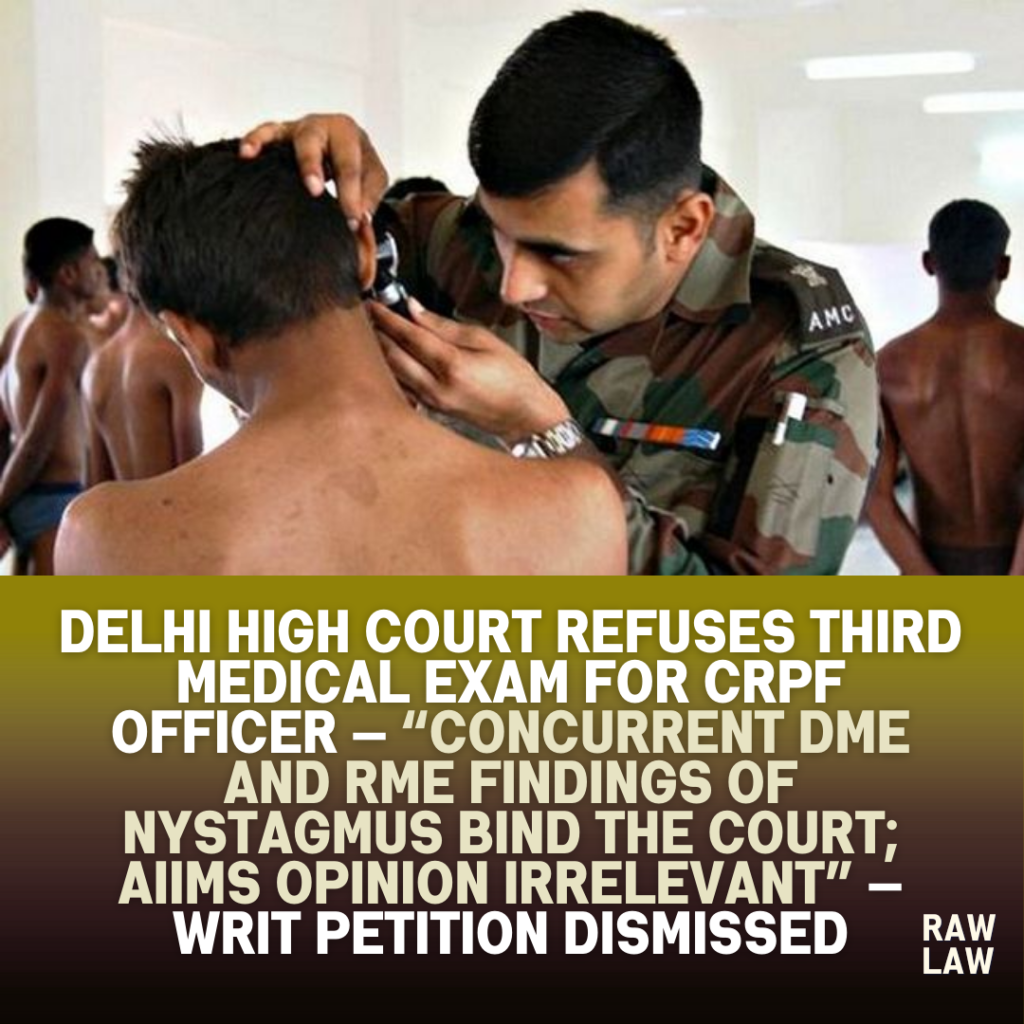
The Delhi High Court has dismissed a writ petition filed by a CRPF Sub-Inspector who sought appointment as Assistant Commandant through the Limited Departmental Competitive Examination (LDCE). The petitioner challenged the medical unfitness opinion rendered by both the Detailed Medical Examination (DME) and Review Medical Examination (RME), which unanimously declared him unfit due to bilateral nystagmus. The Court held that once DME and RME findings are concurrent and issued by competent medical boards—including specialists—judicial intervention is impermissible unless exceptional circumstances exist. The Court found no such exceptions. It further held that the AIIMS certificate obtained by the petitioner privately could not override statutory medical board findings. Accordingly, the writ petition was dismissed.
2. Facts
The petitioner applied for recruitment as Assistant Commandant under the LDCE notification issued in February 2025. He cleared all stages of the examination. On 17 October 2025, his DME declared him medically unfit on three grounds: bilateral nystagmus, elevated blood pressure, and borderline cardiomegaly. Dissatisfied, he sought a Review Medical Examination. On 22 October 2025, the RME again declared him unfit, this time specifying nystagmus as the sole disqualifying condition. The petitioner thereafter obtained an ophthalmic assessment from Dr. Rajendra Prasad Centre, AIIMS, which recorded the absence of nystagmus. Relying on this, he sought intervention of the Court to direct a fresh medical board. The Court called for comments from the medical board, which affirmed that the RME consisted of three ophthalmologists and that nystagmus itself — irrespective of cause — was a standalone ground of disqualification. The present judgment resolves this challenge.
3. Issues
The Court identified the following issues:
- Whether the Court can direct a fresh medical board when both the DME and RME have concurred in their medical findings.
- Whether obtaining a private medical opinion from AIIMS justifies judicial intervention.
- Whether absence of electroretinography (ERG) invalidated the RME report.
- Whether the Supreme Court’s order in Divyanshu Singh warranted a third medical examination in the present case.
- Whether specialist examination was lacking, thereby attracting the exception carved out in Aman Singh.
4. Petitioner’s arguments
The petitioner argued that the AIIMS report categorically ruled out nystagmus, thereby casting doubt on the findings of the DME and RME. He submitted that nystagmus could only be conclusively ruled out through ERG testing, which was not conducted by the RME. He relied on Divyanshu Singh v. Union of India, contending that when discrepancies exist between medical evaluations or when specialist investigation is necessary, courts may direct a fresh examination. He also referenced a previous selection in 2003 in which he had been found medically fit, asserting that his long service record without visual disability militated against the conclusions reached by the boards. The petitioner urged that fairness required a new medical assessment to settle the conflict of opinion.
5. Respondent’s arguments
The Union of India argued that the judgments of this Court, especially Staff Selection Commission v. Aman Singh and KM Priyanka v. Union of India, strictly limit judicial interference where both DME and RME findings are concurrent. They emphasised that the petitioner was examined by three ophthalmologists, each of whom independently confirmed nystagmus. The respondents further submitted that ERG testing is unnecessary for diagnosing nystagmus and is relevant only for determining its cause. Since nystagmus, by itself, is a disqualifying condition under the 2015 CAPFs/AR Visual Standards, cause is irrelevant. They contended that allowing private medical certificates to override specialised service medical assessments would undermine the recruitment process.
6. Analysis of the law
The Court restated the principles laid down in Aman Singh and KM Priyanka:
• Courts will not order a third medical examination in the presence of consistent DME and RME reports.
• Exceptions arise only when the condition requires specialised assessment which is absent on the board, or when outside-hospital evaluations commissioned by the authorities are ignored, or when there is discordance between DME and RME findings.
Applying these principles, the Court held that the petitioner’s case satisfied none of the exceptions. Three ophthalmologists were present on the RME. The petitioner was not referred to AIIMS by the respondents, making the AIIMS report legally irrelevant. Most importantly, the DME and RME were perfectly consistent: both found bilateral nystagmus. The Court emphasised that recruitment medical standards treat nystagmus as an automatic disqualification, and therefore ERG testing—used to identify cause—was unnecessary.
7. Precedent analysis
The Court examined two precedents:
1. Staff Selection Commission v. Aman Singh (2024 SCC OnLine Del 7600)
Holding: No judicial referral to a third board when DME and RME concur unless exceptions apply.
Application: The Court held that none of the exceptions applied because multiple ophthalmologists had already examined the petitioner.
2. KM Priyanka v. Union of India (2020 SCC OnLine Del 1851)
Holding: Private medical opinions cannot dislodge opinions of statutory medical boards.
Application: The AIIMS report did not justify intervention.
3. Divyanshu Singh v. Union of India (SC, 2025)
Holding (as interpreted from facts): Third examination may be directed where there exists discordance between initial and review medical boards.
Application: No discordance existed here—both boards found nystagmus.
Thus, the High Court concluded that the petitioner’s reliance on Divyanshu Singh was misconceived.
8. Court’s reasoning
The Court reviewed the medical board’s written comments placed on record. The board explicitly stated that:
• Three eye specialists examined the petitioner.
• ERG was unnecessary because diagnosis of nystagmus was clinical; ERG identifies causes but does not determine existence.
• Under recruitment standards, nystagmus is itself a disqualification irrespective of underlying cause.
Given this, the Court rejected the petitioner’s argument that failure to perform ERG invalidated the RME. The Court also observed that the AIIMS report could not substitute the official medical assessment, as allowing candidates to bypass statutory medical boards via private certificates would “demolish the recruitment structure.” The Court therefore concluded that there was no legal basis to disturb the concurrent findings of unfitness.
9. Conclusion
The High Court held that the petitioner had failed to establish any ground for judicial interference. The DME and RME reports were concurrent, specialist-supported, and consistent with the CAPFs medical standards. No procedural irregularity or misdiagnosis was shown. The AIIMS opinion could not outweigh statutory medical assessments, and the precedent relied upon was distinguishable. Accordingly, the writ petition was dismissed.
10. Implications
This judgment reinforces the narrow scope of judicial scrutiny in recruitment-related medical assessments. It underlines that:
• Specialist presence within the medical board satisfies natural justice.
• Private medical certificates cannot override DME/RME findings.
• ERG or other specialised testing is not necessary when the disqualifying condition itself is clinically evident.
• Courts will interfere only where procedural irregularity, discordant medical findings, or lack of specialist expertise is demonstrated.
The ruling strengthens institutional integrity of CAPFs medical evaluations and offers crucial clarity for future LDCE candidates alleging improper medical rejection.
CASE LAW REFERENCES
1. Staff Selection Commission v. Aman Singh (2024 SCC OnLine Del 7600)
Held: No third examination when DME & RME concur.
Applied: Used to reject fresh medical board request.
2. KM Priyanka v. Union of India (2020 SCC OnLine Del 1851)
Held: Private medical reports cannot override statutory boards.
Applied: AIIMS opinion disregarded.
3. Divyanshu Singh v. Union of India (SC 2025)
Held: Third exam justified only when DME–RME findings conflict.
Applied: No conflict here; precedent distinguishable.
FAQs
1. Can the Court order a fresh medical exam for CAPFs recruitment?
Only if DME and RME findings conflict, or if specialist assessment was lacking. Neither exception applied here.
2. Does an AIIMS certificate override DME/RME findings?
No. Private medical opinions cannot substitute official recruitment medical boards.
3. Is electroretinography (ERG) required to diagnose nystagmus?
No. ERG identifies the cause of nystagmus, whereas the condition itself is clinically diagnosable and independently disqualifying.


