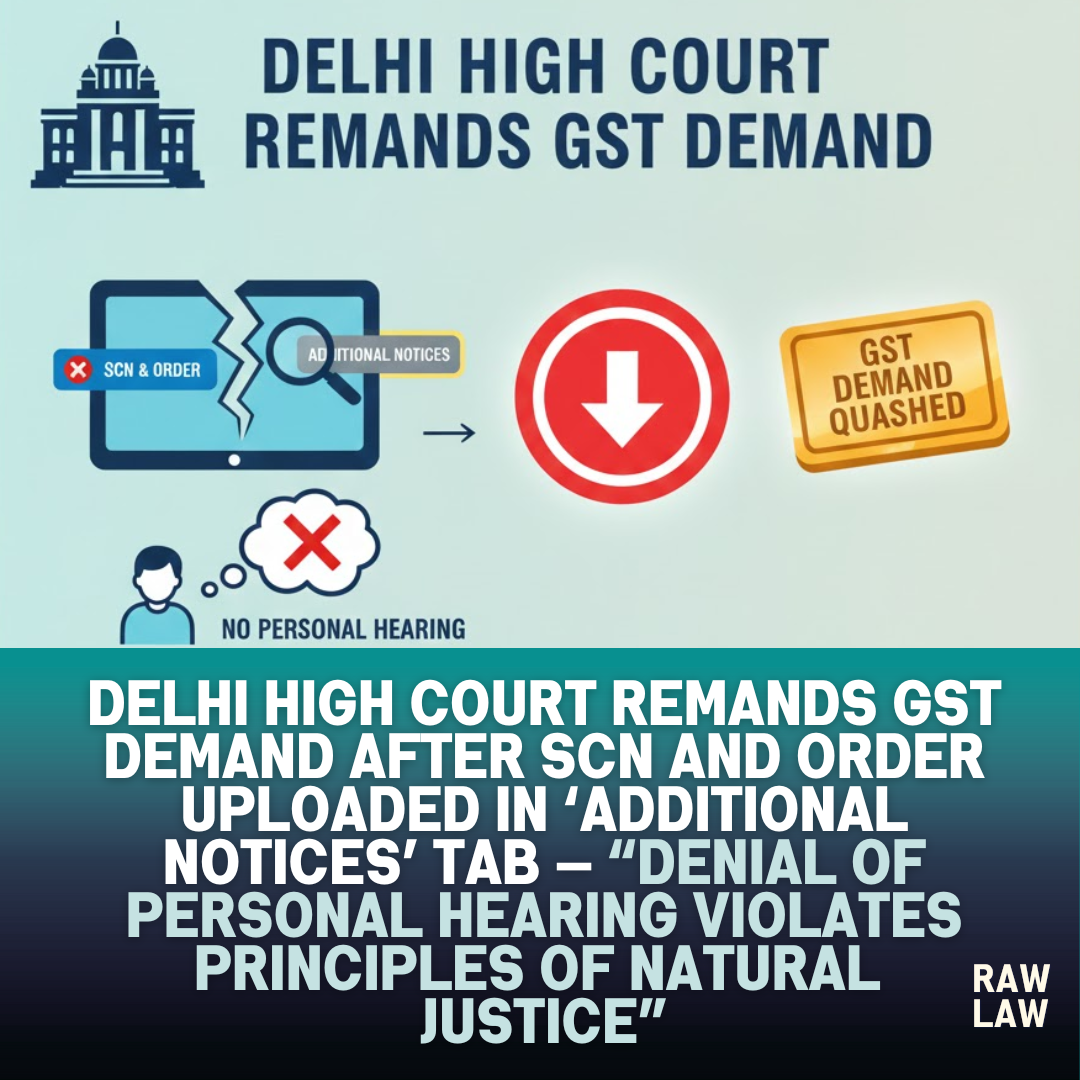
Delhi High Court remands GST demand after SCN and order uploaded in ‘Additional Notices’ tab — denial of personal hearing violates principles of natural justice

Headnote
Central Goods and Services Tax Act, 2017 – Section 73 – Section 168A – Show cause notice – Adjudication order – Limitation extension notifications – GST portal “Additional Notices” tab – Personal hearing – Natural justice – Remand.
Held, where a show cause notice and adjudication order are uploaded only under the “Additional Notices” tab on the GST portal, without fixing a date for personal hearing or effectively communicating the proceedings to the assessee, the resulting demand order is vitiated for violation of principles of natural justice. Even if replies were filed, absence of a clear hearing opportunity renders the adjudication unsustainable. In cases where substantial tax demands and penalties are imposed ex parte, courts must intervene to ensure procedural fairness. While the constitutional validity of limitation-extension notifications issued under Section 168A CGST Act remains pending before the Supreme Court amid conflicting High Court views, adjudication orders passed during the interregnum must still comply with due process. The Court set aside the demand, remanded the matter for fresh adjudication, and directed effective service of hearing notices, leaving the question of vires of the impugned notifications open and subject to the Supreme Court’s final decision.
Court’s decision
The Delhi High Court set aside a GST demand order passed against a proprietary concern for the tax period July 2017 to March 2018, holding that the assessee had been denied a proper opportunity of personal hearing. The Court remanded the matter to the adjudicating authority, directing fresh consideration after granting effective notice and hearing. The challenge to the validity of limitation-extension notifications was kept open and made subject to the outcome of pending proceedings before the Supreme Court of India.
Facts
The petitioner, a proprietary firm engaged in the business of alloys, challenged a show cause notice dated September 23, 2023 and a consequent demand order dated December 26, 2023 issued under the GST regime. The demand pertained to the period July 2017 to March 2018 and included tax, interest, and penalty.
Apart from assailing the demand on procedural grounds, the petitioner also challenged the validity of multiple Central and State notifications issued in 2023 and 2024 extending limitation for adjudication under Section 168A of the CGST Act. These notifications had already been subjected to scrutiny by several High Courts, with divergent outcomes, and were pending consideration before the Supreme Court.
On facts, the petitioner contended that although replies to the show cause notice were filed, no date for personal hearing was specified. Both the show cause notice and the final order were uploaded only under the “Additional Notices” tab on the GST portal, resulting in lack of effective communication.
Issues
The Court was required to examine whether the impugned demand order was liable to be set aside for violation of principles of natural justice, particularly denial of personal hearing and ineffective service of notices, and whether relief could be granted without adjudicating upon the constitutional validity of the impugned limitation-extension notifications.
Petitioner’s arguments
The petitioner argued that the show cause notice did not specify any date for personal hearing and that the column meant for such hearing was left blank. It was contended that both the notice and the adjudication order were uploaded under the “Additional Notices” tab on the GST portal, which at the relevant time was not prominently visible to taxpayers. As a result, the petitioner was unaware of the adjudication proceedings and was denied an effective opportunity to present its case. The petitioner relied on earlier Delhi High Court decisions where similar orders had been set aside on identical grounds.
Respondent’s arguments
The tax authorities relied on the statutory framework and contended that notices were duly uploaded on the GST portal and replies had been received. It was urged that subsequent changes had been made to the portal making the “Additional Notices” tab more visible. The respondents also relied on the impugned notifications extending limitation, asserting that the adjudication was within extended timelines.
Analysis of the law
The Court reiterated that adherence to principles of natural justice is mandatory in tax adjudication, irrespective of statutory timelines or portal mechanics. Effective communication of notices and grant of personal hearing are integral to fair adjudication, especially where substantial demands and penalties are imposed.
On the issue of limitation-extension notifications, the Court noted the cleavage of judicial opinion across High Courts and the pendency of the matter before the Supreme Court. In such circumstances, the Court deemed it appropriate to avoid ruling on the vires of the notifications and instead focus on procedural infirmities vitiating the impugned order.
Precedent analysis
The Bench relied on earlier Delhi High Court rulings in Satish Chand Mittal v. Sales Tax Officer, Anant Wire Industries v. Sales Tax Officer, and Neelgiri Machinery v. Commissioner of Delhi GST, where demand orders were set aside after finding that notices uploaded only under the “Additional Notices” tab denied effective opportunity of hearing. The Court also took note of the Punjab and Haryana High Court’s approach of deferring to the Supreme Court on the vires of Section 168A notifications.
Court’s reasoning
The Court found that the impugned show cause notice and order were issued before changes were made to improve portal visibility. There was no dispute that no clear personal hearing date was fixed. Given that the order had been passed without ensuring effective notice and hearing, the adjudication was held unsustainable. The Court emphasised that procedural fairness cannot be sacrificed even when statutory extensions are invoked.
Conclusion
Allowing the writ petition, the High Court set aside the GST demand order and remanded the matter to the adjudicating authority for fresh consideration. The petitioner was granted time to file a detailed reply, and the authority was directed to issue personal hearing notices through email and other effective modes.
Implications
The judgment strengthens procedural safeguards for taxpayers facing GST adjudication. It underscores that portal-based communication must be meaningful and that denial of hearing will vitiate demand orders. The ruling also reflects judicial restraint by leaving the contentious issue of limitation-extension notifications to the Supreme Court, while ensuring interim relief through remand.
Case-law references
- Satish Chand Mittal v. Sales Tax Officer SGST – Demand set aside due to ineffective portal notice.
- Anant Wire Industries v. Sales Tax Officer – Remand ordered for denial of personal hearing.
- Neelgiri Machinery v. Commissioner of Delhi GST – Emphasised fair opportunity in GST adjudication.
- M/s HCC-SEW-MEIL-AAG JV v. Assistant Commissioner of State Tax – Pending Supreme Court challenge to Section 168A notifications.
FAQs
1. Can GST demand orders be set aside for portal communication defects?
Yes, if notices are not effectively communicated and personal hearing is denied, courts may set aside such orders.
2. Is the validity of GST limitation-extension notifications settled?
No. The issue is pending before the Supreme Court due to conflicting High Court judgments.
3. What relief do courts usually grant in such cases?
Courts generally remand the matter for fresh adjudication after granting a proper opportunity of hearing.