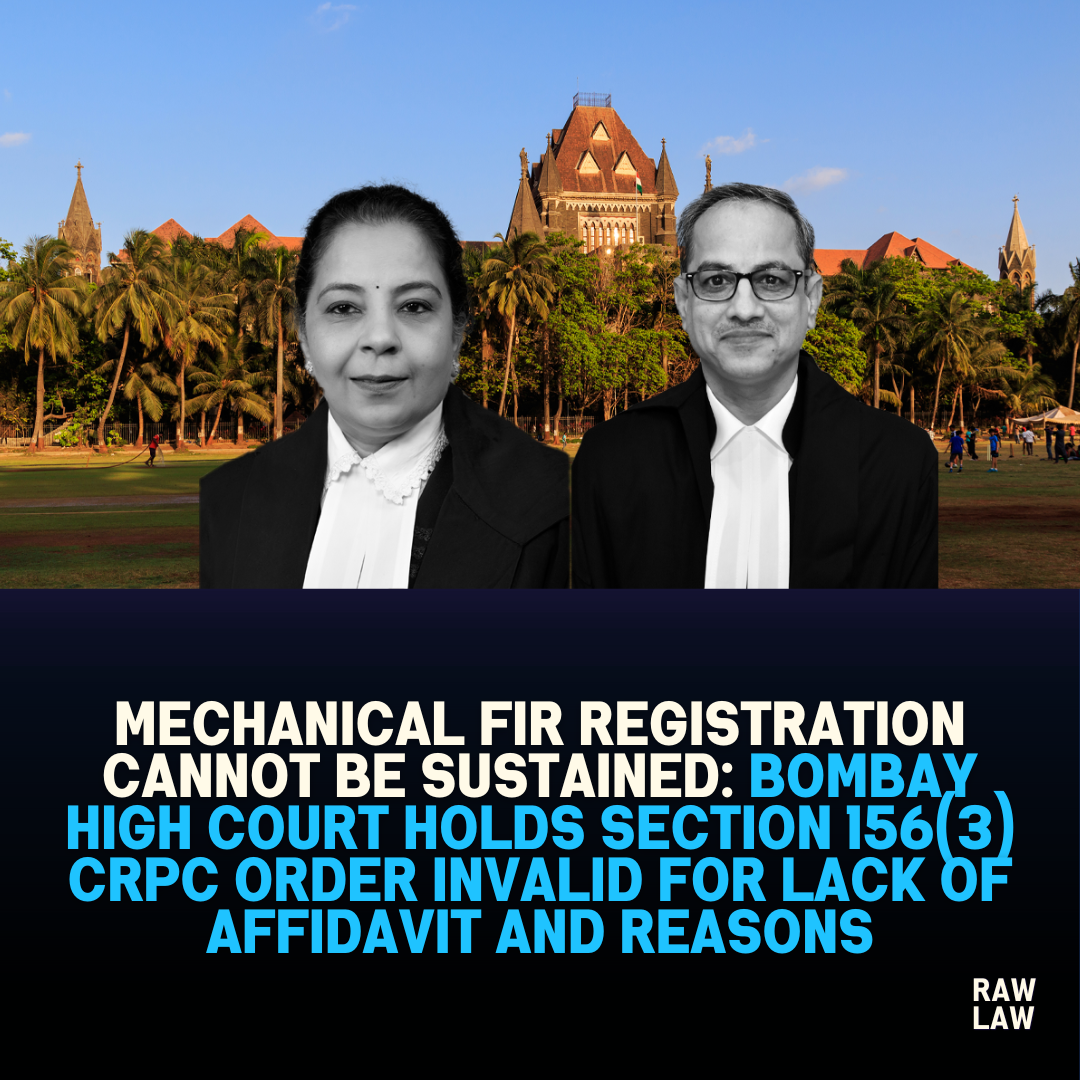
Mechanical FIR Registration Cannot Be Sustained: Bombay High Court Holds Section 156(3) CrPC Order Invalid for Lack of Affidavit and Reasons

Court’s Decision
The Bombay High Court allowed the criminal writ petition and quashed both the order passed by the Additional Sessions Judge under Section 156(3) CrPC and the consequent FIR registered against the petitioners. The Court held that the trial court had acted mechanically, without recording reasons or ensuring compliance with mandatory procedural safeguards laid down by the Supreme Court.
Facts of the Case
The respondent-complainant approached the Additional Sessions Judge, Pune, by filing a Criminal Miscellaneous Application seeking directions under Section 156(3) CrPC for registration of an FIR against the petitioners, who were police personnel. The allegations included offences under the Scheduled Castes and Scheduled Tribes (Prevention of Atrocities) Act, 1989 and various provisions of the IPC, alleging caste-based abuse, criminal intimidation, and conspiracy.
The trial court, by an order dated 26 September 2019, directed investigation under Section 156(3) CrPC, pursuant to which an FIR came to be registered at Hadapsar Police Station. The petitioners challenged both the order and the FIR before the High Court.
Issues
- Whether the Magistrate could direct investigation under Section 156(3) CrPC without ensuring compliance with Section 154(3) CrPC.
- Whether an order under Section 156(3) CrPC can be passed mechanically without recording reasons.
- Whether continuation of the FIR in such circumstances would amount to abuse of process of law.
Petitioners’ Arguments
The petitioners contended that the complaint was motivated by vengeance, as the complainant’s brother was an accused in a serious criminal case and pressure was being exerted on the petitioners to drop his name. It was argued that before invoking Section 156(3) CrPC, the complainant had failed to exhaust the remedy under Section 154(3) CrPC, and that the application was not supported by a sworn affidavit as mandated by the Supreme Court in Priyanka Srivastava. The trial court, it was submitted, failed to apply its mind or record reasons while passing the impugned order.
Respondents’ Arguments
The State and the complainant supported the impugned order, contending that serious cognizable offences were disclosed and that the trial court had rightly exercised its discretion in directing investigation.
Court’s Analysis and Reasoning
The High Court undertook a detailed examination of the law governing Section 156(3) CrPC and reiterated that prior compliance with Sections 154(1) and 154(3) CrPC is mandatory before a Magistrate can be approached. Relying on the Supreme Court’s decision in Priyanka Srivastava v. State of U.P. and its own earlier ruling in Sayed Anwar Ahmed v. State of Maharashtra, the Court emphasised that a Magistrate must not act mechanically while directing registration of an FIR.
The Bench noted that the impugned order merely stated that “considering the nature of the offence” investigation was required, without recording any reasons demonstrating application of mind. The order did not indicate how the Magistrate was satisfied about the veracity of allegations, nor did it address relevant factors such as delay, background of the dispute, or compliance with statutory prerequisites.
The Court further held that the absence of a sworn affidavit in support of the application under Section 156(3) CrPC was a fatal defect, as the affidavit requirement is intended to prevent misuse of criminal process.
Court’s Ultimate Holding
The Bombay High Court held that the trial court’s order directing investigation under Section 156(3) CrPC was unsustainable in law, having been passed mechanically and in violation of settled legal principles. Consequently, the continuation of the FIR was held to be an abuse of the process of law.
Accordingly, the Court quashed and set aside:
- the order dated 26 September 2019 passed by the Additional Sessions Judge, Pune, and
- the consequential FIR registered at Hadapsar Police Station.
Implications
This judgment reinforces strict judicial discipline in matters involving Section 156(3) CrPC, particularly where allegations are made against public servants or involve special statutes like the SC/ST Act. It reiterates that criminal law cannot be set in motion casually or as a tool of vendetta, and that Magistrates must record reasons and ensure statutory compliance before directing investigation. The ruling serves as an important safeguard against misuse of criminal process and mechanical FIR registration.