

Headnote
Trade Marks Act, 1999 – Sections 27, 29 – Infringement and passing off – Fraudulent domain names – Cyber-enabled financial fraud – Domain Name Registrars – Privacy protect services – Dynamic and Dynamic Plus injunctions – Intermediary obligations – Role of banks and regulators.
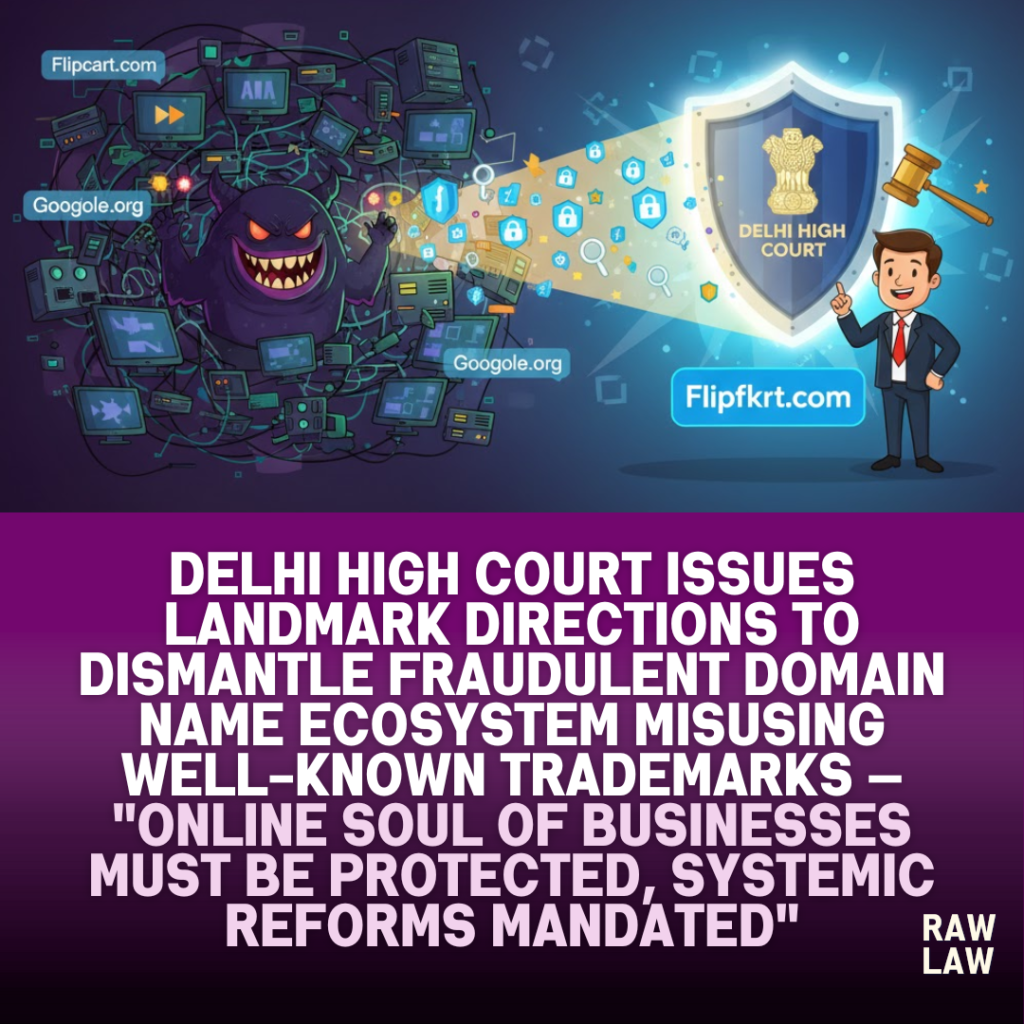
Held, rampant misuse of well-known trademarks through deceptive domain names and fake websites is not merely a private intellectual property dispute but a large-scale cyber fraud affecting unsuspecting consumers. Domain names constitute the “online soul” of a business, and impersonation through infringing domains erodes brand goodwill while enabling organised cheating. Domain Name Registrars cannot function as passive intermediaries when their systems are repeatedly exploited; they owe due diligence obligations, including disclosure of registrant data, disabling misuse of privacy-protect services, and compliance with court orders. Conventional injunctions are inadequate to address serial registrations, necessitating dynamic and dynamic plus injunctions to prevent re-registration of infringing domains. Banks, regulators, law enforcement agencies, and internet authorities must act in coordination to freeze fraudulent accounts, ensure swift information sharing, and prevent recurrence. The Court issued comprehensive, binding directions to registrars, registry operators, banks, RBI, MeitY, DoT, and police authorities, recognising consumer protection as central to trademark enforcement.
Court’s decision
The Delhi High Court finally disposed of a batch of commercial suits led by Dabur India Limited, granting permanent injunctions against infringing domain names and issuing extensive systemic directions to curb misuse of trademarks through fraudulent websites. The Court upheld the use of dynamic and dynamic plus injunctions, directed strict compliance by Domain Name Registrars, mandated cooperation by banks and regulators, and framed a coordinated enforcement mechanism involving multiple government agencies.
Facts
The plaintiff, a century-old Indian brand with extensive goodwill in the trademark “DABUR”, approached the Court after discovering multiple domain names impersonating it. These domains hosted deceptive websites falsely offering distributorships, franchises, employment, and business opportunities. Members of the public were induced to deposit money into bank accounts fraudulently represented as belonging to the plaintiff.
The registrants of the infringing domain names concealed their identities using fictitious details, disposable email IDs, and “privacy protect” services offered by Domain Name Registrars. Even after interim injunctions were passed and domains were blocked, new infringing domains were repeatedly registered, revealing a coordinated and recurring pattern of cyber fraud. Given the scale of the problem, the Court clubbed several similar suits by different brand owners to address systemic failures.
Issues
The Court examined the obligations of Domain Name Registrars and registry operators, the legality and misuse of privacy-protect services, effectiveness of traditional injunctions, scope of dynamic and dynamic plus injunctions, duties of banks in responding to cyber fraud, and the role of regulators and law enforcement agencies in preventing and investigating online financial fraud.
Plaintiff’s arguments
The plaintiff argued that domain names are integral to brand identity and consumer trust, and their misuse facilitates large-scale fraud. It contended that existing remedies like UDRP were ineffective against serial infringers. The plaintiff sought permanent injunctions, disclosure of registrant details, freezing of linked bank accounts, blocking of websites, and broader systemic directions to prevent repeated abuse. Emphasis was placed on public interest, consumer protection, and the need for accountability of intermediaries.
Defendants’ arguments
Domain Name Registrars and intermediaries claimed safe harbour protection and asserted that they merely provide technical services. They resisted blanket injunctions, citing potential impact on legitimate users. Banks and government authorities highlighted regulatory constraints and operational difficulties, urging judicial restraint in issuing policy-like directions.
Analysis of the law
The Court undertook an exhaustive analysis of the Domain Name System, intermediary liability, trademark rights in domain names, and the intersection of intellectual property law with cybercrime regulation. It held that registrars, though intermediaries, cannot ignore repeated misuse of their platforms. Privacy-protect services cannot be allowed to shield fraudsters or override court orders. Trademark enforcement was held to extend beyond private rights to encompass consumer protection and prevention of economic offences.
Precedent analysis
The Court relied on earlier Delhi High Court decisions recognising domain names as protectable identifiers and approving dynamic injunctions. It distinguished cases cautioning against blanket blocking by emphasising the targeted, evidence-based approach adopted here. Supreme Court jurisprudence on intermediary due diligence and evolving remedies in the digital era was also applied.
Court’s reasoning
The Court found that fraudulent domain registrations represent a sophisticated cybercrime ecosystem involving registrars, hosting services, payment systems, and identity misuse. Passive compliance after fraud has occurred was held insufficient. Given the repeated re-registration of infringing domains, the Court held that dynamic and dynamic plus injunctions are necessary and proportionate. Coordinated action by banks, regulators, and law enforcement was found essential to prevent dissipation of fraud proceeds and to protect consumers.
Conclusion
Permanent injunctions were granted against infringing domain names. The Court issued comprehensive directions to Domain Name Registrars, registry operators, banks, RBI, MeitY, DoT, and police authorities, institutionalising mechanisms for verification, disclosure, blocking, freezing of accounts, and inter-agency coordination.
Implications
This judgment marks a watershed in Indian intellectual property and cyber law. It elevates trademark misuse through domain names from a private dispute to a systemic public harm issue, strengthens consumer protection, and reshapes obligations of digital intermediaries. The ruling is likely to significantly influence registrar practices, banking responses to cyber fraud, and enforcement strategies nationwide.
Case-law references
- Snapdeal Pvt. Ltd. v. GoDaddy.com LLC – Limits on indiscriminate domain blocking.
- Sony Interactive Entertainment v. Vikash Kumar – Court-approved domain blocking for infringement.
- Fashnear Technologies Pvt. Ltd. v. Meesho Online Shopping Pvt. Ltd. – Consolidated approach to domain name fraud.
FAQs
1. What is a dynamic plus injunction?
It prevents infringing domain names from being re-registered after suspension or expiry, stopping serial abuse.
2. Are Domain Name Registrars responsible for fraud?
They are intermediaries but must exercise due diligence and comply with court directions to prevent misuse.
3. Why is this judgment important for consumers?
It targets the infrastructure enabling online fraud, ensuring faster blocking of fake websites and freezing of fraudulent accounts.


