

HEADNOTE
Om Prakash v. Brahm Singh
Court: High Court of Delhi
Bench: Justice Girish Kathpalia
Date of Judgment: 12 December 2025
Citation: CM(M) 2416/2025
Laws / Sections Involved: Order VI Rule 17 CPC; Proviso to Order VI Rule 17 CPC; Articles 226 and 227 Constitution of India
Keywords: Amendment of written statement, due diligence test, commencement of trial, civil procedure, supervisory jurisdiction
Summary:
The Delhi High Court dismissed a petition challenging the rejection of an application seeking amendment of a written statement after commencement of trial, reiterating the strict application of the “due diligence” requirement under the proviso to Order VI Rule 17 CPC. The Court held that once trial has commenced, amendments are permissible only if the party demonstrates that despite due diligence, the plea could not have been raised earlier. In the present case, the defendant sought to incorporate references to two writ petitions filed before the High Court, but failed to disclose when and how he became aware of those proceedings. The Court found a complete absence of pleadings demonstrating due diligence and held that allowing the amendment at such an advanced stage would seriously prejudice the plaintiff, whose evidence had already concluded. Upholding the trial court’s order, the High Court dismissed the petition as meritless.
Court’s decision
The Delhi High Court dismissed the petition filed under Article 227 of the Constitution and upheld the trial court’s order dated 19 November 2025 rejecting the defendant’s application for amendment of the written statement. The Court held that the amendment application was squarely barred by the proviso to Order VI Rule 17 CPC, as the trial had already commenced and the defendant failed to establish that despite due diligence, the proposed pleas could not have been raised earlier. Finding no perversity or jurisdictional error in the impugned order, the Court declined to issue notice and dismissed the petition along with all pending applications.
Facts
The petitioner was the defendant in a civil suit where the written statement was filed on 4 August 2023. Issues were framed on 1 February 2024, and the trial commenced on 9 April 2024. The plaintiff led evidence by examining six witnesses, after which the matter reached the stage of recording the defendant’s evidence. At this advanced stage, on 7 July 2025, the defendant filed an application under Order VI Rule 17 CPC seeking to amend the written statement to incorporate references to two writ petitions allegedly connected with the subject matter of the suit. These writ petitions had been filed on 19 December 2023 and 15 March 2024, i.e., prior to framing of issues and commencement of trial. The trial court dismissed the amendment application, prompting the present petition.
Issues
The central issue before the High Court was whether the defendant was entitled to amend his written statement after commencement of trial by invoking Order VI Rule 17 CPC. The Court was required to examine whether the defendant had satisfied the mandatory requirement of demonstrating “due diligence” under the proviso to Order VI Rule 17 CPC. A further issue was whether permitting such amendment at the stage of defendant’s evidence would cause prejudice to the plaintiff and derail the trial process.
Petitioner’s arguments
The petitioner contended that the trial court had misapplied the proviso to Order VI Rule 17 CPC by overstretching the concept of due diligence. It was argued that the defendant was not a party to the two writ petitions sought to be incorporated and therefore could not reasonably be expected to monitor proceedings to which he was not impleaded. According to the petitioner, since the writ petitions were filed after submission of the written statement, the amendment could not have been sought earlier. It was further argued that refusal of amendment would prevent proper adjudication of the real controversy between the parties.
Respondent’s arguments
The respondent did not enter appearance before the High Court. However, the reasoning adopted by the trial court, which was upheld by the High Court, reflected the respondent’s implicit position that the amendment was highly belated and lacked bona fide justification. The trial court had found that the defendant failed to explain why the amendment was not sought prior to commencement of trial, despite the writ petitions having been instituted well before that stage. It was also noted that allowing the amendment would cause serious prejudice to the plaintiff, whose evidence had already concluded.
Analysis of the law
The High Court examined the scope and object of Order VI Rule 17 CPC, with particular emphasis on the proviso inserted by the 2002 amendment. The Court reiterated that while pleadings may generally be amended “at any stage of the proceedings,” the proviso significantly curtails this power once trial has commenced. At that stage, the court must be satisfied that despite due diligence, the party seeking amendment could not have raised the matter earlier. The burden to plead and prove due diligence lies squarely on the applicant. Mere assertion that facts arose later is insufficient unless it is demonstrated that the amendment could not reasonably have been sought prior to commencement of trial.
Precedent analysis
The Court relied heavily on its recent judgment in Trans Asian Industries Expositions Pvt. Ltd. v. G.S. Berar & Co. Pvt. Ltd., where it was held that after commencement of trial, delay becomes secondary and due diligence becomes the decisive factor. Reference was also made to Supreme Court decisions in Chander Kanta Bansal v. Rajinder Singh Anand and Basavaraj v. Indira, which underscore that the proviso to Order VI Rule 17 CPC is not a mere formality but a substantive restriction designed to prevent protraction of trials and abuse of process.
Court’s reasoning
Justice Girish Kathpalia noted that although the defendant could not have mentioned the writ petitions in the originally filed written statement, that alone was not sufficient to bypass the proviso to Order VI Rule 17 CPC. The critical question was whether the defendant, exercising due diligence, could have sought amendment prior to commencement of trial. The Court found that the defendant failed to disclose when and how he became aware of the writ petitions. There was not even a whisper in the amendment application to show that despite due diligence, the plea could not have been raised earlier. The Court further observed that allowing the amendment would cause serious prejudice to the plaintiff, who had already completed evidence, and would inevitably lead to reopening of pleadings, issues, and evidence, resulting in undue delay.
Conclusion
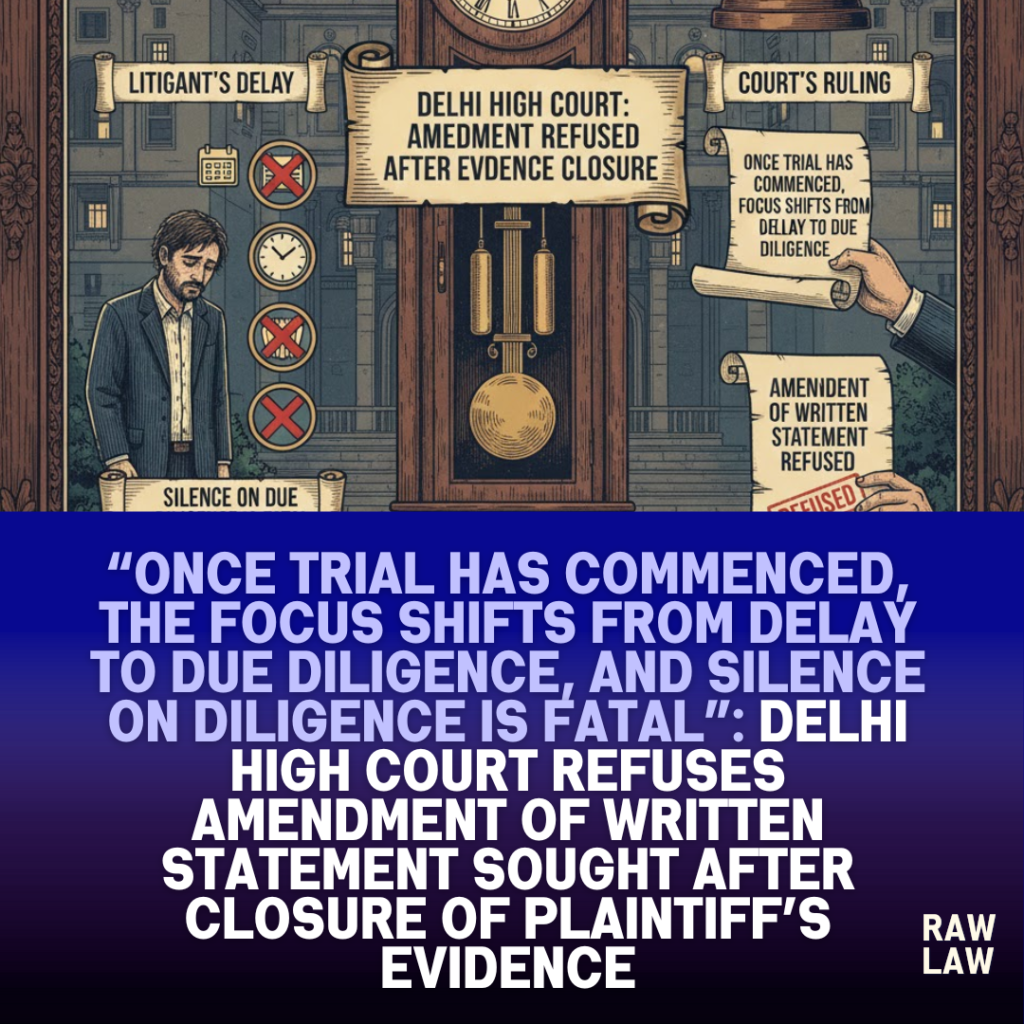
The Delhi High Court concluded that the trial court committed no error in rejecting the amendment application. The petition was dismissed at the threshold without issuance of notice, and the impugned order was upheld in full. The Court reaffirmed that silence on due diligence is fatal to an amendment application filed after commencement of trial.
Implications
This judgment reinforces the rigorous application of the proviso to Order VI Rule 17 CPC and serves as a cautionary reminder that parties must be vigilant and proactive in raising all relevant pleas before commencement of trial. It clarifies that subsequent developments do not automatically justify belated amendments unless accompanied by a clear and convincing demonstration of due diligence. The ruling promotes procedural discipline, prevents tactical delays, and strengthens trial efficiency by discouraging late-stage reshaping of pleadings.
CASE LAW REFERENCES
• Trans Asian Industries Expositions Pvt. Ltd. v. G.S. Berar & Co. Pvt. Ltd. – Due diligence is decisive once trial commences
• Chander Kanta Bansal v. Rajinder Singh Anand – Proviso to Order VI Rule 17 CPC is mandatory
• Basavaraj v. Indira – Belated amendments barred without due diligence
FAQs
Q1. Can pleadings be amended after commencement of trial?
Yes, but only if the party shows that despite due diligence, the amendment could not have been sought earlier.
Q2. Is delay alone a ground to reject amendment?
After commencement of trial, the decisive factor is due diligence, not mere delay.
Q3. What happens if amendment is allowed at a late stage?
It may cause prejudice by reopening pleadings, issues, and evidence, which courts seek to avoid.


