

Court’s decision
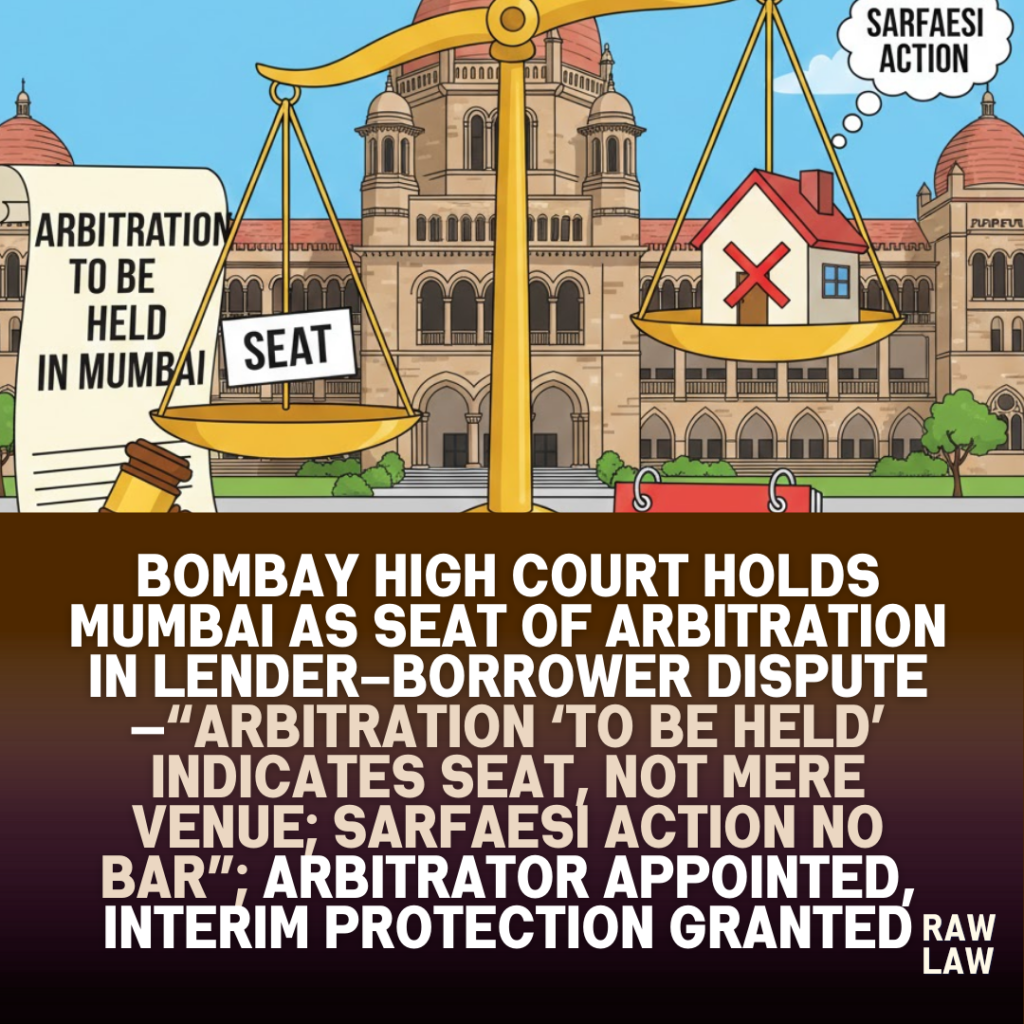
The Bombay High Court (Ordinary Original Civil Jurisdiction) allowed a lender’s application for appointment of an arbitrator under Section 11 of the Arbitration and Conciliation Act, 1996, and also granted interim reliefs under Section 9. The Court held that where an arbitration clause stipulates that arbitration is “to be held” at specified cities, such stipulation denotes the seat of arbitration and not a mere venue. Choosing Mumbai as one of the agreed places conferred exclusive jurisdiction on the Bombay High Court. The Court further ruled that initiation of proceedings under the SARFAESI Act does not bar invocation of arbitration or grant of interim measures. Objections on non-invocation, jurisdiction, arbitrability, and limitation were rejected.
Facts
The petitioner is a housing finance company which sanctioned a home equity loan of ₹2.24 crore to the respondents under a loan agreement dated 27 November 2019. The loan was secured by creation of an equitable mortgage over land situated at Tatibandh, Raipur, Chhattisgarh. A memorandum of entry was executed in favour of the lender.
Upon the respondents’ request, the loan was restructured in June 2021, enhancing the outstanding to ₹2.34 crore. The respondents thereafter defaulted in repayment, resulting in classification of the account as a non-performing asset. Demand notices were issued under the SARFAESI Act, followed by an order under Section 14 by the District Magistrate, Raipur, for taking physical possession of the mortgaged property.
The lender contended that physical possession could not be taken due to amalgamation and lack of demarcation of the mortgaged land. A loan recall and arbitration invocation notice dated 27 May 2025 was issued. The respondents, in parallel, approached the Debts Recovery Tribunal challenging SARFAESI measures. In this backdrop, the lender approached the Bombay High Court seeking appointment of an arbitrator and interim measures.
Issues
The Court considered four principal issues: whether there was valid invocation of arbitration under Section 21; whether the Bombay High Court had territorial jurisdiction; whether arbitration and interim relief were barred due to prior SARFAESI proceedings; and whether the lender’s claims were barred by limitation.
Petitioner’s arguments
The lender argued that the notice dated 27 May 2025 constituted a valid request for reference of disputes to arbitration under Section 21. It was submitted that the arbitration clause empowered the lender to choose one of four cities for arbitration, and once Mumbai was chosen, it became the seat of arbitration, conferring jurisdiction on the Bombay High Court.
It was further contended that SARFAESI proceedings are enforcement mechanisms and do not preclude adjudication of disputes through arbitration. The lender emphasised that interim measures were necessary since the mortgaged land could not be demarcated and possession could not be effectively taken despite orders under the SARFAESI Act. On limitation, it was argued that default was continuing and the claim was well within time.
Respondents’ arguments
The borrowers opposed the proceedings contending that the notice did not validly invoke arbitration, as it did not call upon them to participate in appointment of an arbitrator. They argued that the arbitration clause only specified convenient venues and not a juridical seat, and therefore jurisdiction lay with courts in Chhattisgarh where the property and cause of action were located.
It was further submitted that once SARFAESI proceedings had been initiated and contested before the DRT, the lender was estopped from invoking arbitration. Reliance was placed on judgments suggesting that bank claims falling within the DRT regime are non-arbitrable. The respondents also raised a plea of limitation, asserting that the cause of action arose upon classification of the account as NPA.
Analysis of the law
The Court analysed Section 21 of the Arbitration Act and held that it merely determines commencement of arbitration for limitation purposes. A formal or ritualistic notice is not mandatory. The lender’s notice clearly conveyed that disputes would be referred to arbitration upon non-payment, which was sufficient.
On jurisdiction, the Court examined Section 20 of the Arbitration Act and distinguished between “seat” and “venue”. It held that the expression “arbitration to be held in Mumbai/Delhi/Kolkata/Chennai” indicates anchoring of arbitral proceedings to those places. Unlike clauses referring to “sittings” or “meetings”, the language used reflected party intention to designate seats.
Precedent analysis
The Court relied on the Supreme Court’s decision in BGS SGS Soma v. NHPC to reiterate that where arbitration proceedings are stated to be “held” at a place, that place is the seat. It distinguished Ravi Ranjan Developers, noting that in that case the clause referred only to “sittings” of the tribunal and parties’ conduct also indicated absence of a seat.
The Court also relied on recent Supreme Court authority holding that non-issuance or defective issuance of a Section 21 notice is not fatal if the claim is otherwise arbitrable. On SARFAESI, it followed settled law that enforcement remedies do not bar arbitration, as the two operate in distinct spheres.
Court’s reasoning
Applying these principles, the Court held that Mumbai was one of the agreed seats and, once chosen by the lender, conferred exclusive jurisdiction on the Bombay High Court. The objection to territorial jurisdiction was therefore rejected.
The Court further held that initiation of SARFAESI proceedings does not amount to waiver of arbitration, nor does it render disputes non-arbitrable. On limitation, the Court observed that the issue involved mixed questions of law and fact and could not be conclusively decided at the Section 11 stage.
Given the admitted defaults, subsisting security, and inability to demarcate the mortgaged property, the Court found it appropriate to grant interim protection by appointing a Court Receiver and restraining alienation.
Conclusion
The Bombay High Court appointed a sole arbitrator to adjudicate disputes arising out of the loan agreement and granted interim measures protecting the secured asset. All objections raised by the borrowers were rejected, and the Court affirmed Mumbai as the seat of arbitration.
Implications
This judgment provides significant clarity on arbitration clauses that specify multiple places. It reinforces that the phrase “arbitration to be held” denotes seat, not venue, and that party autonomy in choosing the seat will be respected. The ruling also reaffirms that lenders may simultaneously pursue SARFAESI remedies and arbitration, ensuring both enforcement and adjudication mechanisms remain available.
Case law references
- BGS SGS Soma v. NHPC: Held that where arbitration proceedings are stated to be “held” at a place, that place constitutes the seat of arbitration.
- Ravi Ranjan Developers v. Aditya Kumar Chatterjee: Distinguished; clause there referred only to sittings and parties’ conduct negated intention to designate a seat.
- Bhagheeratha Engineering v. State of Kerala: Held that non-issuance of a Section 21 notice is not fatal if claims are otherwise arbitrable.
- M.D. Frozen Foods Exports v. Hero Fincorp: Relied upon for the principle that SARFAESI proceedings do not bar arbitration.
FAQs
Does “arbitration to be held” indicate seat or venue?
It indicates the seat of arbitration, conferring exclusive jurisdiction on courts of that place.
Can a lender invoke arbitration after starting SARFAESI proceedings?
Yes. SARFAESI proceedings are enforcement mechanisms and do not bar arbitration.
Is a detailed Section 21 notice mandatory to invoke arbitration?
No. A clear request indicating reference of disputes to arbitration is sufficient.


