

1. Court’s decision
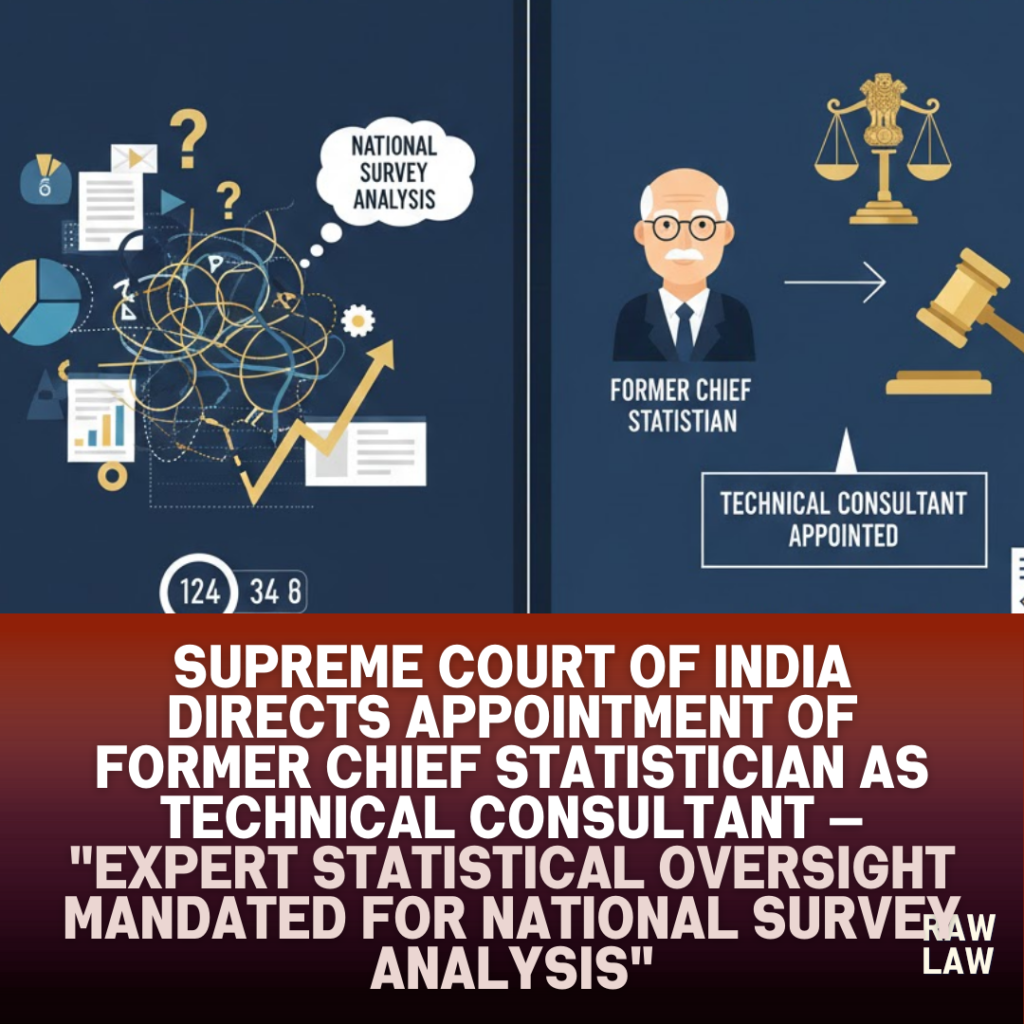
The Supreme Court of India, exercising its criminal appellate jurisdiction, allowed an interlocutory application and directed the appointment of a former Chief Statistician of India as Technical Consultant to a National Task Force. The Court held that comprehensive and scientific analysis of survey data required independent, high-level statistical expertise and mandated the Union Government, through the Ministry of Education, to extend full administrative support and remuneration.
2. Facts
The interlocutory application arose in a pending criminal appeal before the Supreme Court. The applicants sought directions for strengthening the technical capacity of a National Task Force constituted to analyse survey data of national importance. Specifically, they prayed for the appointment of a former Chief Statistician of India as Technical Consultant and for corresponding directions to the Ministry of Education to provide infrastructure, access to data, and appropriate honorarium. The application was heard with the assistance of an Amicus Curiae and the Additional Solicitor General representing the Union of India.
3. Issues
The primary issue before the Court was whether, in the interests of justice and effective adjudication, it was necessary to appoint an independent technical expert of national standing to assist a National Task Force in conducting a comprehensive and scientific analysis of survey data, and whether binding directions should be issued to the executive for administrative and financial support.
4. Petitioners’ arguments
The applicants, through the Amicus Curiae, argued that the survey data in question had significant implications and required rigorous, unbiased, and scientifically sound analysis. It was contended that such an exercise could not be left solely to routine administrative mechanisms. The appointment of a former Chief Statistician of India was urged as essential to ensure credibility, methodological rigor, and public confidence in the findings of the National Task Force.
5. Respondent’s arguments
The Union of India, represented by the Additional Solicitor General, participated in the hearing and addressed the feasibility of the proposed directions. While the detailed objections, if any, were not elaborated in the short order, the presence of the Union’s senior law officer reflected engagement with the Court on the modalities of appointment, administrative support, and compliance with governmental norms for remuneration and infrastructure.
6. Analysis of the law
The Court’s power to issue such directions flows from its broad constitutional and appellate jurisdiction, particularly when ancillary or interlocutory orders are necessary to ensure effective adjudication. Indian constitutional jurisprudence recognises that courts may appoint experts or direct expert assistance where specialised knowledge is required. In matters involving technical or scientific data, judicial reliance on domain experts is considered integral to informed decision-making.
7. Precedent analysis
Although the order does not expressly cite earlier case law, it aligns with established practice where the Supreme Court has constituted committees, monitoring bodies, and expert groups to assist in complex factual or technical matters. Such interventions are treated not as encroachments into executive policy, but as facilitative measures to uphold constitutional values, transparency, and fairness in adjudication.
8. Court’s reasoning
The Bench was satisfied that comprehensive and scientific analysis of survey data warranted the involvement of an eminent statistician with proven expertise. The Court therefore directly appointed the former Chief Statistician of India as Technical Consultant to the National Task Force. Recognising that such an appointment would be ineffective without institutional backing, the Court simultaneously directed the Ministry of Education to issue a formal order of appointment, provide infrastructure and data access, and ensure appropriate remuneration in accordance with prevailing norms.
9. Conclusion
The interlocutory application was disposed of with clear and binding directions. The Supreme Court ensured that the National Task Force would function with enhanced technical capacity, supported by an independent expert and full administrative cooperation from the Union Government. The order reflects a proactive judicial approach to securing scientific integrity in matters involving complex data analysis.
10. Implications
This order underscores the Supreme Court’s willingness to mandate expert-driven processes where technical complexity intersects with legal adjudication. It reinforces the principle that meaningful judicial oversight may require structured expert assistance and that executive authorities can be directed to provide logistical and financial support to court-appointed experts. The decision may serve as a reference point for future cases involving large-scale data, surveys, or technical evaluations of national importance.
Case Law References
- Present interlocutory order – The Court exercised its inherent and appellate powers to appoint an independent technical expert and bind the executive to provide support, reflecting established judicial practice in complex and technical matters.
FAQs
Q1. Can the Supreme Court appoint technical experts during ongoing cases?
Yes. The Supreme Court can appoint experts or direct expert assistance through interlocutory orders when specialised knowledge is necessary for effective adjudication.
Q2. Is the government bound to support court-appointed experts?
Yes. When the Supreme Court issues directions, the concerned ministry or authority is constitutionally obliged to provide administrative, infrastructural, and financial support as ordered.
Q3. Why was a former Chief Statistician appointed in this case?
The Court found that comprehensive and scientific analysis of sensitive survey data required independent, high-level statistical expertise to ensure credibility and rigor.


