

Court’s decision
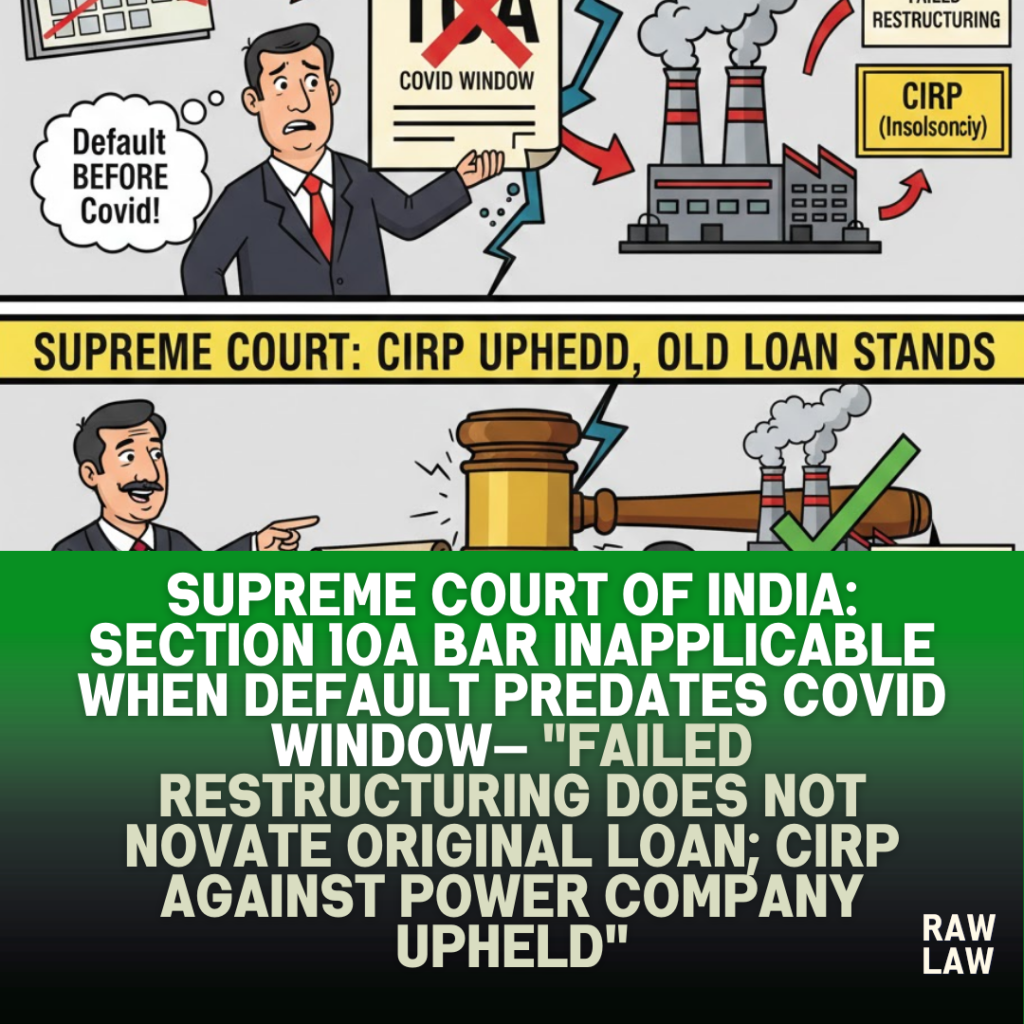
The Supreme Court of India dismissed the appeal filed by Power Trust, promoter of Hiranmaye Energy Ltd., and upheld the admission of a Section 7 application under the Insolvency and Bankruptcy Code, 2016 against the corporate debtor. The Court held that the default occurred on 31 March 2018, well before the Covid-era suspension under Section 10A, and that unfulfilled restructuring proposals did not novate the original loan agreement. It further ruled that business viability is irrelevant at the admission stage under Section 7. The stay on the Corporate Insolvency Resolution Process was vacated.
Facts
A common loan agreement dated 19 June 2013 enabled Hiranmaye Energy Ltd. to avail term loans of over ₹2,300 crore for setting up a thermal power plant at Haldia. The account was classified as non-performing on 30 June 2018 due to defaults.
Two restructuring proposals dated 21 February 2020 and 29 September 2020 were approved in principle, subject to strict pre-implementation conditions including a favourable tariff order from WBERC, creation of a Debt Service Reserve Account, infusion of priority debt, working capital support, and demonstration of operational capacity for 72 hours.
These conditions were admittedly not fulfilled within the stipulated timeline. Consequently, REC Ltd. filed a Section 7 application citing default from 31 March 2018 with outstanding dues exceeding ₹2,100 crore.
The NCLT admitted the application, the NCLAT affirmed it, and the matter reached the Supreme Court.
Issues
- Whether initiation of CIRP was barred under Section 10A as the alleged default fell within the Covid suspension period.
- Whether the restructuring proposals novated the original loan agreement.
- Whether the Adjudicating Authority ought to have examined business viability under Vidarbha Industries.
- Whether post-admission settlement proposals warranted stalling CIRP.
Appellant’s arguments
The appellant argued that the restructuring agreement reset the repayment schedule, making the first instalment due within the Section 10A period. It contended that acceptance of partial payments by the financial creditor amounted to deemed approval and novation of the loan.
Reliance was placed on Vidarbha Industries Power Ltd. v. Axis Bank Ltd. to argue that NCLT has discretion to refuse admission considering business viability. It was also submitted that the corporate debtor was a running concern with a 25-year PPA and significant billing revenue.
Finally, the appellant claimed its settlement proposal was financially superior to the approved resolution plan and deserved reconsideration.
Respondents’ arguments
The respondents submitted that restructuring never crystallised into binding agreements due to non-fulfilment of pre-implementation conditions. Therefore, the original default date remained 31 March 2018, outside Section 10A protection.
They relied on Innoventive Industries Ltd. v. ICICI Bank and M. Suresh Kumar Reddy v. Canara Bank to contend that once default is established, admission under Section 7 is mandatory.
They further argued that the commercial wisdom of the Committee of Creditors is non-justiciable and that repeated settlement proposals were rejected by overwhelming majority.
Analysis of the law
The Court clarified that Section 10A bars initiation of CIRP only for defaults occurring between 25 March 2020 and 24 March 2021. The explanation expressly excludes earlier defaults.
It found that even assuming restructuring acceptance, the second restructuring proposal subsumed the first and fixed the first instalment beyond the Section 10A window. More importantly, the restructuring failed at the threshold stage as pre-conditions were unmet, preventing novation.
The Court reaffirmed that admission under Section 7 requires only proof of financial debt and default. Business viability is not a ground to reject admission.
Precedent analysis
The Court relied upon:
- Innoventive Industries Ltd. v. ICICI Bank – Limited scope of inquiry under Section 7.
- Swiss Ribbons Pvt. Ltd. v. Union of India – Objective of IBC and classification of creditors.
- M. Suresh Kumar Reddy v. Canara Bank – Vidarbha confined to its facts.
- ES Krishnamurthy v. Bharath Hi-Tech Builders – Adjudicating Authority cannot compel settlement.
- Committee of Creditors of Essar Steel v. Satish Kumar Gupta – Commercial wisdom of CoC is paramount.
- GLAS Trust Co. LLC v. BYJU Raveendran – Post-admission withdrawal governed by Section 12A.
The Court clarified that Vidarbha does not dilute Innoventive and is fact-specific.
Court’s reasoning
The Court found that restructuring proposals were conditional and never matured due to non-fulfilment of key requirements. Acceptance of partial payments did not amount to novation or full satisfaction of debt.
It rejected arguments on viability, noting that outstanding liabilities exceeded ₹3,100 crore, far outweighing revenue figures cited.
Regarding settlement proposals, the Court observed that multiple offers were rejected by the CoC. Since a resolution plan was approved with 99.92% voting share, judicial interference would undermine commercial wisdom and time-bound resolution.
The stay granted earlier was vacated.
Conclusion
The appeal was dismissed. The admission of the Section 7 application was upheld. The stay on CIRP was vacated. An application by a secured creditor seeking release of ₹125 crore deposited as a condition of interim stay was rejected, and the amount was ordered to be refunded to the appellant.
Implications
This ruling reinforces the primacy of default date in Section 10A cases and clarifies that failed restructuring proposals do not shift default retrospectively.
It strengthens the binding authority of Innoventive Industries and curtails expansive reliance on Vidarbha. The judgment also reiterates the inviolability of the commercial wisdom of the CoC.
For infrastructure and power-sector insolvency disputes, the decision underscores that business viability cannot defeat statutory insolvency triggers.
Case Law References
- Innoventive Industries Ltd. v. ICICI Bank (2018) 1 SCC 407
- Swiss Ribbons Pvt. Ltd. v. Union of India (2019) 4 SCC 17
- Vidarbha Industries Power Ltd. v. Axis Bank Ltd. (2022) 8 SCC 352
- M. Suresh Kumar Reddy v. Canara Bank (2023) 8 SCC 387
- Committee of Creditors of Essar Steel v. Satish Kumar Gupta (2020) 8 SCC 531
- GLAS Trust Co. LLC v. BYJU Raveendran (2025) 3 SCC 625
FAQs
1. Does Section 10A apply if default occurred before 25 March 2020?
No. Section 10A bars initiation only for defaults occurring during the specified Covid window.
2. Can failed restructuring proposals novate an earlier loan?
No. Unless pre-implementation conditions are fulfilled and binding agreement crystallises, original debt terms remain operative.
3. Can courts override the commercial wisdom of the Committee of Creditors?
No. Approval or rejection of resolution plans is generally non-justiciable.


