

Court’s decision
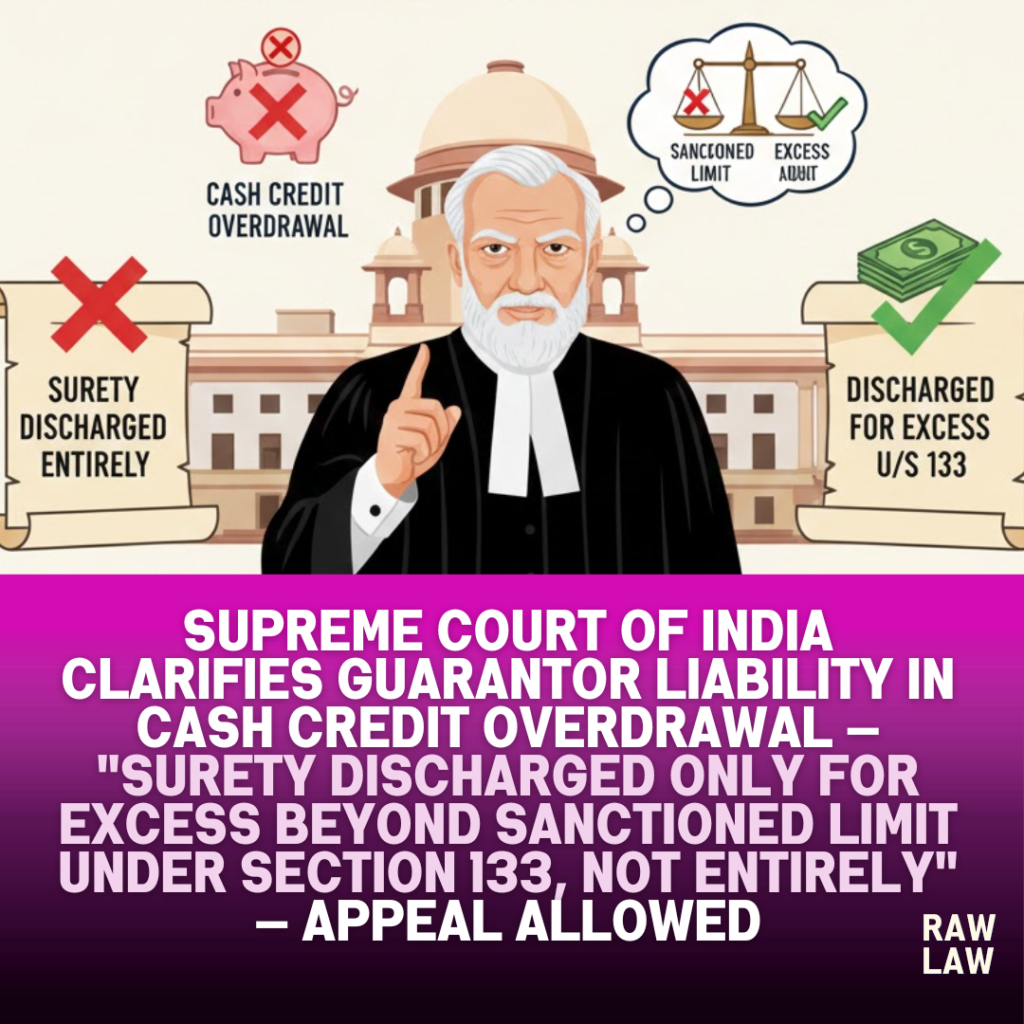
The Supreme Court of India has held that guarantors are liable only to the extent of the originally sanctioned loan amount when a creditor permits overdrawals without their consent. Interpreting Sections 133 and 139 of the Indian Contract Act, 1872, the Court ruled that a surety is discharged only in respect of transactions subsequent to an unauthorized variance in the loan terms, not from the entire liability.
Setting aside the Gujarat High Court’s decision, the Court restored the bank’s right to recover ₹4,00,000 with applicable interest from the guarantors, while exempting them from liability for excess overdrawn amounts.
Facts
A co-operative bank sanctioned a cash-credit facility of ₹4,00,000 to a trading firm in 1993. The firm’s mercantile goods were hypothecated, and two individuals executed contracts of guarantee, standing as sureties for the sanctioned amount.
Subsequently, the borrower allegedly withdrew amounts far exceeding ₹4,00,000, reportedly in connivance with certain bank officials. The borrower defaulted in repayment. The bank instituted recovery proceedings before the Board of Nominees, claiming over ₹26 lakhs with interest.
The Board decreed recovery only against the principal borrower and dismissed the claim against the sureties. On appeal, the Gujarat State Co-operative Tribunal held the sureties liable to the extent of ₹4,00,000 with interest. The Gujarat High Court reversed this, holding that guarantors must be liable for the entire debt or none at all. The bank appealed to the Supreme Court.
Issues
The principal issue before the Supreme Court was whether the sureties were entitled to complete discharge under Section 139 of the Indian Contract Act due to the bank’s act of permitting overdrawals without their knowledge.
Alternatively, the Court had to determine whether Section 133 applied, limiting the discharge only to transactions subsequent to the variance in contractual terms.
The legal question centered on whether guarantor liability in a cash-credit facility can be bifurcated between the sanctioned amount and unauthorized excess withdrawals.
Petitioner’s arguments
The appellant bank argued that the High Court misapplied the law by holding that guarantors must either be liable for the entire amount or not liable at all. It was submitted that Section 133 clearly provides that where a contract is varied without the surety’s consent, the surety is discharged only as to transactions subsequent to the variance. The bank maintained that the sureties remained liable for the originally sanctioned ₹4,00,000 with interest, as their consent extended only to that amount. Relying on precedent, the appellant emphasized that guarantor liability is co-extensive with that of the principal debtor, unless contractually limited, and that creditors are not required to exhaust remedies against borrowers before proceeding against guarantors.
Respondent’s arguments
The respondents contended that the bank’s act of allowing overdrawals without informing the guarantors fundamentally altered the contract, thereby discharging them entirely under Section 139. They argued that the creditor’s conduct impaired their eventual remedy against the principal debtor and enhanced their liability beyond the agreed limit. According to the respondents, had they been informed about the excess withdrawals, they could have taken appropriate measures. Therefore, they claimed complete discharge from liability, asserting that the High Court rightly rejected any bifurcation of responsibility.
Analysis of the law
The Court undertook a detailed analysis of Chapter VIII of the Indian Contract Act dealing with guarantees. Section 128 establishes that a surety’s liability is co-extensive with that of the principal debtor. However, Sections 133 to 139 enumerate circumstances in which a surety may be discharged.
Section 133 provides that any variance in the contract between creditor and principal debtor, made without the surety’s consent, discharges the surety as to transactions subsequent to such variance. The discharge is not absolute but limited to subsequent transactions.
Section 139, on the other hand, applies where the creditor’s act or omission impairs the surety’s eventual remedy against the principal debtor. The Court emphasized that both conditions—an inconsistent act and impairment of remedy—must coexist for Section 139 to apply.
Precedent analysis
The Court examined Radha Kanta Pal, which clarified that Section 139 requires actual impairment of the surety’s remedy. Bishwanath Agarwala was particularly instructive, as it involved overdrawal beyond a sanctioned cash-credit limit. That decision held that guarantors remain liable for the originally sanctioned amount but not for excess withdrawals.
In M/s Indexport Registered and Syndicate Bank v. Channaveerappa Beleri, the Supreme Court reiterated that guarantor liability is co-extensive and creditors may proceed directly against sureties.
In Basavaraj and T. Raju Setty, courts recognized that sureties can waive statutory protections and that discharge under Section 133 is transaction-specific, not absolute.
Drawing from these authorities, the Court concluded that the High Court erred in rejecting bifurcation of liability.
Court’s reasoning
The Supreme Court observed that the sanctioned limit of ₹4,00,000 formed the basis of the contract of guarantee. Permitting overdrawals constituted a material variance without the sureties’ consent.
However, Section 133 expressly limits discharge to transactions subsequent to such variance. Therefore, the sureties cannot avoid liability for the original sanctioned amount.
The Court rejected the High Court’s reasoning that guarantors must either be liable for the entire debt or not at all. Such an interpretation, it held, contradicts the plain language of Section 133.
The Court further clarified that Section 139 was inapplicable because the respondents failed to demonstrate impairment of their eventual remedy against the principal debtor. The bank’s act of permitting overdrawals did not curtail their legal recourse against the borrower.
Conclusion
Allowing the appeal, the Supreme Court set aside the Gujarat High Court’s judgment. It held that the guarantors are liable to the extent of ₹4,00,000 with applicable interest, being the amount originally sanctioned and guaranteed.
They are not liable for amounts withdrawn beyond the sanctioned limit without their consent. The Court reaffirmed that statutory interpretation under Section 133 mandates bifurcation of liability in cases of contractual variance.
Parties were directed to bear their own costs.
Implications
This ruling is a significant clarification of guarantor liability in banking and financial disputes. It reinforces that banks cannot enlarge a guarantor’s liability through unilateral overdrawal permissions.
At the same time, it protects creditors by preserving recovery rights within the original contractual framework. The decision will guide courts dealing with cash-credit facilities, loan restructuring disputes, and overdrawal litigation.
For guarantors, the judgment underscores the importance of monitoring loan accounts. For banks, it signals the necessity of obtaining surety consent before varying sanctioned credit limits.
The ruling strengthens doctrinal clarity under Sections 133 and 139 of the Indian Contract Act and will likely be cited extensively in banking law jurisprudence.
Case law references
- Radha Kanta Pal v. United Bank of India Ltd. (1955)
Held that Section 139 requires proof of impairment of the surety’s eventual remedy. - Bishwanath Agarwala v. State Bank of India (2005)
Established that guarantors remain liable for the sanctioned amount but not for overdrawn sums beyond contractual consent. - State Bank of India v. M/s Indexport Registered (1992)
Reaffirmed that guarantor liability is co-extensive and creditors may proceed directly against guarantors. - Syndicate Bank v. Channaveerappa Beleri (2006)
Clarified that guarantor liability depends on the terms of the guarantee contract. - H.R. Basavaraj v. Canara Bank (2010)
Recognized that sureties may waive statutory protections and that discharge under Section 133 is limited to subsequent transactions. - T. Raju Setty v. Bank of Baroda (1992)
Held that continuing guarantees bind sureties according to agreed contractual terms.
FAQs
1. Are guarantors liable if a bank allows overdrawal beyond the sanctioned loan amount?
Guarantors are liable only to the extent of the sanctioned amount they agreed to guarantee. Unauthorized overdrawals without consent discharge them only for the excess portion.
2. What is the difference between Section 133 and Section 139 of the Contract Act?
Section 133 deals with variance in contract terms without surety consent and limits discharge to subsequent transactions. Section 139 applies where the creditor’s act impairs the surety’s eventual remedy.
3. Can a bank recover money from a guarantor without first suing the borrower?
Yes. Under established law, guarantor liability is co-extensive, and creditors may proceed directly against the guarantor.


