

1. Court’s decision
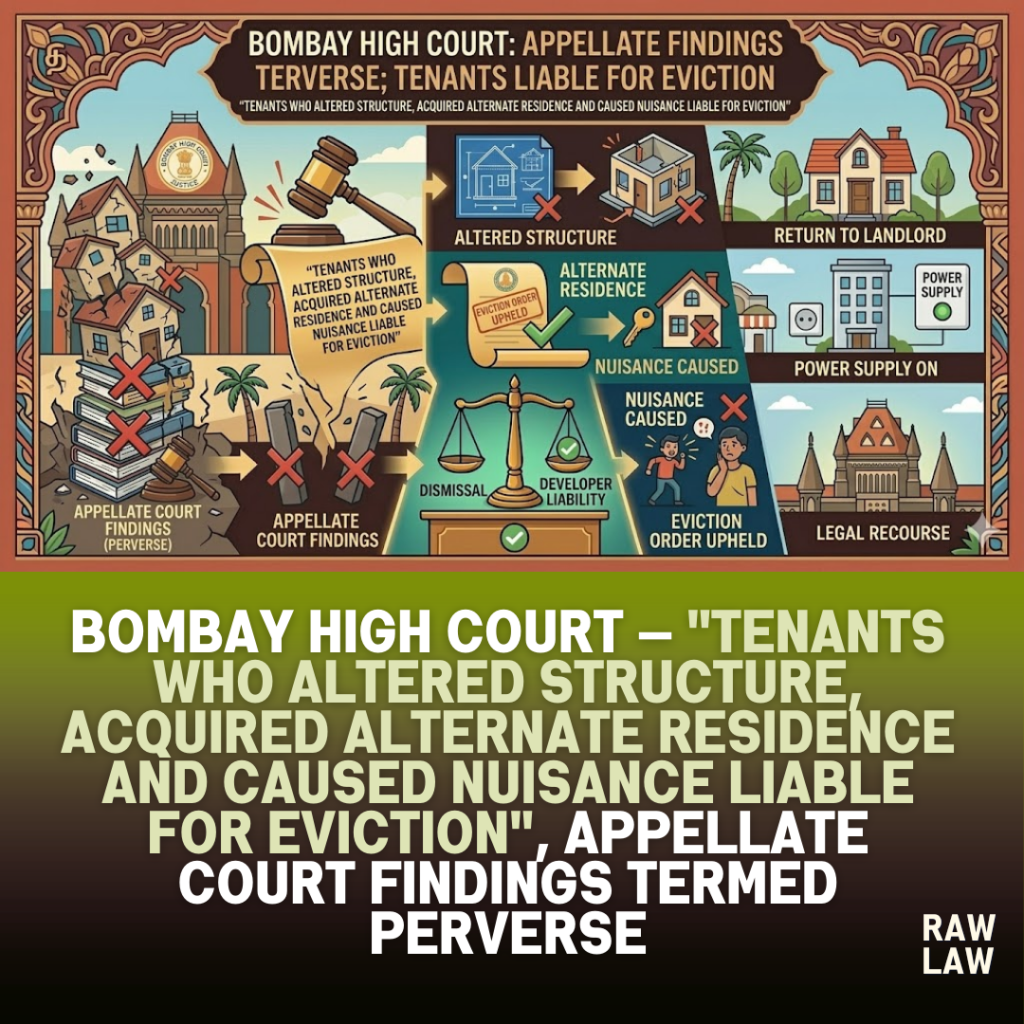
The Bombay High Court set aside the appellate judgment of the Small Causes Court that had dismissed an eviction suit filed by a landlord under the Bombay Rent Act. The Court held that the appellate court had improperly reversed the trial court’s findings on key eviction grounds.
After re-examining the evidence, the High Court concluded that the tenants had carried out substantial structural alterations, acquired alternate accommodation, and created nuisance within the building premises. These findings justified eviction under statutory provisions of the Bombay Rent Act.
Accordingly, the Court restored the eviction decree passed by the trial court on these grounds and directed the tenants to vacate the premises within six weeks.
2. Facts
The dispute concerned a residential flat located at Juhu Tara Road, Santacruz (West), Mumbai, which had been leased to the defendants at a monthly rent of approximately ₹520.
The landlord filed an eviction suit in 1985 under the Bombay Rent Act alleging several statutory grounds including bona fide requirement, nuisance, unauthorized structural alterations, unlawful subletting, acquisition of alternate accommodation, and non-user.
During trial, multiple witnesses were examined including an architect, court commissioners, police officials, and structural engineers. The trial court concluded that some grounds—such as bona fide requirement and non-user—were not proved.
However, it found that the tenants had committed nuisance, made unauthorized structural changes, and acquired alternate accommodation. On this basis, the trial court passed an eviction decree.
The tenants appealed before the Appellate Bench of the Small Causes Court, which reversed the eviction decree and dismissed the suit entirely. This prompted the landlord to file a civil revision application before the High Court.
3. Issues
The High Court considered whether the appellate court had erred in reversing the trial court’s findings regarding three eviction grounds under the Bombay Rent Act.
The issues included whether the tenants had erected permanent structures in the tenanted premises without permission, whether they had acquired suitable alternate residence, and whether their conduct amounted to nuisance or annoyance to neighbouring occupants.
The Court also examined the scope of revisional jurisdiction under Section 115 of the Code of Civil Procedure and whether interference was justified due to perversity in appreciation of evidence.
4. Petitioner’s arguments
The landlord argued that the tenants had carried out major alterations in the flat, including shifting the kitchen, constructing a toilet in the balcony, removing internal walls, and converting rooms without obtaining permission from the landlord or municipal authorities.
It was contended that such changes fundamentally altered the structure of the premises and therefore constituted permanent structural alterations under the Bombay Rent Act.
The landlord further argued that the tenant had acquired alternate accommodation in Pune, which was reflected in municipal electoral records and other documents. According to the landlord, acquisition of alternate residence independently justified eviction.
Additionally, the landlord submitted that the tenants had caused nuisance by constructing an elevated concrete pathway at the entrance of the building and by actions that resulted in seepage damage to the structure.
5. Respondent’s arguments
The tenants contended that the alleged alterations were carried out only for better enjoyment of the premises and were reversible in nature. They argued that the landlord had failed to produce the original sanctioned plan of the building to establish the original structure.
It was also submitted that the toilet in the balcony existed from the beginning and did not constitute a structural change. The tenants maintained that shifting of the kitchen and other internal modifications were minor changes that did not amount to erection of permanent structures.
Regarding alternate accommodation, the tenants argued that the property in Pune belonged to another family member and could not be treated as a suitable residence for eviction purposes.
Finally, the tenants argued that the High Court’s revisional jurisdiction was limited and that it should not re-appreciate evidence merely because another view was possible.
6. Analysis of the law
The Court examined provisions of the Bombay Rent Act governing eviction, particularly those relating to erection of permanent structures, nuisance or annoyance, and acquisition of suitable residence.
The Court noted that tenants are prohibited from making structural changes without written permission of the landlord. Unauthorized alterations that substantially change the character or structure of premises can constitute grounds for eviction.
The Court also clarified that the statutory ground of “acquisition of suitable residence” does not require the landlord to prove that the tenant has permanently shifted to the alternate accommodation. It is sufficient to show that the tenant has acquired another residence.
7. Precedent analysis
The Court relied on several precedents interpreting eviction provisions under rent control legislation.
In earlier decisions, courts have held that removal of internal walls or structural modifications without landlord’s consent amounts to erection of permanent structures.
The Court also referred to Supreme Court judgments explaining that acquisition of alternate residence by a tenant or spouse may constitute a valid ground for eviction if the premises are reasonably suitable.
These precedents reinforced the principle that rent control protections cannot be misused to indefinitely retain premises despite structural violations or availability of alternative accommodation.
8. Court’s reasoning
The High Court observed that the tenants themselves admitted in evidence that they had shifted the kitchen, demolished internal walls, constructed new platforms, and altered the layout of the flat.
These admissions clearly demonstrated substantial alterations carried out without the landlord’s consent. The Court held that the appellate court had ignored these admissions and wrongly treated the alterations as minor or reversible.
The Court also found that documentary evidence such as electoral rolls and telephone records demonstrated that the tenant had access to another residential property in Pune.
Further, the Court held that construction of a concrete pathway at the entrance of the building without permission caused inconvenience and nuisance to the landlord who occupied other portions of the building.
Accordingly, the High Court concluded that the appellate court had misread the evidence and reached perverse findings.
9. Conclusion
The High Court held that the appellate court’s judgment could not be sustained due to its flawed appreciation of evidence.
The Court restored the eviction decree passed by the trial court on the grounds of erection of permanent structures, acquisition of suitable residence, and nuisance.
The tenants were granted six weeks to vacate the premises, subject to filing an undertaking that they would not create third-party rights during that period.
10. Implications
The ruling reiterates that rent control protections cannot be used to justify unauthorized structural modifications or indefinite retention of premises when tenants possess alternate accommodation.
The judgment also highlights that appellate courts must carefully evaluate admissions and material evidence before overturning trial court findings.
For landlords involved in long-standing tenancy disputes, the decision reinforces that courts may intervene where tenants alter premises without permission or misuse statutory protections under rent control laws.
Case Law References
1. Neelakantan v. Mallika Begum (2002)
The Supreme Court held that revisional courts may interfere when findings of lower courts are perverse or based on misreading of evidence.
2. B.R. Mehta v. Atma Devi (1987)
The Supreme Court clarified principles relating to acquisition of alternate accommodation and its impact on tenancy rights.
3. Pandurang Dhondi Chougule v. Maruti Hari Jadhav
The Supreme Court held that revisional jurisdiction may be exercised when lower courts commit errors of law or perversely appreciate evidence.
4. HPCL v. Dilbahar Singh (2014)
The Supreme Court explained the limits of revisional jurisdiction and when interference is justified due to legal infirmity.
FAQs
1. Can tenants be evicted for making structural changes without permission?
Yes. Under rent control laws such as the Bombay Rent Act, tenants who make permanent structural alterations without landlord permission can be evicted.
2. What is “acquisition of suitable residence” in tenancy law?
It means the tenant has obtained another residence suitable for living. Courts may order eviction if tenants retain rented premises despite acquiring alternative accommodation.
3. Can nuisance caused by tenants lead to eviction?
Yes. If a tenant’s conduct creates nuisance or annoyance to neighbouring occupants or the landlord, it can be a valid ground for eviction under rent control legislation.


