

Court’s decision
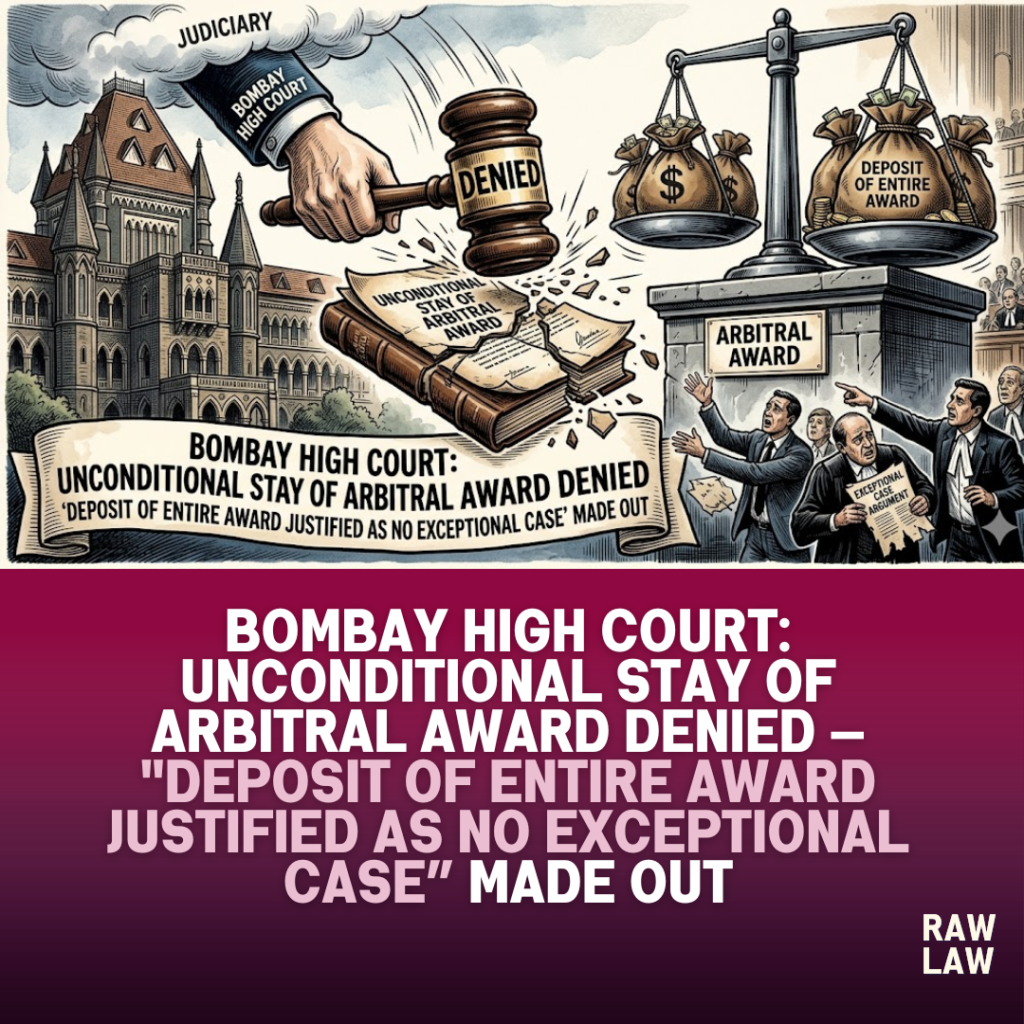
The Bombay High Court dismissed the writ petition challenging a conditional stay on enforcement of an arbitral award, holding that no “exceptional case” was made out to justify an unconditional stay. The Court upheld the District Judge’s order directing deposit of the entire award amount along with accrued interest as a precondition for stay under Section 36 of the Arbitration and Conciliation Act, 1996. It emphasized that mere dissatisfaction with the arbitral award or pendency of a Section 34 challenge does not entitle a party to unconditional stay, particularly in monetary awards.
Facts
The dispute arose from a development agreement concerning land in Pune, involving transfer of development rights, residual FSI, and TDR benefits. The petitioners were granted rights to develop Plot No.5 using residual FSI and TDR from adjoining plots. In return, they agreed to pay substantial consideration and comply with statutory obligations, including conditions under urban land ceiling regulations.
Disputes emerged when the respondents alleged that the petitioners exceeded contractual rights by constructing on Plot No.6 and unlawfully obtained waiver of statutory obligations, thereby gaining additional saleable units. Arbitration was invoked, resulting in a split award. The majority awarded compensation exceeding ₹7.8 crores with interest, based on excess construction and benefits derived from waiver of statutory conditions.
The petitioners challenged the award under Section 34 and sought unconditional stay under Section 36. The District Court granted stay subject to full deposit of the award amount. This conditional order was challenged before the High Court under Article 227.
Issues
The central issue before the Court was whether the petitioners were entitled to an unconditional stay of the arbitral award pending disposal of the Section 34 challenge.
A related issue was whether the District Court erred in directing deposit of the entire award amount and whether such a condition was imposed mechanically without considering alleged infirmities in the award.
The Court also examined the scope of discretion under Section 36 of the Arbitration Act, particularly in relation to money awards and the concept of “exceptional circumstances” justifying unconditional stay.
Petitioner’s arguments
The petitioners argued that the District Court imposed the deposit condition mechanically without examining serious infirmities in the arbitral award. They contended that the award was fundamentally flawed as it granted damages without proof of actual loss, relying instead on speculative calculations such as ready reckoner rates. According to them, the arbitral tribunal engaged in “hazardous guesswork” rather than legal assessment.
They further submitted that the construction on Plot No.6 was within the contemplation of the parties and aligned with the development scheme. Additionally, they argued that benefits arising from waiver of statutory obligations belonged exclusively to them, as the agreement did not entitle the respondents to share in such benefits. On these grounds, they claimed the award was patently illegal and warranted unconditional stay.
Respondent’s arguments
The respondents opposed the petition, asserting that the District Court had exercised its discretion correctly and in accordance with settled law. They argued that in cases involving monetary awards, courts ordinarily require deposit of the awarded amount as a condition for stay.
They emphasized that unconditional stay is an exception, granted only in rare cases involving patent illegality or perversity. According to them, the arbitral tribunal had considered all contentions and rendered a reasoned decision. The petitioners failed to demonstrate any exceptional circumstance or irreparable loss that would justify deviation from standard practice.
The respondents also relied on Supreme Court jurisprudence emphasizing that conditional stay is the norm in money decrees and arbitral awards.
Analysis of the law
The Court undertook a detailed analysis of Section 36 of the Arbitration and Conciliation Act, 1996. It reiterated that filing a Section 34 challenge does not automatically stay enforcement of an arbitral award. A separate application must be made, and the Court may grant stay subject to conditions.
The Court highlighted that for monetary awards, courts must have “due regard” to principles governing stay of money decrees under the Code of Civil Procedure. This includes considerations such as substantial loss, delay, and provision of security.
Importantly, unconditional stay is mandated only where a prima facie case of fraud or corruption is established. In all other cases, the Court retains discretion to impose conditions, typically requiring deposit of the award amount.
The Court clarified that this framework balances enforcement of arbitral awards with protection of the award-debtor’s rights.
Precedent analysis
The Court relied on key Supreme Court decisions interpreting Section 36 and principles governing stay of monetary decrees.
In Pam Developments Pvt. Ltd. v. State of West Bengal, the Supreme Court held that CPC provisions serve as guiding principles and not strict mandates, reinforcing the discretionary nature of Section 36.
In Lifestyle Equities v. Amazon Technologies, the Supreme Court laid down that unconditional stay is permissible only in “exceptional cases,” such as where the decree is egregiously perverse or patently illegal.
Further, in Popular Caterers v. Ameet Mehta, the Supreme Court reiterated that courts must specifically examine whether an exceptional case exists before granting unconditional stay.
The High Court applied these precedents to conclude that conditional stay remains the norm and unconditional stay is a rare exception.
Court’s reasoning
The Court found that the petitioners failed to establish any exceptional circumstance warranting unconditional stay. It noted that the fact of construction on Plot No.6 was largely undisputed and appeared contrary to the express terms of the agreement, which restricted development rights to Plot No.5.
The Court also observed that the contractual documents clearly limited development rights and required compliance with statutory obligations. The arbitral tribunal’s findings regarding breach and unauthorized benefit were prima facie supported by the record.
On the issue of damages, the Court held that reliance on an architect’s report and ready reckoner rates did not, at this stage, demonstrate patent illegality or perversity.
Crucially, the Court emphasized that the petitioners failed to show substantial loss or furnish adequate security. Mere liability to pay under an arbitral award does not constitute substantial loss.
Thus, the Court concluded that the District Judge’s order was neither arbitrary nor legally flawed.
Conclusion
The High Court dismissed the writ petition and upheld the conditional stay order requiring deposit of the entire award amount. It reaffirmed that unconditional stay is not a matter of right and can only be granted in rare, exceptional circumstances.
The Court clarified that its observations were limited to the issue of stay and would not influence the merits of the Section 34 proceedings pending before the District Court.
Implications
This ruling reinforces the pro-enforcement stance of Indian arbitration law and strengthens the finality of arbitral awards. It underscores that parties cannot avoid compliance with monetary awards merely by filing a challenge under Section 34.
The judgment also provides clarity on the threshold for “exceptional cases,” emphasizing that allegations of illegality must be evident and substantial. Routine contractual disputes and valuation disagreements will not suffice.
For developers and commercial entities, the ruling highlights the importance of strict adherence to contractual terms, particularly in complex development agreements involving FSI and TDR rights.
Overall, the decision strengthens judicial consistency in applying Section 36 and discourages dilatory tactics in arbitration enforcement.
Case law references
- Pam Developments Pvt. Ltd. v. State of West Bengal (2019)
Held that CPC provisions are guiding factors under Section 36, not mandatory rules. The Court applied this to affirm judicial discretion in imposing conditions. - Lifestyle Equities v. Amazon Technologies (2025)
Established that unconditional stay is granted only in exceptional cases involving patent illegality or perversity. The High Court relied heavily on this test. - Popular Caterers v. Ameet Mehta (2025)
Reinforced the requirement of demonstrating exceptional circumstances before granting unconditional stay. Applied to reject the petitioners’ plea. - Alkem Laboratories Ltd. v. Issar Pharmaceuticals Pvt. Ltd.
Discussed requirement of proof of loss in damages claims. Distinguished as not sufficient to establish patent illegality at the interim stage.
FAQs
1. Can an arbitral award be automatically stayed by filing a challenge under Section 34?
No. Filing a Section 34 petition does not automatically stay enforcement. A separate application under Section 36 is required, and the court may impose conditions such as deposit of the award amount.
2. When can a court grant unconditional stay of an arbitral award?
Unconditional stay is granted only in exceptional cases, such as where the award is patently illegal, perverse, or obtained through fraud or corruption.
3. Is deposit of the entire award amount mandatory for stay?
While not strictly mandatory, courts generally require deposit of the full award amount in monetary awards, unless exceptional circumstances justify deviation.


