

Court’s decision
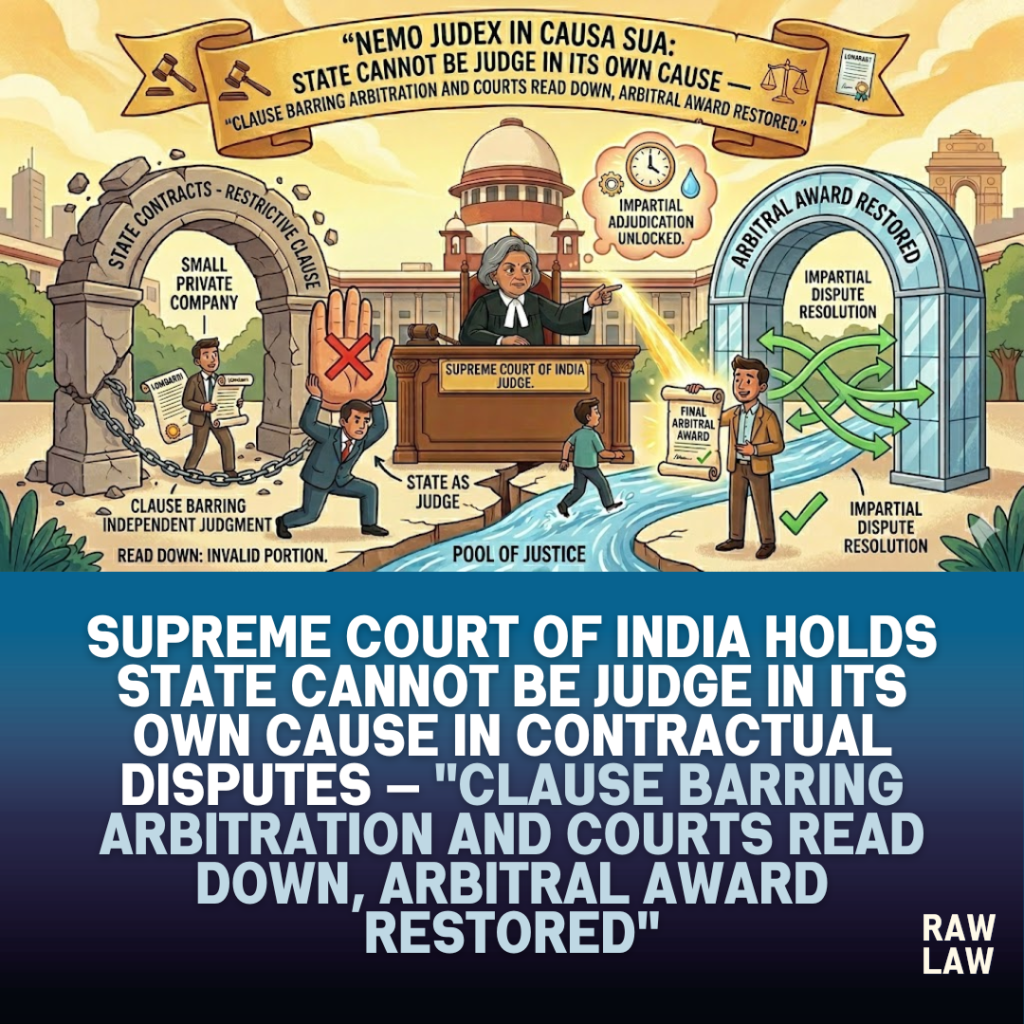
The Supreme Court of India set aside the High Court’s judgment and restored the arbitral award, holding that a contractual clause allowing a State authority to unilaterally determine breach and bar judicial or arbitral review is contrary to fundamental principles of the rule of law. The Court ruled that such clauses cannot exclude remedies entirely and must be interpreted harmoniously with arbitration provisions. It emphasized that when liability is disputed, adjudication must occur before an independent forum. Accordingly, the arbitral award directing repayment of recovered penalties with interest was upheld.
Facts
The dispute arose from a manning agreement between a private contractor and a government administration for providing crew to multiple vessels. During the contract period, a vessel suffered damage after drifting and hitting a submerged object. Years later, the administration issued a show cause notice and subsequently imposed a substantial monetary penalty, which it unilaterally recovered from pending dues.
The contractor denied liability and invoked arbitration. A sole arbitrator was appointed by the Supreme Court. The arbitrator ruled in favor of the contractor, holding that the penalty clause relied upon by the administration was legally unsustainable when read as barring all legal remedies. The award granted refund of the recovered amount with interest.
The administration challenged the award under statutory provisions, ultimately succeeding before the High Court, which held that the dispute fell within “excepted matters” excluded from arbitration. This led to the present appeal before the Supreme Court.
Issues
The central issue before the Court was whether a contractual clause that declares the administration’s decision as final and bars recourse to courts and arbitration can validly exclude disputes from adjudication.
A related issue was whether the arbitrator had jurisdiction to interpret such clauses and adjudicate disputes concerning liability, particularly when the contract purported to designate certain matters as “excepted.”
Additionally, the Court examined whether such clauses violate statutory provisions and foundational legal principles, including access to justice and prohibition against restraint of legal proceedings.
Petitioner’s arguments
The petitioner contended that disputes relating to breach, negligence, and liability fall squarely within the scope of arbitration when the arbitration clause is broadly worded. It argued that contractual clauses must be interpreted harmoniously to avoid absurd outcomes and denial of remedies. The petitioner emphasized that the impugned clause, if interpreted as barring all legal recourse, would render the contractor remediless and violate statutory protections under contract law. It further asserted that the administration had participated in arbitration without objection and was estopped from later challenging jurisdiction. The petitioner also argued that only quantification of damages, not determination of liability, could be considered an excepted matter.
Respondent’s arguments
The respondent defended the High Court’s reasoning, arguing that the arbitrator derives authority solely from the contract and cannot adjudicate upon the validity of contractual clauses. It maintained that the clause in question clearly excluded certain matters from arbitration and made the administration’s decision final. According to the respondent, disputes falling within such “excepted matters” are beyond arbitral jurisdiction. It was also contended that any challenge to the legality of the clause should have been brought before a civil court, not determined by the arbitrator.
Analysis of the law
The Court undertook a detailed analysis of contractual interpretation, emphasizing that contracts involving the State must conform to rule of law principles. It reiterated that agreements restraining legal proceedings are void under statutory law, particularly where they absolutely bar enforcement of rights.
The Court also examined the scope of civil court jurisdiction and noted that exclusion of judicial remedies must be explicit and cannot result in a complete denial of justice. Arbitration clauses, on the other hand, are legally recognized mechanisms for dispute resolution and must be interpreted broadly unless expressly restricted.
The Court highlighted that contractual clauses cannot override fundamental legal doctrines such as fairness, access to justice, and impartial adjudication.
Precedent analysis
The Court relied on established precedents holding that a party to a contract cannot adjudicate disputes involving its own allegations of breach. Prior rulings have clarified that assessment of damages by a State authority is permissible only when breach is admitted or undisputed.
It also referred to jurisprudence affirming that questions of breach must be determined by an independent adjudicatory body, such as a court or arbitral tribunal. These precedents reinforce the principle that unilateral decision-making in disputed matters violates natural justice.
Additionally, earlier rulings on “excepted matters” were distinguished on the ground that they did not involve total exclusion of remedies or denial of adjudicatory mechanisms.
Court’s reasoning
The Court held that the clause in question could not be interpreted to allow the administration to decide both liability and damages in cases where breach is disputed. Such an interpretation would violate the principle that no person can be a judge in their own cause.
It clarified that the finality attached to administrative decisions under the clause applies only in cases where liability is admitted. In disputed cases, adjudication must occur through arbitration or judicial processes.
The Court further held that interpreting the clause as barring both courts and arbitration would create a “vacuum in legal remedies,” which is impermissible in law. It invoked the maxim “ubi jus ibi remedium” to emphasize that every legal right must have an enforceable remedy.
The Court also criticized the inequitable nature of the clause, noting that while the administration reserved rights to recover dues through legal proceedings, the contractor was denied reciprocal remedies.
Conclusion
The Supreme Court concluded that the High Court erred in treating the dispute as an excepted matter and in holding that the arbitrator lacked jurisdiction. It held that the arbitrator rightly interpreted the contract and exercised jurisdiction over the dispute.
Accordingly, the Court set aside the High Court’s judgment and restored the arbitral award in favor of the contractor. It reaffirmed that contractual clauses cannot override fundamental legal principles or deny access to justice.
Implications
This judgment has significant implications for government contracts and arbitration law in India. It reinforces that the State cannot insert clauses that make it the sole adjudicator of disputes, especially where liability is contested.
The ruling strengthens the enforceability of arbitration clauses and limits the scope of “excepted matters.” It also sends a clear message that contractual provisions cannot create immunity from judicial scrutiny.
For contractors, the decision ensures protection against arbitrary recovery actions by government authorities. For public bodies, it serves as a caution against drafting one-sided clauses that undermine fairness and legality.
Overall, the judgment upholds the supremacy of rule of law in contractual relationships involving the State.
Case law references
State of Karnataka v. Shree Rameshwara Rice Mills
Held that State authorities can assess damages only when breach is admitted. They cannot adjudicate disputed breaches. Applied here to reject unilateral determination of liability.
J.G. Engineers Private Limited v. Union of India
Established that one party cannot decide whether the other committed breach. Applied to affirm need for independent adjudication.
Sri Vedagiri Lakshmi Narasimha Swami Temple case
Held that exclusion of civil court jurisdiction cannot create a vacuum in remedies. Applied to invalidate interpretation barring all forums.
Northern Railway v. Sarvesh Chopra
Discussed excepted matters, but distinguished as it did not involve complete denial of remedies.
FAQs
1. Can a contract clause bar both arbitration and court remedies in India?
No. The Supreme Court has held that such clauses are void as they violate statutory provisions and fundamental principles of access to justice.
2. What are “excepted matters” in arbitration law?
Excepted matters are specific issues excluded from arbitration by contract. However, they typically relate to quantification or administrative decisions, not disputed liability.
3. Can the government decide contractual disputes unilaterally?
No. The Court reaffirmed that the government cannot act as judge in its own cause when liability is disputed. Such disputes must be resolved by courts or arbitral tribunals.


