

Court’s decision
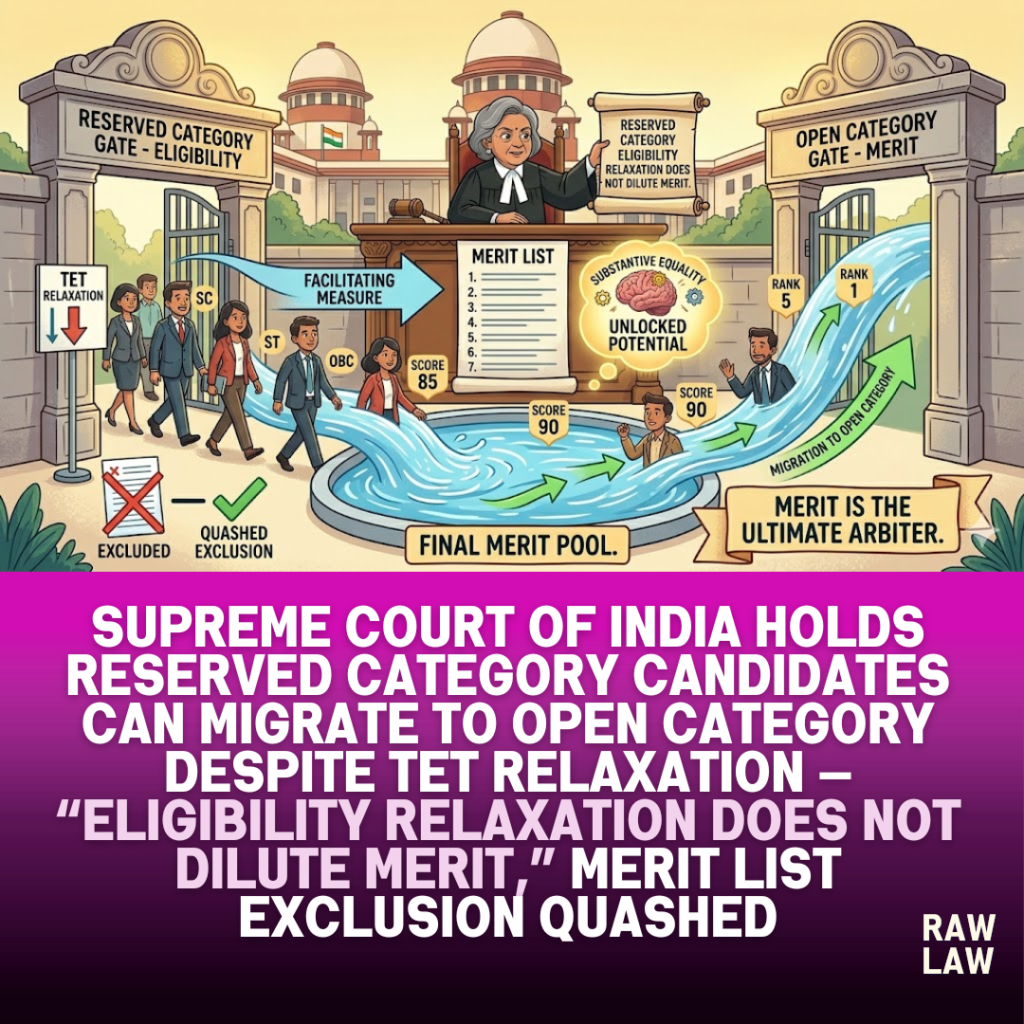
The Supreme Court of India allowed the appeals and held that candidates belonging to reserved categories who availed relaxation in qualifying marks in the Teacher Eligibility Test (TET) are still entitled to migrate to the open category if they secure higher merit in the main examination. The Court ruled that such relaxation affects only eligibility and not merit. It quashed the High Court judgment and directed inclusion of such candidates in the open category merit list where they outperform general category candidates.
Facts
The dispute arose from recruitment of teachers in Maharashtra through the Teachers Aptitude and Intelligence Test (TAIT). Candidates from reserved categories, despite scoring higher marks than general category candidates in TAIT, were excluded from the open category list because they had availed relaxation in TET qualifying marks.
TET is a qualifying examination mandated under statutory guidelines, while TAIT determines final merit. The State allowed a 5% relaxation in TET qualifying marks for reserved categories.
After publication of the merit list, affected candidates challenged their exclusion. The High Court upheld the State’s action, holding that candidates who availed relaxation could not compete in the open category. This led to the appeal before the Supreme Court.
Issues
The principal issue was whether candidates belonging to reserved categories who availed relaxation in a qualifying examination can migrate to the open category based on superior performance in the main selection examination.
A related issue was whether such relaxation amounts to a concession in the recruitment process affecting merit, thereby disqualifying candidates from open category consideration.
The Court also examined whether recruitment rules or notifications expressly prohibited such migration.
Petitioner’s arguments
The petitioners argued that relaxation in TET is merely an eligibility concession and does not affect merit, which is determined solely by performance in TAIT. They contended that the open category is merit-based and not reserved exclusively for general category candidates. It was submitted that excluding more meritorious candidates defeats the principle of equality. The petitioners emphasized that the High Court wrongly relied on precedent without appreciating factual differences and that relaxation is intended to level the playing field, not to penalize candidates during final selection.
Respondent’s arguments
The respondents argued that TET is an essential eligibility requirement and that candidates who qualified with relaxed standards cannot claim parity with general category candidates. They contended that allowing migration would grant a “double benefit” of reservation. It was also argued that recruitment rules and administrative instructions prohibited such migration, relying on prior judicial precedent to support the position that relaxed standards disqualify candidates from open category consideration.
Analysis of the law
The Court undertook a detailed examination of constitutional principles and service jurisprudence relating to reservation. It emphasized that relaxation in eligibility criteria serves only to enable participation and does not impact the merit-based evaluation process.
The Court distinguished between eligibility and selection, clarifying that qualifying examinations like TET determine eligibility, whereas merit is assessed through competitive examinations like TAIT.
It also noted that reservation policies must align with equality principles under Articles 14 and 16, ensuring that merit is not compromised once candidates enter the zone of consideration.
Precedent analysis
The Court relied heavily on earlier judgments which held that concessions in eligibility do not affect merit-based selection. It reaffirmed that such relaxations merely bring candidates into the zone of consideration.
It distinguished cases where candidates failed to meet essential eligibility criteria or where recruitment rules expressly barred migration. In such cases, migration is impermissible.
The Court clarified that precedents denying migration applied only where candidates lacked essential qualifications or where explicit prohibitions existed, neither of which applied in the present case.
Court’s reasoning
The Court held that relaxation in TET qualifying marks does not alter the merit evaluation process because final selection is based entirely on TAIT scores. Since all candidates compete on equal footing in the main examination, no undue advantage is conferred.
It emphasized that the open category is not a reserved category but a merit-based pool open to all candidates. Denying migration to more meritorious candidates would undermine fairness and equality.
The Court further held that in the absence of an express prohibition in recruitment rules, migration cannot be denied. Administrative instructions issued after the examination cannot override statutory guidelines or alter eligibility conditions retrospectively.
It also clarified that reliance on precedent was misplaced, as those cases involved different factual contexts where eligibility conditions were not met.
Conclusion
The Supreme Court concluded that the High Court erred in denying migration to the open category. It held that candidates who availed relaxation in TET but secured higher marks in TAIT are entitled to be considered in the open category.
The Court quashed the High Court judgment and directed the authorities to revise the merit list by including such candidates in the open category based on merit.
Implications
This judgment significantly clarifies the law on reservation and migration in public employment. It reinforces that eligibility relaxation does not equate to merit relaxation and cannot be used to deny fair competition.
The ruling strengthens the principle that open category seats are merit-based and accessible to all candidates irrespective of category.
It also limits arbitrary administrative actions that alter recruitment outcomes without statutory backing. For recruitment authorities, the judgment underscores the need for clarity in rules and adherence to constitutional principles.
For candidates, it ensures that merit is given primacy once eligibility conditions are satisfied.
Case law references
Jitendra Kumar Singh v. State of Uttar Pradesh
Held that concessions in eligibility such as age or fee do not affect merit and do not bar migration to open category.
Vikas Sankhala v. Vikas Kumar Agarwal
Held that relaxation in TET qualifying marks does not impact merit when final selection is based on performance; migration allowed.
Government of NCT of Delhi v. Pradeep Kumar
Held migration impermissible where candidates do not meet essential eligibility criteria; distinguished in present case.
Union of India v. Sajib Roy
Held migration depends on recruitment rules; applied to emphasize absence of prohibition in present case.
Union of India v. G. Kiran
Held migration barred where rules expressly prohibit it; distinguished due to absence of such rule here.
FAQs
1. Can reserved category candidates move to open category after availing relaxation?
Yes, the Supreme Court has held that if relaxation is only in eligibility and not in merit, candidates can migrate to the open category based on higher marks.
2. Does TET relaxation affect merit in teacher recruitment?
No. TET is only a qualifying exam. Merit is determined by the main examination like TAIT, where all candidates compete equally.
3. Can recruitment rules prevent migration to open category?
Yes, but only if there is an explicit prohibition. In the absence of such rules, migration based on merit is allowed.


