

Court’s decision
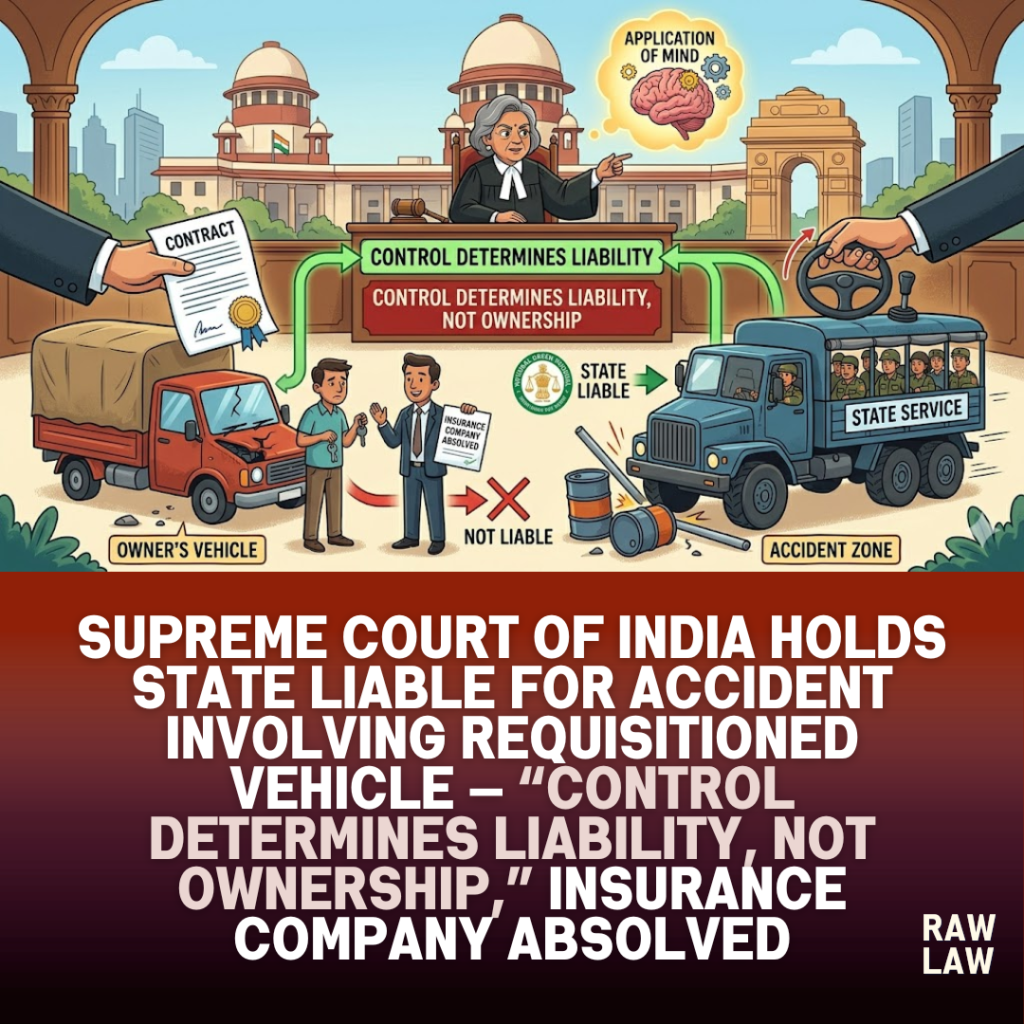
The Supreme Court of India dismissed the appeal and upheld the High Court’s ruling that liability for compensation in a motor accident involving a requisitioned vehicle rests with the State authority, not the insurance company. The Court held that once a vehicle is requisitioned for public purposes, control and possession shift to the State, thereby transferring liability. The insurance policy does not extend to such compelled governmental use.
Facts
The case arose from a fatal road accident in which a bus collided with a motorcycle, resulting in the death of the rider. The bus, though privately owned by a school, had been requisitioned by the District Magistrate for election duty during Gram Panchayat elections.
The Motor Accident Claims Tribunal awarded compensation to the deceased’s family and initially fastened liability on the insurance company. On appeal, the High Court shifted liability to the State authority and enhanced the compensation amount significantly.
Aggrieved by the shifting of liability, the District Magistrate approached the Supreme Court, contending that the insurance company should bear responsibility since the vehicle was insured at the time of the accident.
Issues
The primary issue before the Court was whether liability for compensation in an accident involving a requisitioned vehicle lies with the insurance company or the State authority that had requisitioned the vehicle.
A related issue was whether the existence of a valid insurance policy overrides the effect of State control and use of the vehicle for public purposes.
The Court also examined whether requisition alters the legal characterization of “ownership” for liability purposes.
Petitioner’s arguments
The petitioner argued that since the vehicle was insured, liability should remain with the insurance company. It was contended that the State had neither ownership nor insurable interest in the vehicle, and fastening liability on public authorities would discourage them from requisitioning vehicles for essential public functions. The petitioner further submitted that the High Court erred in shifting liability despite the existence of a valid insurance policy covering the vehicle.
Respondent’s arguments
The respondents, including the insurance company and claimants, argued that once the vehicle was requisitioned, control and possession transferred to the State. It was contended that liability must follow control, not ownership. The insurance company emphasized that the policy covered normal use by the owner, not compelled use under State authority. The claimants supported the High Court’s decision, asserting that the State should bear responsibility for risks arising from its actions.
Analysis of the law
The Court analyzed the concept of requisition under statutory law and emphasized that requisition is not a voluntary arrangement but a compulsory act under legal authority. When a vehicle is requisitioned, the owner loses effective control, and the State assumes operational command.
The Court examined the definition of “owner” under motor vehicle law and interpreted it in a functional sense, focusing on possession and control rather than formal ownership.
It also analyzed the scope of insurance contracts, noting that insurers underwrite risks based on ordinary usage by the insured, not extraordinary deployment under State control.
Precedent analysis
The Court relied on established precedents which held that during requisition, the State assumes the role of the effective owner for liability purposes. These decisions emphasized that liability should attach to the entity exercising control over the vehicle.
It distinguished cases where vehicles were operated under contractual arrangements, where insurers remained liable, noting that such cases involved voluntary agreements rather than statutory requisition.
The Court reaffirmed that where control is transferred by operation of law, liability must follow control.
Court’s reasoning
The Court held that requisition fundamentally alters the legal relationship between the owner, insurer, and State. Once requisitioned, the vehicle operates under the exclusive direction of the State, and the owner has no control over its use.
It emphasized that liability must align with control and decision-making authority. Since the State determines how, when, and where the vehicle is used, it must bear responsibility for consequences arising from such use.
The Court further held that insurance policies cannot be stretched to cover risks beyond their contractual scope. Compelled use under State authority is not part of the ordinary risk contemplated by the insurer.
It also rejected the argument that imposing liability on the State would discourage requisition, noting that statutory powers inherently carry corresponding responsibilities.
Additionally, the Court observed that even if the driver remained an employee of the owner, he operated under State directions during requisition, reinforcing the State’s liability.
Conclusion
The Supreme Court concluded that the High Court correctly shifted liability to the State authority. It held that the insurance company cannot be made liable for risks arising from the State’s exercise of statutory powers.
The appeal was dismissed, and the compensation awarded to the claimants remained payable by the State.
Implications
This judgment clarifies the legal position on liability in cases involving requisitioned vehicles. It establishes that control, not ownership, is the decisive factor in determining liability.
The ruling ensures fairness by preventing insurers from being burdened with risks outside their contractual scope. It also reinforces accountability of public authorities when exercising statutory powers.
For government bodies, the judgment underscores the need to anticipate and manage risks associated with requisitioned assets. For insurers and vehicle owners, it provides clarity on the limits of insurance coverage.
Case law references
National Insurance Co. Ltd. v. Deepa Devi
Held that during requisition, control shifts to the State, making it liable despite ownership remaining with the private party.
Purnya Kala Devi v. State of Assam
Held that possession and control determine “ownership” for liability under motor vehicle law.
U.P. State Road Transport Corporation v. Kulsum
Held insurer liable in contractual arrangements; distinguished as not involving requisition.
U.P. SRTC v. National Insurance Co. Ltd.
Reaffirmed insurer liability in contractual operation cases; distinguished in present case.
FAQs
1. Who is liable for accidents involving requisitioned vehicles?
The Supreme Court has held that the State authority that requisitions the vehicle is liable, as it exercises control during that period.
2. Does insurance cover accidents during government requisition?
Generally, no. Insurance policies cover ordinary use by the owner, not compelled use under State authority.
3. Why is control more important than ownership in such cases?
Because liability follows the entity that directs and controls the vehicle’s operation, which is the State during requisition.


