

Court’s decision
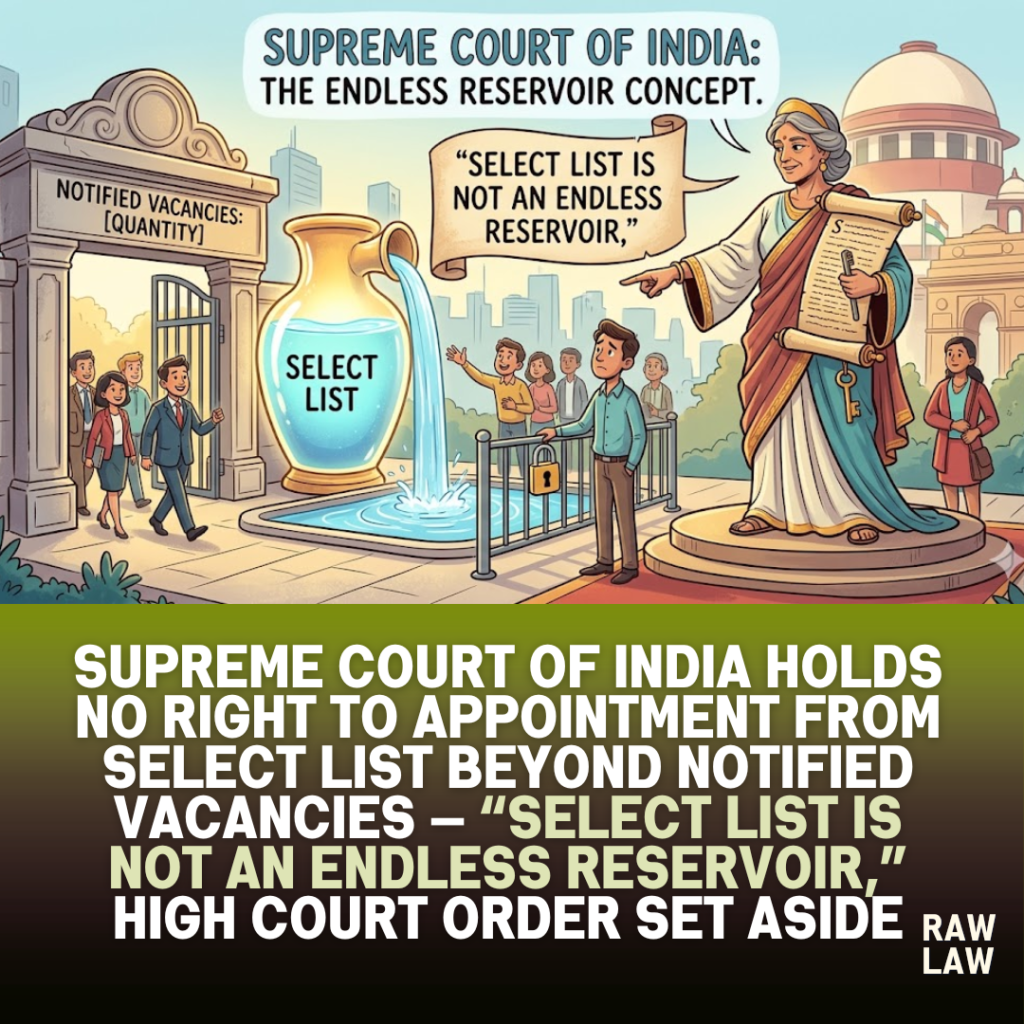
The Supreme Court of India allowed the State’s appeal and set aside the High Court’s direction to appoint a candidate to a higher post from the same select list after a selected candidate failed to join. The Court held that in the absence of a statutory provision for a waiting or reserve list, a candidate cannot claim appointment merely because a selected candidate did not join.
Facts
The case arose from a recruitment process conducted in 2011 for Gazetted Probationers under Karnataka services. The respondent, an ex-serviceman, participated in the process and was selected for one Group A post but not for another higher-preference post.
A candidate selected for the higher post did not complete mandatory pre-appointment formalities and did not join. The respondent claimed that as the next eligible candidate, he should be appointed to that post.
The Department rejected this request, stating that the rules did not permit operation of the same select list beyond notified vacancies. The Tribunal upheld this view, but the High Court reversed it and directed consideration of the respondent for appointment.
Issues
The primary issue was whether a candidate next in merit can claim appointment when a selected candidate fails to join.
A related issue was whether the select list could be operated beyond notified vacancies in the absence of a waiting list provision.
The Court also examined whether non-joining of a selected candidate creates an enforceable right in favor of another candidate.
Petitioner’s arguments
The State argued that the recruitment rules did not provide for any waiting list or additional select list. It contended that the select list was limited to notified vacancies and could not be extended. The State emphasized that vacancies arising due to non-joining must be treated as fresh vacancies for future recruitment. It also relied on established legal principles that inclusion in a select list does not confer a vested right to appointment.
Respondent’s arguments
The respondent argued that since the selected candidate did not complete mandatory formalities or join duty, the vacancy remained unfilled and should be offered to the next candidate in merit. He contended that he had indicated preference for the post and was entitled to be considered. The respondent also argued that denial of such appointment was arbitrary and contrary to fairness in public employment.
Analysis of the law
The Court examined the Karnataka Recruitment of Gazetted Probationers Rules, 1997, particularly provisions governing preparation of select lists.
It held that the rules contemplate preparation of service-wise lists equal to the number of notified vacancies. These lists are not intended to function as open-ended pools for future appointments.
The Court emphasized that recruitment must strictly adhere to statutory rules and notified vacancies, and any deviation would undermine the integrity of the selection process.
Precedent analysis
The Court relied on settled precedents establishing that inclusion in a select list does not create an indefeasible right to appointment.
In Shankarsan Dash v. Union of India, it was held that even selected candidates do not have an absolute right to appointment.
In Rakhi Ray v. High Court of Delhi and State of Orissa v. Rajkishore Nanda, the Court reiterated that select lists cannot be operated beyond the scope of notified vacancies.
These precedents were applied to reject the respondent’s claim.
Court’s reasoning
The Court held that the respondent’s claim was based on an incorrect assumption that non-joining by a selected candidate automatically entitles the next candidate to appointment.
It clarified that such a right can arise only if the governing rules provide for a waiting list or similar mechanism. In this case, the rules contained no such provision.
The Court also noted that the recruitment process involved multiple services and preference-based allocation, making post-facto substitution legally untenable.
It further observed that allowing such claims would disrupt the finality of selection processes and violate statutory rules.
Conclusion
The Supreme Court held that the respondent had no enforceable right to claim appointment to the unfilled post. It restored the Tribunal’s order and dismissed the writ petition, reaffirming that vacancies arising from non-joining must be filled through fresh recruitment.
Implications
This judgment reinforces the principle that public employment must strictly follow statutory rules and notified vacancies.
It prevents backdoor expansion of select lists and protects the integrity and finality of recruitment processes.
For candidates, the ruling clarifies that merit position alone does not guarantee appointment unless supported by statutory provisions.
For governments, it affirms the need to conduct fresh recruitment for unfilled vacancies rather than relying on past lists.
Case law references
Shankarsan Dash v. Union of India
Held that inclusion in a select list does not confer a right to appointment.
Rakhi Ray v. High Court of Delhi
Clarified limits on operation of select lists.
State of Orissa v. Rajkishore Nanda
Reaffirmed that appointments must align with notified vacancies.
FAQs
1. Does being next in merit guarantee appointment if a selected candidate doesn’t join?
No. The Supreme Court held that such a right exists only if rules provide for a waiting list.
2. Can a select list be used beyond notified vacancies?
No. Select lists are limited to the vacancies notified in the recruitment.
3. What happens to vacancies when selected candidates don’t join?
They are treated as fresh vacancies and must be filled through new recruitment.


