
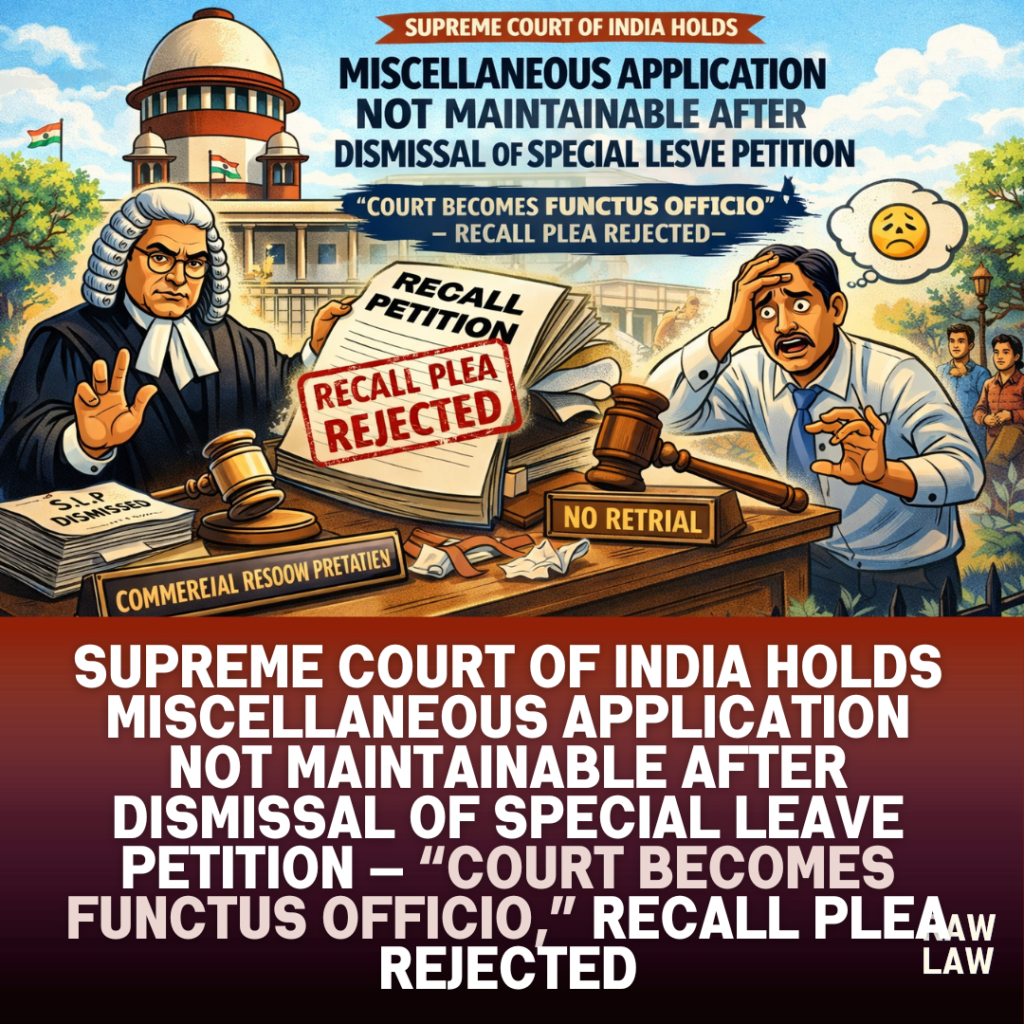

Court’s decision
The Supreme Court of India dismissed the miscellaneous application seeking recall of an earlier order dismissing a Special Leave Petition (SLP). The Court held that once an SLP is dismissed, the Court becomes functus officio and cannot entertain recall applications except in narrowly defined circumstances. It further ruled that subsequent developments in insolvency proceedings cannot be used to reopen a concluded matter.
Facts
The dispute originated from an agreement to sell a commercial property, where the applicant sought specific performance of the contract. The property was mortgaged to a bank, and the agreement was contingent upon approval of a One Time Settlement (OTS) with the bank.
The trial court granted interim protection, but the appellate court set aside the injunction. The High Court upheld this decision, noting that the agreement was contingent and unenforceable without bank approval.
The applicant approached the Supreme Court through an SLP, which was dismissed. Subsequently, the applicant filed a miscellaneous application seeking recall of that dismissal, citing later developments including approval of an OTS and withdrawal of insolvency proceedings under the Insolvency and Bankruptcy Code (IBC).
Issues
The primary issue was whether a miscellaneous application is maintainable to recall an order dismissing an SLP.
A related issue was whether subsequent developments in insolvency proceedings can justify reopening a concluded judicial order.
The Court also examined whether allegations of suppression or fraud could sustain a recall application in such circumstances.
Petitioner’s arguments
The petitioner argued that subsequent developments, including the approval of a One Time Settlement and withdrawal of insolvency proceedings, materially altered the factual matrix. It contended that these developments were not disclosed earlier and had a direct bearing on the case.
The petitioner also alleged suppression of material facts and argued that the earlier dismissal of the SLP was vitiated by fraud. It was submitted that the Court retains inherent power to recall its orders where justice demands.
Respondent’s arguments
The respondents raised a preliminary objection to maintainability, arguing that once the SLP was dismissed, the Court became functus officio and lacked jurisdiction to entertain the application.
They contended that the alleged subsequent developments arose in separate insolvency proceedings and could not be used to reopen a concluded matter.
It was also argued that no fraud or suppression had been established to justify recall of the order.
Analysis of the law
The Court examined the doctrine of functus officio, which limits judicial authority after final disposal of a matter. It held that miscellaneous applications post-disposal are maintainable only in exceptional cases, such as correction of clerical errors or impossibility of implementation.
The Court clarified that dismissal of an SLP does not result in merger of the lower court’s order but nonetheless brings finality to proceedings before the Supreme Court.
It also analyzed the limited scope of recall jurisdiction, emphasizing that allegations of fraud must be substantiated and cannot be invoked casually.
Precedent analysis
The Court relied on precedents affirming that post-disposal applications are not maintainable except in limited circumstances.
In Jaipur Vidyut Vitran Nigam Ltd. v. Adani Power Rajasthan Ltd., it was held that the Court becomes functus officio after disposal.
In Ajay Kumar Jain v. State of Uttar Pradesh, the Court discouraged the growing practice of filing miscellaneous applications in disposed matters.
The Court also relied on insolvency jurisprudence, including K. Sashidhar v. Indian Overseas Bank and Essar Steel case, to emphasize the primacy of commercial wisdom of the Committee of Creditors.
Court’s reasoning
The Court held that the miscellaneous application was not maintainable as it did not fall within the limited exceptions permitting post-disposal intervention.
It found that the subsequent developments relied upon by the petitioner arose in separate insolvency proceedings and could not retroactively affect the earlier judicial determination.
The Court rejected the allegation of fraud, noting that the earlier dismissal was a non-speaking order and not based on specific representations now alleged to be suppressed.
It further held that commercial decisions taken by the Committee of Creditors under the IBC cannot be re-evaluated in collateral proceedings.
Conclusion
The Supreme Court dismissed the miscellaneous application, holding that there was no ground to recall the earlier order dismissing the SLP. It reaffirmed that finality of judicial decisions cannot be disturbed except in rare and exceptional cases.
Implications
This judgment reinforces the principle of finality in litigation and limits the scope of post-disposal applications before the Supreme Court.
It discourages attempts to reopen concluded matters based on subsequent developments in parallel proceedings.
The ruling also strengthens the autonomy of insolvency processes by affirming the primacy of commercial wisdom of creditors.
For litigants, the judgment underscores the importance of presenting all relevant facts at the appropriate stage, as later developments may not be sufficient to reopen closed proceedings.
Case law references
Jaipur Vidyut Vitran Nigam Ltd. v. Adani Power Rajasthan Ltd.
Held that courts become functus officio after disposal of a matter.
Ajay Kumar Jain v. State of Uttar Pradesh
Restricted maintainability of miscellaneous applications post-disposal.
K. Sashidhar v. Indian Overseas Bank
Recognized non-justiciability of commercial wisdom of creditors.
Committee of Creditors of Essar Steel v. Satish Kumar Gupta
Reaffirmed primacy of CoC decisions in insolvency resolution.
Vallal RCK v. Siva Industries
Held limited scope of interference in Section 12A withdrawals.
FAQs
1. Can the Supreme Court recall an order dismissing an SLP?
Only in rare cases such as clerical errors or proven fraud. Otherwise, the Court becomes functus officio.
2. What does functus officio mean in law?
It means that once a court has decided a matter, it has no further authority to revisit it except in limited circumstances.
3. Can later developments reopen a concluded case?
No. Subsequent events in separate proceedings cannot be used to reopen final judicial decisions.


