

Court’s Decision
The Bombay High Court dismissed the writ petition filed by a five-star hotel operator seeking a writ of mandamus (a direction by the High Court commanding a public authority to perform a legal duty) against the Union Territory Administration of Daman and Diu to issue a licence for installing and operating electronic amusement/slot machines in its hotel.
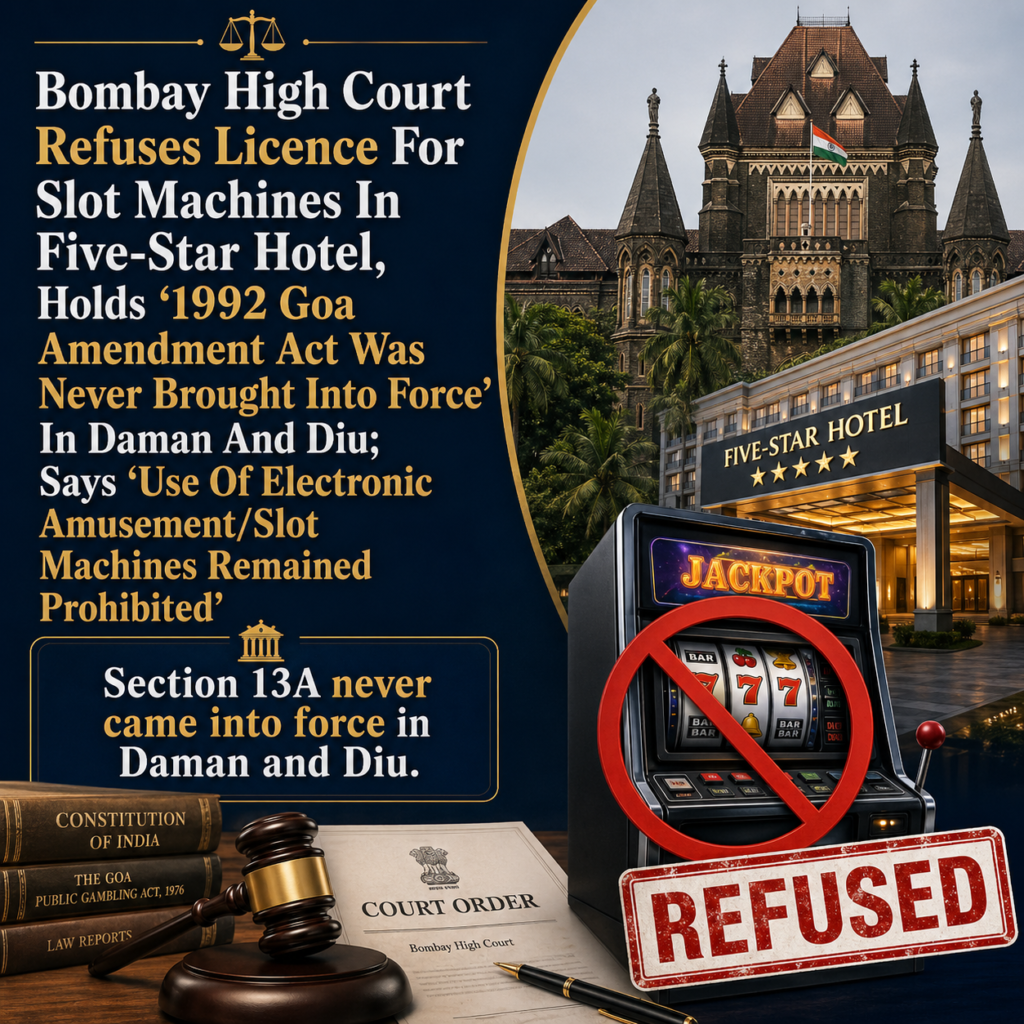
The Court held that the Goa Public Gambling (Amendment) Act, 1992 was never brought into force for the Union Territory of Daman and Diu, because the Central Government never appointed a commencement date by notification in the Official Gazette. Consequently, Section 13A (provision permitting the Government to authorise electronic amusement/slot machines in five-star hotels subject to conditions) was never operational in Daman and Diu.
The Court held:
“The 1992 Goa Amendment Act was never brought into force as far as the UT of Daman and Diu is concerned.”
It further held:
“Consequently, Section 13A was never made applicable for UT of Daman and Diu. With the result, use of electronic amusement/slot machines remained prohibited in UT of Daman and Diu.”
The writ petition was accordingly dismissed.
Facts
The petitioner operated a five-star hotel known as The Deltin at Daman and sought permission to install 140 electronic amusement/slot machines in the hotel.
The dispute arose from the legal position under the Goa, Daman and Diu Public Gambling Act, 1976 (law prohibiting public gambling, keeping common gaming houses, and gaming in common gaming houses).
Originally, the 1976 Act did not permit electronic amusement machines or slot machines. In 1992, the Goa Legislature amended the Act and inserted Section 13A (authorisation of electronic amusement/slot machines in five-star hotels), allowing the Government to authorise such machines in five-star hotels subject to prescribed conditions.
The petitioners contended that by a 1998 notification, the 1992 Goa Amendment Act was extended to Daman and Diu. On that basis, they claimed that Section 13A became applicable to Daman and Diu.
In 2007, the petitioner wrote to the UT Administration seeking permission to set up slot machines in its proposed five-star hotel. The Administration issued a letter stating that it had no objection, subject to the hotel being constructed and all formalities being completed within three years.
In 2008, the UT Administration issued a notification prescribing the procedure and forms for applying for licence to operate electronic amusement/slot machines in five-star hotels. The petitioners relied heavily on this notification to argue that Section 13A was treated as being in force in Daman and Diu.
However, in 2014, the 2008 notification was withdrawn. Thereafter, in 2018, the UT Administration rejected applications for grant of licence for operating casinos/electronic amusement machines in Daman.
Issues
- Whether the Goa Public Gambling (Amendment) Act, 1992 was validly brought into force in the Union Territory of Daman and Diu.
- Whether Section 13A (authorisation of electronic amusement/slot machines in five-star hotels) became operational in Daman and Diu.
- Whether the 2008 notification prescribing procedure for licence could itself prove that Section 13A was in force.
- Whether the petitioners could claim relief on the basis of promissory estoppel (principle preventing the Government from going back on a clear promise if the other party acted upon it) or legitimate expectation (expectation arising from consistent representation or conduct of a public authority).
- Whether a writ of mandamus could be issued directing grant of licence when the underlying statutory provision itself was not in force.
Petitioners’ Arguments
The petitioners argued that the 1992 Goa Amendment Act was extended to Daman and Diu by the 1998 notification and therefore Section 13A became applicable.
They submitted that the Administration itself had issued a no-objection letter in 2007 and thereafter issued the 2008 notification prescribing the procedure for grant of licence. According to them, these acts showed that both the UT Administration and the Central Government had accepted that Section 13A was in force.
They further argued that they had invested more than ₹450 crore in constructing the five-star hotel based on the representation that they would be granted licence for electronic amusement/slot machines.
They relied on promissory estoppel and legitimate expectation, contending that the Administration could not later resile from its assurance after the petitioners had altered their position.
They also argued that since the application for licence was made before the withdrawal of the 2008 notification, the later withdrawal could not defeat their accrued rights.
Respondents’ Arguments
The UT Administration opposed the petition and argued that the 1992 Goa Amendment Act was never brought into force for Daman and Diu.
The Administration submitted that although the 1992 Amendment was extended to Daman and Diu by the 1998 notification, there was a crucial modification: the Act would come into force only on such date as the Central Government may appoint by notification in the Official Gazette.
The respondents argued that no such commencement notification was ever issued by the Central Government. Therefore, Section 13A never became operational in Daman and Diu.
They further argued that the 2008 notification prescribing rules and procedure had no legal foundation because rules cannot operate before the parent Act comes into force.
The respondents also submitted that the decision not to permit casinos/slot machines was a policy decision taken in public interest and that no mandamus could be issued contrary to law.
Analysis Of The Law
The Court examined the statutory history in detail.
The 1976 Act prohibited public gambling and did not permit slot machines. After Goa became a separate State in 1987, the laws then in force continued to apply separately to Goa and to the Union Territory of Daman and Diu.
The 1992 Goa Amendment Act inserted Section 13A, but that amendment was enacted by the Goa Legislature and came into force immediately only for the State of Goa.
In 1998, the Central Government extended the 1992 Amendment to Daman and Diu, but with an important modification: it would come into force only on a date appointed by the Central Government through notification in the Official Gazette.
The Court found that no such notification was ever issued.
The Court held that when a statute prescribes a particular mode of bringing a law into force, that mode must be strictly followed. Since the Central Government never notified the commencement date, the 1992 Amendment never became operative in Daman and Diu.
The Court rejected the argument that the 2008 notification itself could be treated as proof that Section 13A was in force. It held that the 2008 notification had no foundation because the parent amendment had not commenced.
The Court relied on Section 22 of the General Clauses Act (rules, bye-laws or orders made before commencement of an Act do not take effect until the Act itself commences) and held that even if rules were framed, they could not take effect before the commencement of the Act.
Precedent Analysis
1. Viraj Impex Pvt. Ltd. v. Union of India
The Court relied heavily on this judgment for the principle that law must be made known in the manner prescribed by the legislature. Publication in the Official Gazette is not an empty formality. If a statute prescribes a mode of commencement, that mode must be strictly followed.
2. Sant Lal Gupta v. Modern Cooperative Group Housing Society
The respondents relied on this judgment to argue that courts cannot create a legal fiction by interpretation. The Court accepted the broader proposition that merely because the Administration issued a procedural notification, the Court could not presume that the parent law had validly commenced.
3. Hero Motocorp Ltd. v. Union of India
The respondents relied on this case to argue that there can be no promissory estoppel against law or against a policy decision taken in public interest. The Court accepted that public policy can override claims based on promissory estoppel.
4. Motilal Padampat Sugar Mills, Manuelsons Hotels, Brahmputra Metallics
The petitioners relied on these cases for promissory estoppel and legitimate expectation. The Court acknowledged the principles but held that they could not help the petitioners because the claimed promise was contrary to law and public policy.
5. Monnet Ispat
The petitioners relied on this case to argue that actual loss need not be proved once the promisee has altered its position. The Court, however, found that the doctrine could not be applied where the statutory provision itself was not in force.
Court’s Reasoning
The Court held that the central issue was not merely whether the Administration had once issued a no-objection letter or framed a procedure. The real issue was whether Section 13A had legally come into force in Daman and Diu.
The Court found that it had not.
The Court reasoned that the 1998 notification did not automatically bring the 1992 Amendment into force. It only extended the amendment subject to a modified commencement clause requiring a further notification by the Central Government.
Since that further notification was never issued, the Court held that Section 13A never became operational.
The Court further held that the 2008 notification could not independently authorise what the statute itself did not permit. In other words, rules and procedures cannot create substantive rights when the enabling provision itself has not commenced.
On promissory estoppel, the Court held that the petitioners could not rely on the 2007 no-objection letter because:
- the Administrator had no authority to promise something not supported by law;
- the promise, even if made, was subject to conditions and limited to three years;
- the licence application was made in 2014, much beyond the three-year period;
- the decision not to permit such machines was based on public policy;
- courts cannot issue mandamus contrary to existing law.
The Court also noted that under the present legal position, operation of such slot machines/electronic amusement machines remained prohibited and would amount to an offence. Therefore, the Court could not direct the Administration to issue a licence.
Conclusion
The Bombay High Court dismissed the petition seeking a licence to operate electronic amusement/slot machines in a five-star hotel in Daman.
The Court held that the 1992 Goa Amendment Act was never brought into force in Daman and Diu because the Central Government never issued the required commencement notification.
Consequently, Section 13A was never operational in Daman and Diu, the 2008 notification had no legal foundation, and no mandamus could be issued to grant a licence.
The Court also rejected the plea of promissory estoppel and legitimate expectation, holding that public policy and statutory requirements prevailed.
RAW LAW Takeaway
This judgment clarifies that a procedural notification or government assurance cannot create a legal right unless the enabling statute is actually in force. Where the law requires a commencement notification by the Central Government, absence of such notification means the statutory provision never becomes operative. Therefore, no licence can be claimed, and no writ of mandamus can be issued, on the basis of a provision that never legally came into force.


