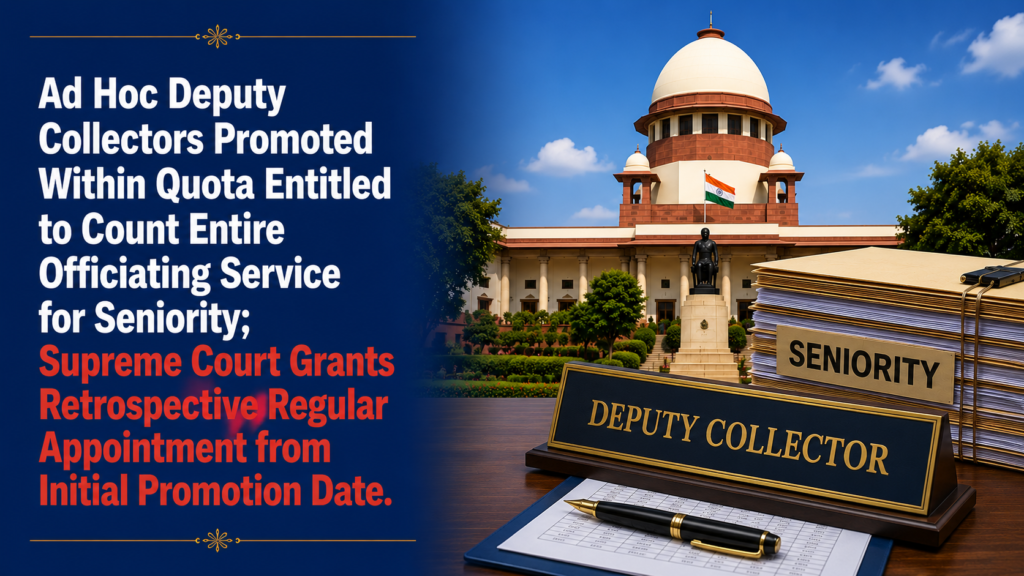
Ad Hoc Deputy Collectors Promoted Within Quota Entitled to Count Entire Officiating Service for Seniority; Supreme Court Grants Retrospective Regular Appointment from Initial Promotion Date.

Supreme Court Holds Deputy Collectors Promoted on Ad Hoc Basis Within Quota Can Count Entire Officiating Service for Seniority After Regularisation.
Facts
The dispute concerned the inter se seniority between promotee Deputy Collectors and direct recruits in the Uttarakhand Civil Services (Executive Branch).
The promotees were originally appointed as Tehsildars and, owing to an acute shortage of Deputy Collectors, were promoted on an ad hoc/stop-gap basis as Deputy Collectors on 1 October 2007 pending regular recruitment. They continued to discharge the duties of Deputy Collectors uninterrupted until they were regularly promoted on 7 May 2012.
Meanwhile, direct recruits selected through the Uttarakhand Public Service Commission entered service in August 2009. The promotees sought regular appointment and seniority from 1 October 2007, contending that their entire continuous officiating service should be counted. The High Court substantially accepted their claim, leading to appeals by the State and the direct recruits before the Supreme Court.
Issues
The Supreme Court considered:
- Whether failure to consult the Public Service Commission before continuing ad hoc promotions beyond one year invalidated the appointments.
- Whether promotee Deputy Collectors were entitled to count their continuous ad hoc service for determining seniority.
- Whether the promotees had been appointed within the prescribed promotee quota.
- Whether the High Court correctly directed reconsideration of vacancy positions by the State Government.
State’s and Direct Recruits’ Arguments
The State and the direct recruits argued that the promotees’ appointments were merely stop-gap arrangements made dehors the statutory recruitment rules and therefore could not be counted for seniority.
They submitted that consultation with the Public Service Commission had not taken place, that the promotees were appointed in excess of their quota, and that seniority could only commence from substantive appointment after regular promotion.
Reliance was placed principally upon Vinod Giri Goswami and Aghore Nath Dey, contending that ad hoc service outside the statutory scheme could not confer seniority.
Promotees’ Arguments
The promotees contended that there were sufficient vacancies within the promotee quota when they were appointed in October 2007 and that the Commission subsequently approved their promotions.
They argued that consultation with the Public Service Commission was merely procedural and that the State itself failed to make the necessary reference. Consequently, the Government could not rely upon its own omission to deny them the statutory benefit contained in Rule 24(4), which permits counting continuous officiating service after subsequent approval by the Commission.
Analysis of the Law
The Supreme Court examined Rule 24(4) of the Uttarakhand Civil Services (Executive Branch) Rules, 2005 and Regulation 5(a) of the Uttarakhand Public Service Commission Regulations, 2003.
The Court observed that Regulation 5(a) requires consultation with the Public Service Commission where an officiating appointment continues beyond one year. However, neither the Rules nor the Regulations declare that failure to obtain such consultation renders the appointment void.
Applying the principles laid down in Manbodhan Lal Srivastava, Suraj Parkash Gupta, Direct Recruit Class II Engineering Officers’ Association, Aghore Nath Dey, and P. Rammohan Rao, the Court held that the consultation requirement is directory rather than mandatory.
Accordingly, failure of the Government to consult the Commission cannot prejudice employees who had no control over that procedural lapse.
Precedent Analysis
The Court distinguished Vinod Giri Goswami by noting that the earlier decision denied seniority because there was no finding that the promotees had continuously served within the promotee quota.
In contrast, the present case established that the promotees had continuously worked against vacancies available within the promotion quota until their regularisation.
The Court relied upon Manbodhan Lal Srivastava to hold consultation with the Public Service Commission to be directory, Suraj Parkash Gupta for the proposition that governmental delay in obtaining approval cannot prejudice employees, Direct Recruit Class II Engineering Officers’ Association regarding counting continuous officiating service after regularisation, and P. Rammohan Rao recognising that delay caused by the Government itself supports, rather than defeats, the employee’s claim.
Court’s Reasoning
The Supreme Court found no material indicating that the Public Service Commission had been consulted before the promotees continued beyond one year in their ad hoc capacity. Nevertheless, that omission was entirely attributable to the State Government.
The Court held that the State could not derive any advantage from its own failure to perform a procedural obligation. Since consultation was merely directory, the appointments remained valid.
The Court further examined the vacancy records and found clear documentary evidence that 19 vacancies existed in the promotee quota during the recruitment year 2007–08, while only 19 promotee Deputy Collectors were in position. Therefore, the promotees had not exceeded their quota and had continuously served against available promotional vacancies.
Having subsequently been regularly promoted, they became entitled to the statutory benefit under Rule 24(4), which expressly provides that continuous officiating service rendered within the promotee quota shall be counted once promotion is approved by the Commission.
Consequently, the High Court erred in directing the State Government to reconsider the existence of vacancies because the documentary record already established that sufficient promotional vacancies were available.
Conclusion
The Supreme Court held that the promotees were entitled to count their entire continuous ad hoc service rendered from 1 October 2007 for determining seniority.
The Court ruled that failure of the State Government to consult the Public Service Commission did not invalidate the appointments, since the consultation requirement was directory and the promotees could not be penalised for the Government’s own procedural lapse.
Accordingly, the Court directed the State Government to treat the promotees as regularly appointed from 1 October 2007 and issue a revised seniority list within three months.
Case Details
Case: State of Uttarakhand v. Jagdish Chandra Kandpal & Others
Court: Supreme Court of India
Case Numbers: Civil Appeal Nos. 3070, 3071, 3072 & 4452 of 2024
Bench: Justice Pamidighantam Sri Narasimha and Justice Alok Aradhe
Date: 29 July 2026
Result: Appeals by the State and direct recruits were dismissed, the promotees’ appeal was allowed, and the Supreme Court held that the promotee Deputy Collectors were entitled to regular appointment and seniority from 1 October 2007, directing revision of the seniority list accordingly.