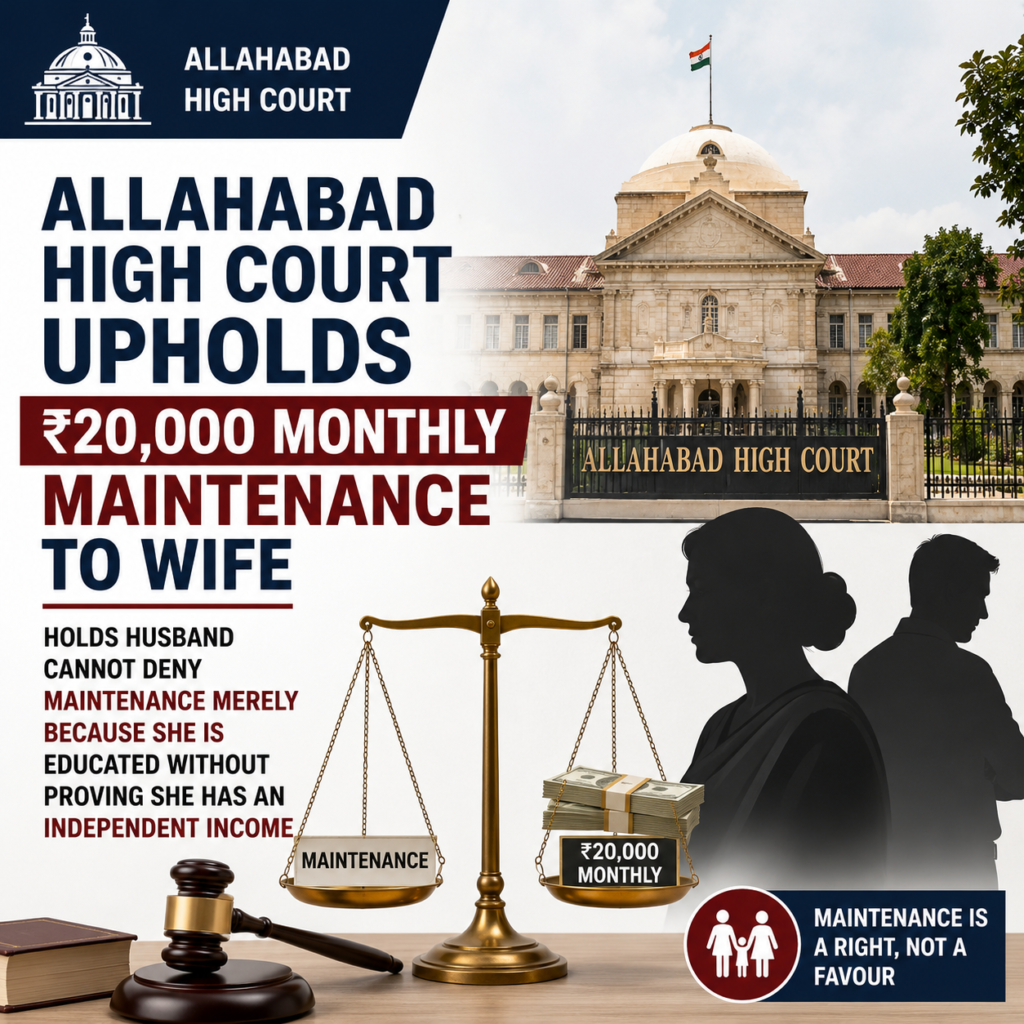
Chartered Accountant Fails to Prove Wife’s Independent Income, Allahabad High Court Upholds ₹20,000 Monthly Maintenance
Facts
Alok Tiwari filed a criminal revision challenging the order dated 14 August 2024 passed by the Principal Judge, Family Court, Mainpuri, under Section 125 of the Code of Criminal Procedure.
The Family Court had directed him to pay maintenance of ₹20,000 per month to his wife, Neha Shukla, from the date of her maintenance application, namely, 17 June 2017.
The parties were married on 12 February 2013 according to Hindu rites. The wife alleged that her husband and his family pressured her and her widowed mother to arrange money for purchasing a flat. A demand of ₹25 lakh was allegedly made, and she claimed to have suffered physical and mental cruelty when the demand was not fulfilled.
The husband admitted receiving ₹5.5 lakh from the wife’s mother during the flat transaction but described the amount as a loan.
The record also contained medical papers relating to injuries sustained by the wife. The husband gave different explanations regarding how those injuries occurred, including that she had fallen in the bathroom, bedroom or from the staircase.
After the wife returned to her parental home in December 2016, the husband instituted divorce proceedings and did not make any serious attempt to resume cohabitation. The mediation record indicated that the wife was willing to live with him, but he was unwilling to continue the matrimonial relationship.
On the financial aspect, the husband was a qualified Chartered Accountant. He claimed that he had lost regular employment after the liquidation of the Jaypee Group and was earning irregularly as a freelance consultant. However, evidence showed that he had continued professional work at different places and had earlier admitted earning approximately ₹90,000 per month.
He owned a Honda City car and had incurred expenditure on air travel, hotels and vacations during the marriage. Despite possessing special knowledge of his finances, he did not produce income-tax returns, bank statements, complete accounts or professional receipts.
The wife was qualified with M.Sc. and B.Ed. degrees. The husband alleged that she earned through tuition and coaching and was also supported by her mother’s pension and properties. However, no documentary evidence was produced to establish that the wife had an actual and sufficient independent income.
Issues
- Whether the wife had sufficient reason to reside separately from her husband.
- Whether the husband had neglected or refused to maintain her.
- Whether the wife’s educational qualifications and alleged capacity to earn disentitled her from receiving maintenance.
- Whether the pension and properties of the wife’s mother could be treated as financial resources available to the wife.
- Whether the husband had sufficient earning capacity to pay ₹20,000 per month.
- Whether maintenance of ₹20,000 per month from the date of the application was excessive or legally unsustainable.
- Whether the Family Court’s findings warranted interference in the High Court’s revisional jurisdiction.
Petitioner’s Arguments
The petitioner, who was the revisionist-husband, argued that his wife was highly educated, employable and financially independent.
He alleged that she earned income from private tuition and coaching but had concealed her actual earnings and financial condition from the Court.
He further relied on the pension and properties of the wife’s mother to contend that the wife had adequate financial support and was not unable to maintain herself.
The husband denied the allegations of cruelty and monetary demands. According to him, the wife had voluntarily left the matrimonial home, behaved improperly with his family and threatened to falsely implicate them in criminal cases.
On his own finances, he submitted that he was no longer in regular employment. He claimed that after the liquidation of the Jaypee Group, he had been working only as a freelance Chartered Accountant with irregular income.
He also relied on his responsibility to maintain his aged parents and contended that the award of ₹20,000 per month was excessive and disproportionate to his current earnings.
Respondent’s Arguments
The respondent-wife supported the Family Court’s decision and submitted that it was based on a detailed appreciation of oral and documentary evidence.
She argued that she was compelled to reside separately because of cruelty, harassment, financial demands and neglect by her husband.
She relied on the pressure allegedly exerted upon her and her widowed mother to arrange money for the purchase of a flat, the husband’s admitted receipt of ₹5.5 lakh, and the medical documents relating to her injuries.
The wife contended that the husband was a professionally qualified Chartered Accountant who had worked with different organisations and continued to undertake consultancy work.
She further submitted that the husband had deliberately withheld income-tax returns, bank statements and complete financial records that would have disclosed his true income.
The wife denied having any regular or sufficient independent income. She argued that her educational qualifications did not establish that she was actually employed or earning enough to maintain herself.
Analysis of the Law
Wife’s right to live separately
For maintenance under Section 125 Cr.P.C., a wife residing separately must establish sufficient cause for doing so and neglect or refusal by the husband to maintain her.
The Court held that continuous pressure on a wife and her widowed mother to arrange money for purchasing a flat, accompanied by harassment, can amount to cruelty even where the demand may not strictly fall within the technical definition of dowry.
The husband’s admitted receipt of ₹5.5 lakh, the medical records relating to the wife’s injuries, his inconsistent explanations for those injuries, the subsequent divorce proceedings and his unwillingness to resume cohabitation collectively supported the finding that the wife had sufficient cause to live separately.
The Court also observed that unsupported allegations against a wife’s character and mental condition are relevant while examining whether she was justified in residing separately.
Education is not the same as actual income
The Court distinguished between a person’s educational qualifications, capacity to earn and actual earnings.
A wife cannot be denied maintenance merely because she is educated or theoretically capable of employment. The relevant inquiry is whether she has an actual and sufficient income that enables her to maintain herself according to the standard contemplated by law.
No appointment letter, salary record, coaching document, tuition-income record, bank entry or other reliable evidence was produced to establish that the wife was earning enough to maintain herself.
Mother’s pension cannot replace husband’s obligation
The Court rejected the husband’s reliance on the wife’s mother’s pension and properties.
The statutory obligation to maintain the wife rests upon the husband. Financial assistance received from a parent cannot automatically be treated as the wife’s independent income.
There was also no evidence that the properties relied upon by the husband belonged exclusively to the wife or generated income available to her.
Assessment of the husband’s income
The Court held that the husband’s financial capacity could be assessed through his qualifications, employment history, professional engagements, lifestyle, prior income disclosures and the documents withheld by him.
The husband was a qualified Chartered Accountant, had worked with different organisations, continued consultancy work and had previously admitted earning around ₹90,000 per month.
His ownership of a car and expenditure on air travel, hotels and vacations also indicated a standard of living inconsistent with his plea of financial incapacity.
Since the husband failed to produce the best evidence concerning his income, including tax returns, bank statements and professional accounts, the Family Court was justified in drawing an adverse inference against him.
Revisional jurisdiction
The High Court clarified that a revisional court does not function as a regular appellate court and cannot reappreciate the entire evidence merely because another view may be possible.
Interference is permissible only where the order under challenge suffers from patent illegality, perversity, jurisdictional error or material irregularity.
Since the Family Court had considered the pleadings, evidence, admissions and surrounding circumstances in detail, the High Court found no such defect.
Precedent Analysis
The Court relied upon the Supreme Court’s decision in Rajnesh v. Neha and Others, (2021) 2 SCC 324.
In that decision, the Supreme Court held that the amount of maintenance must be determined after considering:
- The status and standard of living of the parties;
- The reasonable needs of the wife;
- The husband’s income and earning capacity;
- The husband’s liabilities and responsibilities; and
- The standard of living enjoyed by the wife in the matrimonial home.
The object of maintenance proceedings is to prevent destitution and ensure that a wife who cannot maintain herself is not left without financial support.
Applying these principles, the Court held that the husband’s professional qualifications, admitted work experience, earlier income, consultancy work and lifestyle justified the maintenance award.
The Court also recognised the settled principle that maintenance may be granted from the date of the application where the circumstances justify such relief.
Court’s Reasoning
The Court found that the wife had sufficient cause to reside separately. This conclusion was supported by:
- The admitted payment of ₹5.5 lakh by her mother during the flat transaction;
- Allegations of pressure to arrange additional money;
- Medical records concerning her injuries;
- The husband’s contradictory explanations regarding those injuries;
- His institution of divorce proceedings shortly after separation;
- His failure to make genuine efforts to bring her back; and
- His unwillingness to continue cohabitation during mediation.
On the wife’s alleged income, the Court found no credible evidence that she was employed or earning sufficient money from tuition or coaching. Her M.Sc. and B.Ed. qualifications could not, by themselves, defeat her claim.
The Court held that the wife’s mother’s pension and properties could not discharge the husband’s statutory obligation to maintain his wife.
Regarding the husband’s financial capacity, the Court relied upon his status as a Chartered Accountant, his continued professional engagement, his past admission of earning ₹90,000 per month, his car ownership and expenditure on travel and hotels.
The Court drew an adverse inference from his failure to disclose complete financial documents, despite those records being within his special knowledge.
It concluded that maintenance of ₹20,000 per month was just, reasonable and proportionate. No perversity, illegality or material irregularity was found in the Family Court’s order.
Conclusion
The Allahabad High Court dismissed the husband’s criminal revision and affirmed the Family Court’s order directing him to pay ₹20,000 per month as maintenance to his wife.
The maintenance remained payable from the date of the original application, namely, 17 June 2017.
The Court held that:
- The wife had sufficient cause to reside separately;
- The husband had neglected to maintain her;
- Her educational qualifications did not establish actual financial independence;
- Her mother’s pension and properties could not substitute the husband’s legal obligation;
- The husband possessed sufficient professional earning capacity; and
- The maintenance amount was neither excessive nor disproportionate.
Any amount already paid as interim maintenance or under earlier court orders was directed to be adjusted against the arrears.
Case Details
Case: Alok Tiwari v. State of U.P. and Another
Court: High Court of Judicature at Allahabad
Case Number: Criminal Revision No. 5768 of 2024
Judge: Justice Garima Prashad
Date: 17 June 2026
Result: Criminal revision dismissed; Family Court’s award of ₹20,000 monthly maintenance to the wife from 17 June 2017 affirmed, subject to adjustment of amounts already paid.