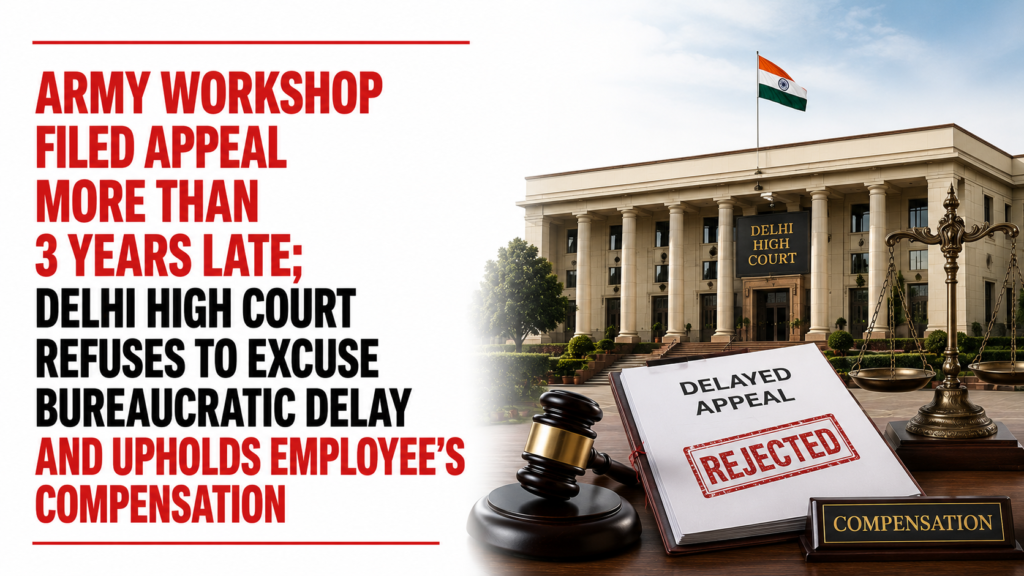
Government Cannot Escape Limitation by Citing File Movement; Delhi High Court Dismisses Army Workshop’s Delayed Appeal
Facts
The appellants, The Commandant, 510 Army Base Workshop and another, challenged an order dated 31 May 2013 passed by the Employees’ Compensation Commissioner, whereby the respondent, Sudarshan Pareek, was awarded compensation of ₹5,23,586, together with interest at 12% per annum from 12 January 2011 under the Employees’ Compensation Act, 1923.
The respondent had been employed with the appellant since 20 October 2009. During the course of his employment, he was nominated to attend an advanced professional training programme on quasi-judicial functions at the Judicial Academy, Chandigarh, scheduled from 13 December to 18 December 2010. After obtaining official permission, he travelled from Meerut Cantonment to Chandigarh on 12 December 2010. During the journey, he met with a road accident and sustained multiple injuries.
Subsequently, a Medical Board assessed the respondent as suffering from 85% permanent disability arising from the accident. When the employer declined compensation, the respondent approached the Employees’ Compensation Commissioner under Section 22 of the Employees’ Compensation Act, who allowed the claim.
The Army authorities filed the present appeal after an extraordinary delay of 1,241 days beyond the prescribed limitation period. Their application for condonation of delay stated that the delay occurred because the matter was processed through various governmental offices for approvals, legal opinion, and administrative sanctions before the appeal could be instituted.
Issues
- Whether the appellants had shown sufficient cause for condonation of the extraordinary delay of 1,241 days in filing the appeal.
- Whether an employee already receiving disability benefits for a pre-existing 65% disability could claim compensation for a subsequent accident resulting in 85% permanent disability.
- Whether the compensation award was without jurisdiction because it was pronounced after the Commissioner had been transferred from one district to another.
Appellants’ Arguments
The appellants submitted that the delay occurred due to the movement of the case file through various governmental authorities for obtaining administrative approval, sanction from the Ministry of Defence, legal vetting, and engagement of counsel.
On merits, they argued that the respondent was already receiving disability benefits on account of an earlier 65% disability. Consequently, awarding compensation on the basis of 85% permanent disability amounted to granting an impermissible additional benefit.
The appellants also contended that the award was rendered without jurisdiction because it had been pronounced after the Commissioner had been transferred from the New Delhi District to the South West District.
Respondent’s Arguments
The respondent opposed condonation of delay, contending that the appellants had merely narrated internal administrative procedures without explaining the prolonged inaction extending over more than three years.
He further submitted that the disability assessed after the accident was distinct from his earlier disability and represented the consequences of the employment-related accident sustained while travelling pursuant to official orders.
The respondent also maintained that no material had been produced to demonstrate any procedural irregularity arising from the Commissioner’s transfer.
Analysis of the Law
The Court held that Section 5 of the Limitation Act requires a litigant to establish “sufficient cause” for delay. Merely explaining internal governmental procedures, movement of files, or administrative approvals does not satisfy this requirement. Government departments are subject to the same law of limitation as private litigants and cannot claim preferential treatment.
Applying the Employees’ Compensation Act, the Court held that a pre-existing disability does not disentitle an employee from claiming compensation for injuries suffered in a subsequent employment accident. The Act does not contain any provision denying compensation merely because an employee had an earlier disability. Since the Medical Board specifically assessed the respondent’s disability arising from the accident at 85%, the earlier disability could not defeat his statutory entitlement.
Regarding jurisdiction, the Court referred to Section 21 of the Employees’ Compensation Act, which expressly permits transfer of proceedings between Commissioners. As the appellants produced no material showing that the statutory procedure governing transfer had been violated, the jurisdictional challenge was rejected.
Precedent Analysis
Postmaster General v. Living Media India Ltd. (2012) 3 SCC 563
The Supreme Court held that condonation of delay is an exception and not a matter of course. Government departments cannot seek automatic condonation merely because files move through several administrative levels. The law of limitation applies equally to the Government. The High Court relied on this decision to reject the explanation based solely on bureaucratic processing.
State of Madhya Pradesh v. Bherulal (2020) 10 SCC 654
The Supreme Court criticised the recurring practice of Government departments attributing delays to official procedures and movement of files. It held that such explanations cannot routinely constitute sufficient cause. The Delhi High Court applied this principle in holding that the appellants had failed to explain the delay of over three years.
Court’s Reasoning
The Court found that the appellants had failed to provide any satisfactory explanation for the 1,241-day delay. Their application merely narrated the movement of files among different governmental authorities without explaining why the statutory limitation period was allowed to expire or why the appeal remained pending for more than three years thereafter. Such administrative processing did not constitute sufficient cause.
Even on merits, the Court found no substance in the appeal. The respondent’s earlier 65% disability predated the accident. The Medical Board had independently assessed the disability caused by the accident at 85%, and the Employees’ Compensation Act does not prohibit compensation merely because an employee had a pre-existing disability.
The Court also rejected the jurisdictional objection, observing that Section 21 of the Act specifically contemplates transfer of proceedings between Commissioners. Since the appellants produced no evidence showing any procedural irregularity in the transfer, the challenge failed.
Accordingly, the Court held that the appeal was barred by limitation and, in any event, devoid of merit.
Conclusion
The Delhi High Court dismissed both the application for condonation of the 1,241-day delay and the appeal. It directed that the entire compensation amount already deposited before the Commissioner, along with accrued interest, be released to the respondent. The appellants were further directed to pay the remaining interest due under the award within four weeks.
Case Details
Case: The Commandant, 510 Army Base Workshop & Anr. v. Sudarshan Pareek
Court: High Court of Delhi
Case No.: FAO 535/2016 with CM APPL. 42809/2016 & CM APPL. 42810/2016
Judge: Justice Manoj Kumar Ohri
Reserved On: 10 July 2026
Pronounced On: 24 July 2026
Relevant Provisions: Sections 5, Limitation Act, 1963; Sections 21 and 22, Employees’ Compensation Act, 1923
Result: Appeal dismissed as barred by limitation and on merits; compensation award upheld; deposited amount with accrued interest directed to be released to the respondent; remaining interest payable within four weeks.