

Court’s decision
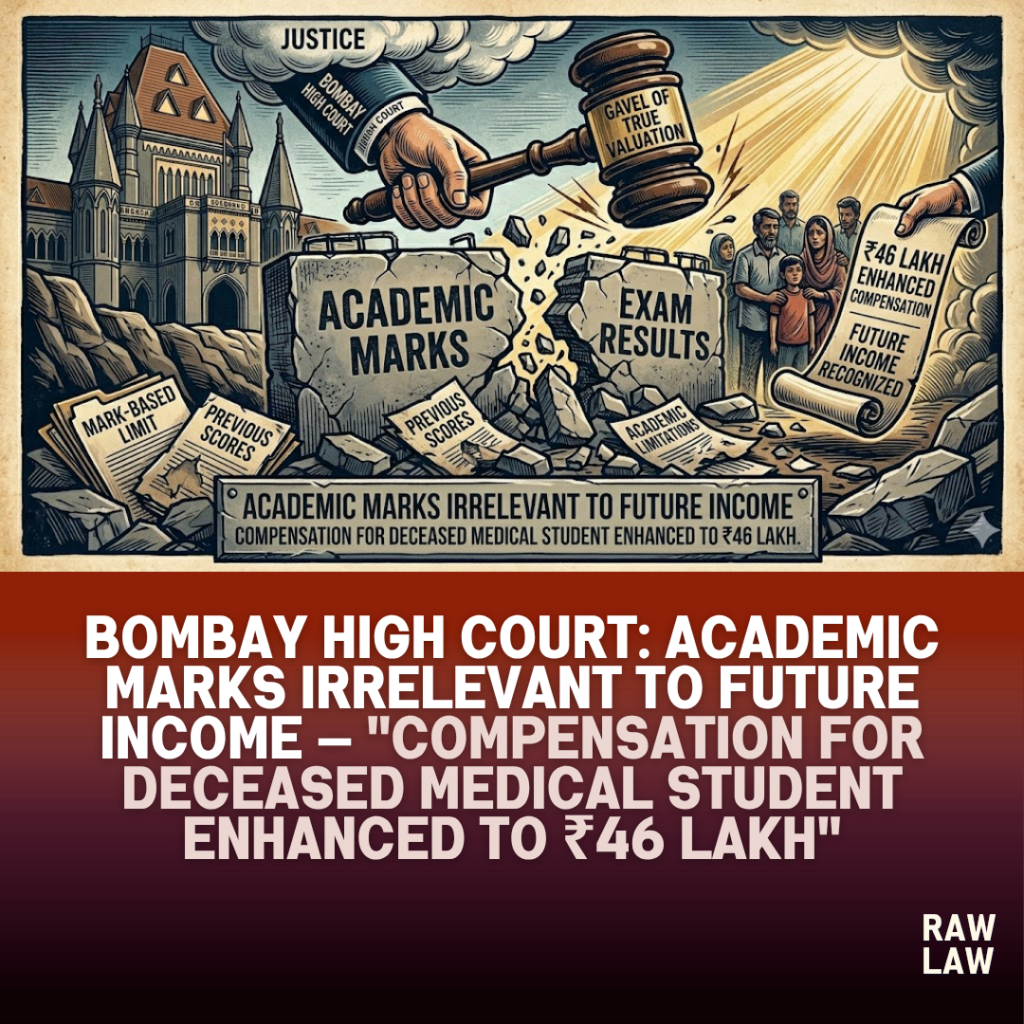
The Bombay High Court partly allowed the claimants’ appeal and enhanced compensation to ₹46,06,000 while dismissing the insurance company’s appeal. The Court held that academic performance cannot be determinative of future earning capacity and applied a realistic assessment of income for a deceased homeopathy student. It reaffirmed that compensation must be based on reasonable probability and not rigid assumptions, especially in cases involving students and future professionals.
Facts
The case arose from a fatal motor accident in 2014 where a 23-year-old student pursuing a BHMS (homeopathy) degree died after his motorcycle collided with a truck.
The claimants—his parents and brother—filed a claim under Section 166 of the Motor Vehicles Act seeking compensation of over ₹1.32 crore.
The Motor Accident Claims Tribunal awarded ₹21.93 lakh, assessing the notional income of the deceased at ₹20,000 per month and applying a multiplier of 18.
Both parties appealed: the insurance company sought reduction, while the claimants sought enhancement.
Issues
The primary issue was determination of notional income of a deceased student with no proven earnings.
The Court also examined whether academic performance could be used as a basis to reduce future earning potential.
Another issue was whether the compensation awarded by the Tribunal was just and reasonable under settled principles.
Petitioner’s arguments
The insurance company argued that the deceased was an average student scoring below 50% and therefore his future earning capacity was uncertain.
It contended that ₹20,000 per month was excessive and should be reduced to ₹10,000, relying on precedents involving engineering students.
The insurer also argued that the claimants were not dependents, particularly since one was allegedly receiving pension and another was employed.
Respondent’s arguments
The claimants argued that the deceased was pursuing a professional medical degree and had the potential to earn significantly as a homeopathy doctor.
They contended that the Tribunal undervalued his future income and failed to consider realistic earning prospects.
It was further argued that academic performance cannot determine professional success or income potential.
The claimants sought enhancement of monthly income to at least ₹30,000–₹35,000 with addition of future prospects.
Analysis of the law
The Court reiterated that compensation under the Motor Vehicles Act must be based on “just compensation”, requiring a balance between evidence and reasonable estimation.
It emphasized that in cases involving students, strict documentary proof of income is often unavailable and courts must rely on reasonable guesswork grounded in reality.
The Court also clarified that preponderance of probability is the applicable standard, not strict proof as in criminal trials.
It further reaffirmed principles governing future prospects, multiplier method, and conventional heads as laid down by the Supreme Court.
Precedent analysis
The Court relied on:
- Chandra v. Mukesh Kumar Yadav (2022)
Recognized need for realistic estimation of income in absence of documentary proof. - Prabhavathi v. BMTC (2025)
Clarified that strict rules of evidence do not apply in compensation cases. - National Insurance Co. v. Pranay Sethi (2017)
Established framework for future prospects and conventional heads.
It distinguished Meena Pawaia v. Ashraf Ali (2021), noting that engineering student cases cannot be equated with medical aspirants.
Court’s reasoning
The Court rejected the Tribunal’s reasoning linking academic performance to earning capacity, observing that “academic excellence and earning potential are distinct.”
It held that even an average student could succeed professionally and earn well in practice.
As noted in the judgment, the deceased had reached the third year of a medical degree and therefore had a reasonable probability of becoming a practicing doctor.
The Court found that reducing income based on marks was unjustified and unrealistic.
It reassessed monthly income at ₹30,000, considering the nature of the profession and future prospects.
Applying 40% addition for future prospects, multiplier of 18, and deductions, the Court recalculated compensation.
Conclusion
The Bombay High Court enhanced compensation to ₹46,06,000 with 7% interest and dismissed the insurer’s appeal, granting an additional ₹24.13 lakh over the Tribunal’s award.
Implications
This judgment is a significant development in motor accident compensation jurisprudence involving students.
It clarifies that academic performance cannot be a proxy for future earning capacity, especially in professional courses.
The ruling strengthens the principle of realistic assessment in absence of direct income evidence.
It also reinforces a claimant-friendly approach, ensuring fair compensation for loss of future potential rather than rigid reliance on academic metrics.
Case law references
- Chandra v. Mukesh Kumar Yadav (2022)
Courts must use realistic estimation where no documentary proof exists. - Prabhavathi v. BMTC (2025)
Standard of proof is preponderance of probability. - National Insurance Co. v. Pranay Sethi (2017)
Framework for compensation including future prospects. - Meena Pawaia v. Ashraf Ali (2021)
Distinguished on facts—engineering student case not comparable.
FAQs
1. Can academic marks determine compensation in accident cases?
No. Courts have held that academic performance does not determine future earning capacity.
2. How do courts calculate income of a deceased student?
Courts use reasonable estimation based on course, career prospects, and surrounding circumstances.
3. What is “future prospects” in compensation law?
It refers to expected increase in income over time, typically added as a percentage (e.g., 40%) to base income.


