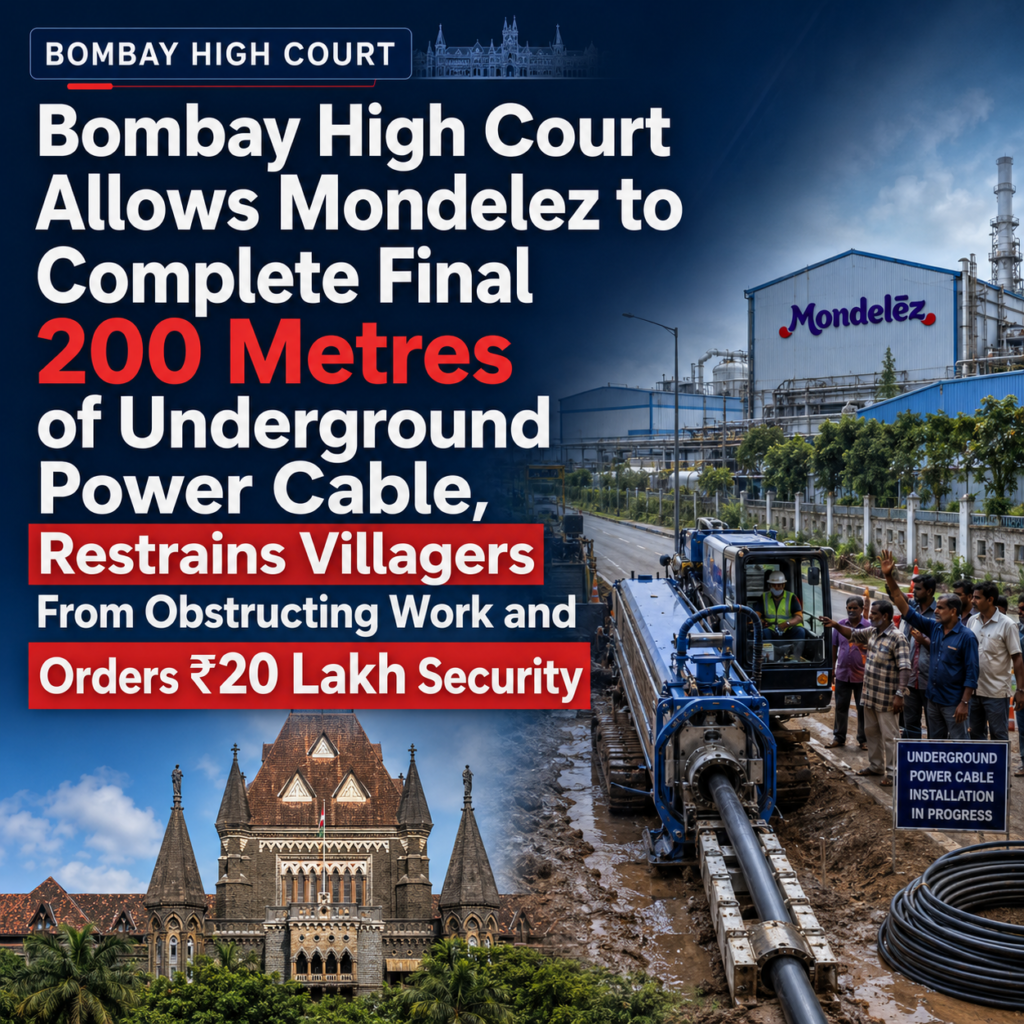
Bombay High Court Allows Mondelez to Complete Final 200 Metres of Underground Power Cable, Restrains Villagers From Obstructing Work

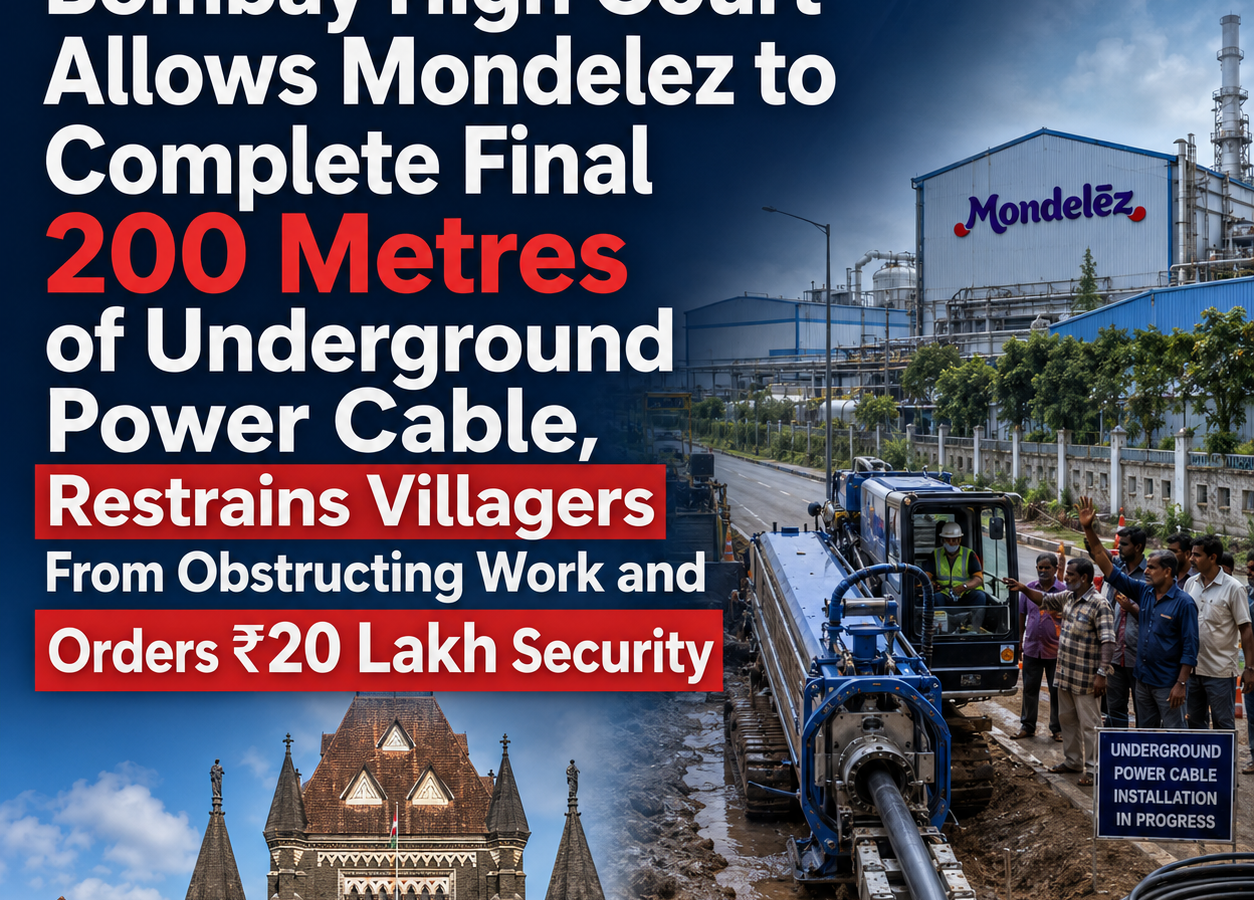
Villagers Cannot Block Final Stretch of Mondelez’s 14-Km Power Cable After Authorities Granted Permissions: Bombay High Court
The Bombay High Court has permitted Mondelez India Foods Private Limited to complete the remaining 200 metres of an underground high-tension electricity cable leading to its Induri manufacturing plant.
Justice N. J. Jamadar set aside concurrent orders of the trial court and the District Court that had refused temporary injunction. The Court held that the lower courts had ignored clear material showing the existence of the public road and had incorrectly assessed the balance of convenience.
Mondelez was permitted to complete the cable work through horizontal directional drilling, subject to strict compliance with statutory permissions and a deposit of ₹20 lakh as security for any compensation that may ultimately be awarded to the respondents.
Facts
Mondelez India Foods Private Limited, formerly known as Cadbury India Company Limited, operates a manufacturing plant at Village Induri, Taluka Maval, District Pune.
The company required additional electricity supply and applied to the Maharashtra State Electricity Distribution Company Limited for an additional load of 4689 KV.
After receiving approval, Mondelez obtained permissions and no-objection certificates from MSEDCL, the Maharashtra Industrial Development Corporation, the Pune Zilla Parishad and the Induri Village Panchayat for laying an underground high-tension cable from the MSEDCL substation to its factory.
The proposed express feeder line covered approximately 14 kilometres.
The company completed around 13.8 kilometres of the cable route. However, local residents allegedly obstructed work on the final stretch of approximately 200 metres adjoining Gat No. 391 at Village Induri.
Mondelez claimed that the remaining cable was to be laid along the side margin of a public or Zilla Parishad road.
The residents disputed this claim. They alleged that Mondelez was attempting to lay the cable through their private properties under the guise of carrying out work along the road margin.
After issuing a cease-and-desist notice, Mondelez instituted a civil suit seeking a permanent injunction restraining the residents from obstructing the cable-laying work.
It also filed an application for temporary injunction.
The trial court rejected the application, holding that Mondelez had not established that the disputed strip formed part of the Zilla Parishad road. It also held that an alternative remedy was available under the Works of Licensees Rules, 2006.
The District Court dismissed the appeal and affirmed the trial court’s order.
Mondelez then approached the Bombay High Court under Article 227 of the Constitution.
Issues
The Court considered the following issues:
- Whether Mondelez had established a strong prima facie case that the proposed cable route passed along an existing public road.
- Whether the lower courts had perversely ignored the Court Commissioner’s report and other material confirming the existence of the road.
- Whether residents claiming ownership over the disputed stretch could obstruct the laying of an electricity cable sanctioned by MSEDCL and other authorities.
- Whether Mondelez was required to pursue an alternative remedy under the Works of Licensees Rules, 2006.
- Whether granting a temporary injunction would improperly amount to granting final relief at the interim stage.
- Whether the balance of convenience and risk of irreparable injury justified allowing the remaining cable work.
- What conditions were necessary to protect the respondents if they ultimately succeeded in proving ownership or entitlement to compensation.
Petitioner’s Arguments
Mondelez argued that the lower courts had failed to apply the settled principles governing temporary injunctions.
It submitted that the entire 13.8-kilometre cable-laying work had already been completed and that only the final 200 metres remained because of the respondents’ obstruction.
The company relied upon permissions granted by MSEDCL, MIDC, Pune Zilla Parishad and the Induri Village Panchayat.
It pointed out that the Zilla Parishad had specifically permitted the cable to be laid at the prescribed distance from the centre or edge of the district road.
Mondelez argued that the Executive Engineer of the Zilla Parishad, who had been appointed as Court Commissioner, had inspected the site and submitted a report confirming the existence of the road.
According to the company, the trial court and the District Court wrongly ignored this report and relied instead upon irrelevant questions regarding whether the road had been formally acquired or transferred between public authorities.
Mondelez further argued that even where electricity lines pass through private property, the statutory framework permits the licensee to carry out the work, subject to payment of compensation for any damage caused.
It relied upon the Supreme Court’s decisions concerning the powers of electricity and telegraph authorities to lay transmission lines in the larger public interest.
The company submitted that refusing interim relief would render the entire 13.8-kilometre cable project useless.
It also contended that the remaining cable would be installed through horizontal directional drilling, a trenchless method carried out below the road surface, causing minimal damage and allowing continued use of the land.
Mondelez expressed willingness to comply with any condition imposed by the Court and offered to secure the respondents against any eventual compensation claim.
Respondent’s Arguments
The respondents supported the concurrent orders passed by the lower courts.
They argued that the High Court’s jurisdiction under Article 227 was supervisory and could not be used as a disguised appellate jurisdiction to reappreciate the evidence.
It was submitted that Mondelez had failed to prove that the disputed stretch was part of the public road or its side margin.
The respondents alleged that the company was attempting to lay the cable through private agricultural and residential properties.
They contended that granting temporary injunction would effectively grant the final relief sought in the suit before the rights of the parties had been finally adjudicated.
The respondents also argued that Mondelez was not itself an electricity licensee but only a consumer seeking additional electricity for its private manufacturing plant.
According to them, the company could not rely upon statutory powers granted to MSEDCL or other electricity authorities.
It was further submitted that if the work was intended to pass through private property, Mondelez or the licensee had an alternative remedy under Rule 3 of the Works of Licensees Rules, 2006 by approaching the designated authority in the event of obstruction.
Analysis of the Law
Scope of Supervisory Jurisdiction Under Article 227
The Court recognised that Article 227 confers supervisory and not appellate jurisdiction.
Ordinarily, the High Court does not reappreciate evidence or interfere merely because another view is possible.
However, intervention is justified where a subordinate court:
- ignores material evidence;
- relies upon irrelevant considerations;
- exercises discretion perversely;
- commits a patent error of law; or
- causes a grave miscarriage of justice.
The Court found that the present case fell within those exceptional grounds.
Prima Facie Existence of the Road
The Court examined the report of the Executive Engineer appointed as Court Commissioner.
The report showed that the road branched from State Highway No. 55 and had originally been classified as Other District Road No. 61 under the control of the Pune Zilla Parishad.
The road was later upgraded and entrusted to the Public Works Department.
The report and the photographs annexed to it showed the existence of the road and structures on both sides.
The villagers had obstructed the cable work only for the final 200-metre stretch, claiming that the land beneath the road belonged to them.
The Court held that the lower courts had improperly downplayed this report and had relied upon irrelevant considerations such as whether the road appeared in a Gat map or whether the land beneath the road had been formally acquired.
Once the physical existence of the road was prima facie established, the respondents faced a serious burden in proving private ownership of the land beneath it.
Statutory Power to Lay Electricity Lines
The Court examined Sections 10 and 16 of the Indian Telegraph Act, 1885.
Section 10 empowers the telegraph authority to place and maintain lines under, over, along or across immovable property, subject to the obligation to cause as little damage as possible and pay full compensation for damage sustained.
Section 16 authorises the District Magistrate to permit the exercise of such powers where obstruction or resistance occurs.
The Court also considered the Electricity Act, 2003 and the statutory powers extended to electricity licensees.
It held that uninterrupted access for laying electricity infrastructure is recognised as being in the larger public interest.
The fact that the dedicated feeder was meant to serve a particular industrial consumer did not remove the statutory character of the work undertaken by the licensee.
The infrastructure remained part of the electricity distribution system, even though its cost was borne by Mondelez.
Alternative Remedy Under the Works of Licensees Rules
The Court held that Rule 3 of the Works of Licensees Rules, 2006 applies where an owner or occupier of land raises an objection to work proposed on that land.
In the present case, the respondents had not prima facie established their ownership or occupation of the road stretch.
Since the material showed that the cable was to be laid along an existing road, Mondelez could not be denied injunction merely on the ground that it should pursue the alternative statutory remedy.
Temporary Injunction Principles
The Court reiterated that temporary injunction depends upon:
- a strong prima facie case;
- balance of convenience; and
- risk of irreparable injury.
The Court held that the lower courts had failed to properly compare the consequences of granting and refusing injunction.
Mondelez had completed 13.8 kilometres of cable work. Refusal to permit the remaining 200 metres would render the entire project ineffective.
In contrast, horizontal directional drilling beneath the surface was unlikely to cause substantial or irreversible damage to the respondents.
Any damage ultimately proved could be compensated in money.
Interim Relief Resembling Final Relief
The Court acknowledged that interim relief should ordinarily not grant the entire final relief sought in the suit.
However, this is not an absolute rule.
In rare and exceptional cases, such interim relief may be granted where:
- the applicant has an exceptionally strong prima facie case;
- refusal would effectively defeat the main proceeding;
- the injury is immediate and irreparable; and
- equities can be protected through suitable conditions.
The Court found those conditions satisfied in the present case.
Precedent Analysis
Rajendra Diwan v. Pradeep Kumar Ranibala
The Supreme Court explained that Article 227 jurisdiction is supervisory and cannot be converted into an appellate forum.
Interference is permissible only in cases of patent illegality, perversity, arbitrariness, jurisdictional error or grave miscarriage of justice.
The Bombay High Court relied upon this principle while holding that the lower courts’ treatment of the Commissioner’s report and the road evidence was ex facie perverse.
Power Grid Corporation of India Ltd. v. Century Textiles and Industries Ltd.
The Supreme Court held that electricity transmission authorities exercising powers under the Telegraph Act are entitled to unobstructed access for laying transmission lines.
Electricity infrastructure is essential for economic growth, development and public welfare, and the statutory scheme does not permit private obstruction to defeat that object.
The Court applied this principle to the dedicated express feeder sanctioned for Mondelez.
Century Rayon Ltd. v. IVP Ltd.
The Supreme Court reiterated the importance of unobstructed access for electricity infrastructure and recognised the statutory authority of licensees to lay electricity lines, subject to payment of compensation where required.
The Court rejected the argument that the principle was irrelevant merely because Mondelez was the consumer funding the dedicated line.
Jala Maisaiah v. Transmission Corporation of Telangana Ltd.
The Telangana High Court had recognised the authority of electricity transmission bodies to lay lines through property in accordance with statutory powers, with compensation being the landowner’s primary remedy for proven damage.
This supported Mondelez’s submission that physical obstruction was not the appropriate remedy.
Hubbard v. Vosper
The English Court of Appeal emphasised that while deciding temporary injunctions, the Court must consider the entire case and determine where the balance of convenience lies.
The Bombay High Court relied upon this approach while comparing the prejudice to Mondelez with the limited possible impact upon the respondents.
Ramakant Ambalal Choksi v. Harish Ambalal Choksi
The Supreme Court restated the three essential requirements for temporary injunction:
- prima facie case;
- irreparable injury; and
- balance of convenience.
It also held that the Court must compare the likely injury caused by granting or refusing injunction.
Deoraj v. State of Maharashtra
The Supreme Court held that interim relief resembling final relief may be granted in rare cases where withholding relief would effectively defeat the main proceeding and cause immediate and extreme injustice.
The Bombay High Court relied upon this decision to permit completion of the remaining cable work despite the relief substantially resembling the final relief sought in the suit.
Court’s Reasoning
The Court found that Mondelez had obtained the required approvals from MSEDCL, MIDC, the Zilla Parishad and the Village Panchayat.
The company had already completed 13.8 kilometres of the dedicated feeder line, leaving only approximately 200 metres unfinished.
The report of the Executive Engineer clearly established the existence of the road along the disputed stretch.
The lower courts had ignored this material and had been influenced by questions regarding the transfer of administrative control, the absence of the road in the Gat map and the acquisition history of the underlying land.
The Court held that these considerations did not disprove the actual existence of the road.
Once the road was prima facie shown to exist, the respondents’ allegation of private ownership became doubtful and required proof at trial.
The Court further held that electricity infrastructure cannot be obstructed merely because a particular consumer bears its cost.
The dedicated feeder was being executed under MSEDCL’s sanction as part of the distribution system.
The balance of convenience was overwhelmingly in Mondelez’s favour.
Without the final 200 metres, the entire 13.8-kilometre cable would remain unusable.
By contrast, the underground cable would be installed through horizontal directional drilling beneath the road surface and would cause minimal disruption.
Any damage ultimately proved could be compensated monetarily.
The Court therefore found an exceptionally strong prima facie case warranting interim protection.
To preserve the respondents’ rights, the Court required Mondelez to deposit ₹20 lakh before the trial court as security for any compensation that might later be awarded.
Conclusion
The Bombay High Court allowed the writ petition and set aside:
- the trial court’s order dated 12 July 2024 rejecting temporary injunction; and
- the District Court’s order dated 30 August 2025 affirming that refusal.
The application for temporary injunction was allowed.
The respondents were restrained from obstructing Mondelez and its authorised agents from laying the underground express feeder cable over the remaining disputed stretch.
The relief was made subject to the following conditions:
- the work must strictly comply with all permissions granted by the competent authorities;
- the cable must be laid through horizontal directional drilling;
- minimum possible damage must be caused to the land;
- Mondelez must deposit ₹20 lakh before the trial court as security;
- the amount must be invested in an interest-bearing account; and
- the security will remain subject to the final outcome of the civil suit.
The Court clarified that its findings were confined to the temporary injunction application and would not influence the final adjudication of ownership, compensation or other rights in the suit.
Case: Mondelez India Foods Private Limited v. Vishal Pansare & Ors.
Court: High Court of Judicature at Bombay
Case Number: Writ Petition No. 12747 of 2025
Judge: Justice N. J. Jamadar
Date: 23 June 2026
Result: Petition allowed; lower court orders set aside and temporary injunction granted permitting Mondelez to complete the remaining 200 metres of underground electricity cable through horizontal directional drilling, subject to depositing ₹20 lakh as security.