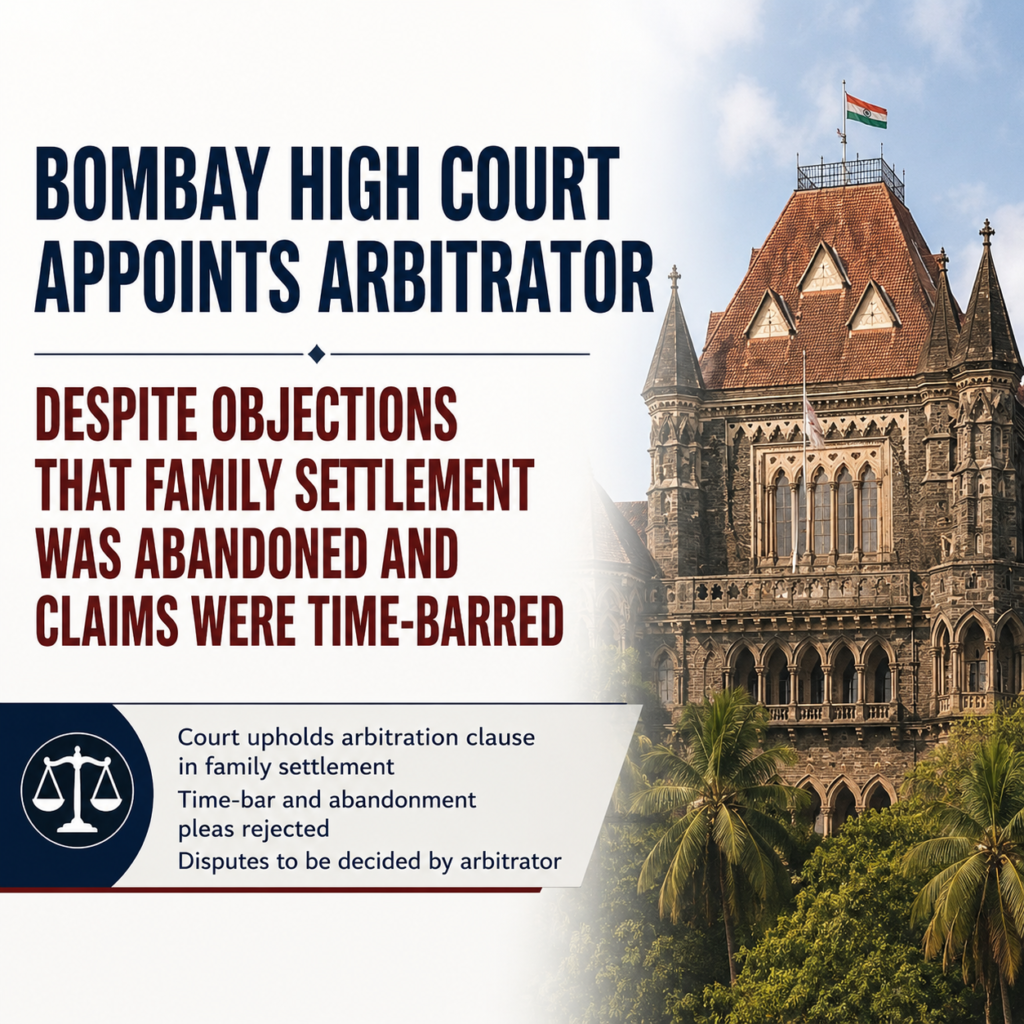
Bombay High Court Appoints Arbitrator Despite Objections That Family Settlement Was Abandoned and Claims Were Time-Barred

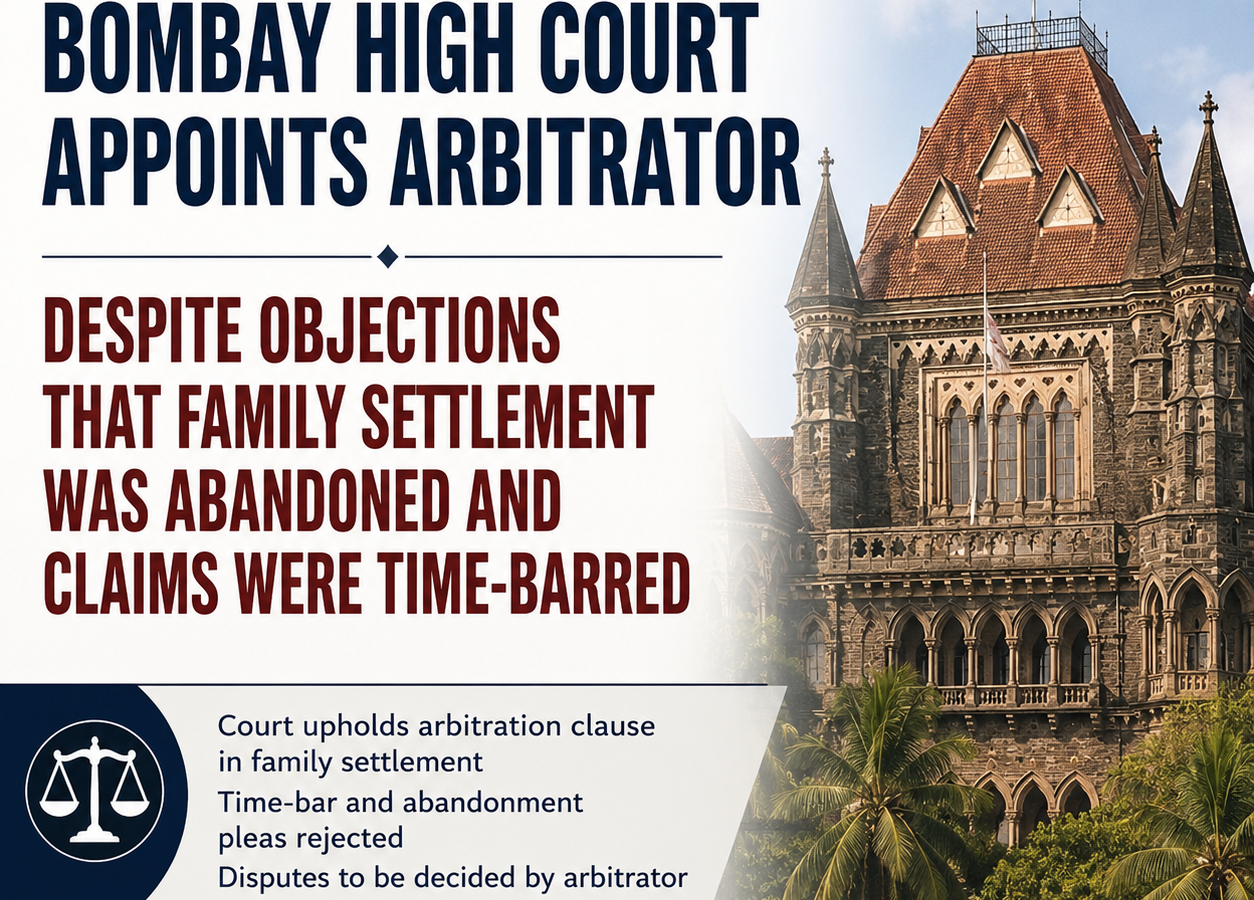
Bombay High Court Appoints Arbitrator in Family Settlement Dispute; Holds Section 11 Court Cannot Examine Limitation of Claims or Alleged Abandonment Beyond Existence of Arbitration Agreement
Facts
The applicant, Mr. Palwinder Singh Samra, filed an application under Section 11 of the Arbitration and Conciliation Act, 1996 seeking appointment of an arbitral tribunal against the respondent, Mr. Sukhvinder Singh Samra. The parties are real brothers who were carrying on joint partnership businesses and had executed a Family Settlement Deed / MoU dated 15 November 2017 to separate their businesses and distribute their properties. The said MoU contained Clause 15, which provided for arbitration of disputes, with the arbitration proceedings to be conducted at Navi Mumbai.
Disputes arose between the parties and the applicant issued a notice under Section 21 of the Arbitration Act on 28 January 2026 invoking the arbitration clause. Since the parties failed to agree on appointment of an arbitrator, the applicant approached the Bombay High Court under Section 11.
Issues
The principal issue before the Court was whether an arbitrator should be appointed under Section 11 of the Arbitration Act when the respondent objected on the grounds that the claim was barred by limitation, the MoU and arbitration clause had been abandoned, and the applicant had earlier pursued civil proceedings in respect of the same subject matter.
The Court also considered whether, at the Section 11 stage, it could examine issues such as alleged destruction of the MoU, withdrawal of a civil suit without liberty, and whether the arbitral claims were stale or time-barred.
Petitioner’s Arguments
The applicant argued that the Family Settlement Deed dated 15 November 2017 contained a valid arbitration clause and that the disputes between the parties arose out of the said agreement. It was submitted that the Court’s role under Section 11 is limited to examining the prima facie existence of an arbitration agreement.
The applicant further submitted that the arbitration clause was not disputed in the response to the Section 21 notice. As regards limitation, abandonment, destruction of the agreement, and earlier civil proceedings, the applicant contended that these were matters to be decided by the arbitral tribunal and not by the referral court at the Section 11 stage.
Reliance was placed on In Re: Interplay Between Arbitration Agreements under the Arbitration and Conciliation Act, 1996 and the Indian Stamp Act, 1899, SBI General Insurance Co. Ltd. v. Krish Spinning, and other judgments to contend that the referral court must confine itself to the existence of the arbitration agreement.
Respondent’s Arguments
The respondent opposed the application on the ground that the claim was stale and barred by limitation. It was argued that the transfer contemplated under the MoU was to take place on 9 February 2018, whereas the notice invoking arbitration was issued only on 28 January 2026.
The respondent further argued that the applicant had already filed Civil Suit No. 2335 of 2022 before the Civil Judge, Junior Division, Amritsar, in respect of the same property, and therefore had abandoned the arbitration remedy. It was also contended that since the suit was withdrawn without liberty to file arbitration proceedings, a subsequent Section 11 application was barred under Order XXIII Rule 1 of the Code of Civil Procedure.
The respondent additionally contended that the applicant had filed proceedings under the Punjab Land Revenue Code for partition of the property, which was inconsistent with the claim sought to be referred to arbitration. It was also argued that the MoU of 2017 had been destroyed in the presence of witnesses and, in the absence of the original or certified copy, the Court could not find that an arbitration agreement existed.
Analysis of the Law
The Court held that the scope of judicial interference under Section 11 has significantly narrowed after the Supreme Court’s decisions in Interplay and SBI General Insurance Co. Ltd. The referral court is required to examine only the existence of the arbitration agreement and not enter into other disputed questions.
The Court noted that while limitation for filing a Section 11 application can be examined, the referral court cannot conduct a detailed enquiry into whether the underlying arbitral claims are time-barred. The limitation for filing a Section 11 application is to be counted from the date of valid invocation of arbitration and refusal or failure by the other party to appoint an arbitrator.
The Court held that the issue whether the claim itself is barred by limitation is for the arbitral tribunal to determine, and not for the referral court at the appointment stage.
Precedent Analysis
The Court relied heavily on the Supreme Court’s ruling in SBI General Insurance Co. Ltd. v. Krish Spinning, where it was clarified that the Section 11 court should only examine whether the application for appointment of arbitrator is filed within limitation and should not undertake an intricate evidentiary enquiry into whether the underlying claims are time-barred.
The Court also relied on the seven-judge bench decision in Interplay, which held that the referral court under Section 11 must examine only the existence of an arbitration agreement and not other issues. The Court observed that issues such as abandonment, waiver, destruction of the MoU, effect of prior civil proceedings, and applicability of Order XXIII Rule 1 CPC would require factual examination and therefore fall within the domain of the arbitral tribunal.
The respondent’s reliance on Rajiv Gaddh v. Subodh Parkash was distinguished. The Court held that Rajiv Gaddh dealt with a situation where an earlier Section 11 application had been withdrawn without liberty and a fresh Section 11 application was later filed. That was not the position in the present case, where the earlier proceeding was a civil suit and not a Section 11 application.
Court’s Reasoning
The Court found that there was no real dispute regarding the existence of Clause 15 in the MoU of 2017. The respondent’s objection was not that no arbitration clause ever existed, but that the MoU had allegedly been destroyed later and therefore was not acted upon. The Court held that once the MoU and arbitration clause were admitted, the question whether the agreement was subsequently destroyed or abandoned was a matter of evidence to be decided by the arbitral tribunal.
The Court further held that the applicant’s earlier filing of a civil suit did not permit the Section 11 court to reject the present application on the ground of waiver or abandonment. Such an enquiry would travel beyond the limited scope of Section 11.
On limitation, the Court held that the Section 21 notice was issued on 28 January 2026 and the Section 11 application was filed thereafter within the permissible period. Whether the substantive claims were time-barred was left open for the arbitrator.
Conclusion
The Bombay High Court allowed the arbitration application and appointed Mr. Aseem Naphade, Advocate, as the sole arbitrator to adjudicate the disputes between the parties arising out of and in connection with the Family Settlement Deed / MoU dated 15 November 2017.
The Court held that questions relating to limitation of claims, abandonment of the arbitration clause, withdrawal of civil suit, alleged destruction of the MoU, and other factual objections must be decided by the arbitral tribunal. All contentions of both parties were expressly kept open.
Case Details
Case: Mr. Palwinder Singh Samra v. Mr. Sukhvinder Singh Samra
Court: Bombay High Court, Ordinary Original Civil Jurisdiction
Case Number: Arbitration Application (L) No. 15700 of 2026
Judge: Justice Arun R. Pedneker
Date: 2 July 2026
Result: Arbitration application allowed; sole arbitrator appointed; all contentions kept open.