

Court’s decision
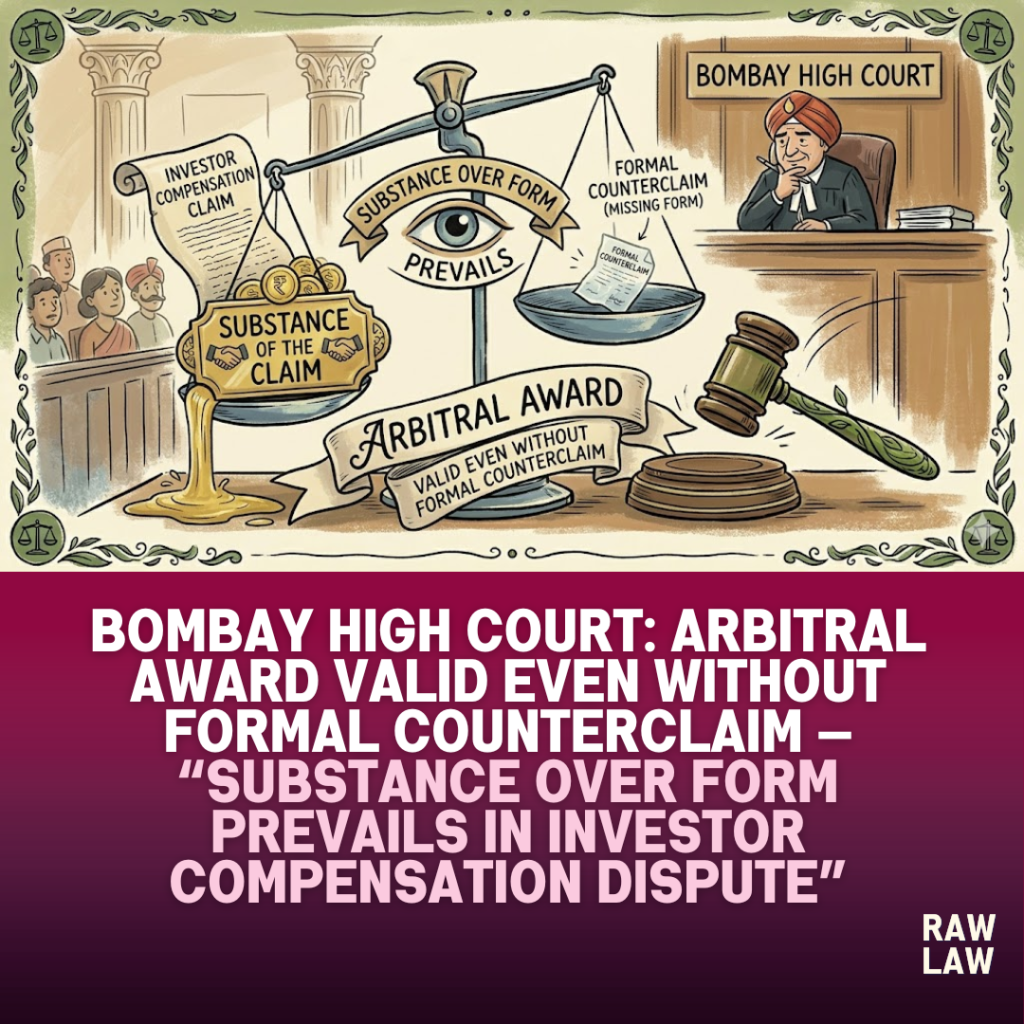
The Bombay High Court dismissed the challenge to an arbitral award, holding that an award in favour of an investor can be sustained even in the absence of a formally filed counterclaim, where the substance of the claim is evident from the record. The Court upheld the majority arbitral award granting ₹23.30 lakh compensation, emphasizing that procedural technicalities cannot defeat substantive justice, especially where both parties operated under a shared misconception regarding conciliation findings.
Facts
The dispute arose from a trading error under a Margin Trading Facility, where shares purchased by the investor were auctioned due to a technical glitch attributable to the stockbroker. As noted on pages 4–5, the broker mistakenly uploaded incorrect PAN details, preventing pledge creation and leading to auction of shares.
The investor suffered financial loss due to rising share prices post-auction. A complaint was filed before the stock exchange mechanism, leading to conciliation proceedings.
The conciliator declared the process unsuccessful but recorded an “admissible claim value” of ₹75 lakh, which both parties mistakenly treated as an awarded amount.
The broker challenged this before arbitration, and despite no formal counterclaim by the investor, the majority arbitral award granted ₹23.30 lakh compensation.
Issues
The key issue was whether an arbitral tribunal can award compensation in favour of a party that did not formally file a claim or counterclaim.
Another issue was whether treating a statement of defence as a counterclaim renders the award illegal under Section 34 of the Arbitration and Conciliation Act.
The Court also examined whether the award of compensation for alleged “notional loss” was legally sustainable.
Petitioner’s arguments
The stockbroker argued that the arbitral award was patently illegal because no counterclaim had been filed by the investor.
It contended that the arbitral tribunal exceeded its jurisdiction by granting relief without a formal claim.
The petitioner also argued that the alleged loss was merely notional and not compensable under law.
It further submitted that the conciliator’s determination of ₹75 lakh was erroneous and wrongly influenced the arbitral proceedings.
Respondent’s arguments
The investor argued that the statement of defence clearly contained a claim for compensation, and the tribunal rightly treated it as a counterclaim.
It was contended that procedural form should not override substantive justice, particularly where the investor was not legally trained.
The respondent emphasized that the broker admitted its mistake, and the loss suffered was real and directly attributable to that error.
It was further argued that the arbitral award adopted a conservative approach in quantifying damages.
Analysis of the law
The Court analyzed the scope of interference under Section 34 of the Arbitration Act, reiterating that courts cannot reappreciate evidence or interfere unless the award is patently illegal or against public policy.
It emphasized that arbitration law prioritizes substance over procedural technicalities, especially in commercial disputes.
The Court also examined the SEBI framework governing conciliation and arbitration, clarifying that a conciliator’s determination of claim value is only for fee computation and not binding.
Precedent analysis
The Court relied on multiple precedents to support limited judicial interference and flexible approach in quantifying damages:
- Construction & Design Services v. Delhi Development Authority
Recognized that arbitral tribunals may adopt reasonable estimation in quantifying damages. - Board of Control for Cricket in India v. Kochi Cricket Pvt. Ltd.
Reaffirmed limited scope of interference under Section 34. - New India Assurance v. Shirdi Industries Ltd.
Allowed tribunals to apply “rough and ready” formulas where exact loss is difficult to quantify.
The Court applied these principles to uphold the arbitral award.
Court’s reasoning
The Court found that both parties operated under a misconception that the conciliator had awarded ₹75 lakh. This confusion influenced the arbitration process.
It observed that the investor’s statement of defence clearly articulated a compensation claim, even if not formally labeled as a counterclaim.
The Court held that rejecting the claim solely on procedural grounds would be unjust, particularly when the broker itself misunderstood the conciliator’s role.
On merits, the Court noted that the broker admitted its error, and the loss suffered by the investor was real.
It upheld the tribunal’s approach of calculating compensation based on share price difference as a reasonable and conservative method.
Conclusion
The Bombay High Court upheld the arbitral award of ₹23.30 lakh and dismissed the petition, finding no patent illegality or perversity in the tribunal’s approach.
Implications
This judgment reinforces a pro-arbitration stance by prioritizing substantive justice over procedural technicalities.
It clarifies that courts will not interfere with arbitral awards merely due to absence of formal pleadings if the claim is otherwise evident.
The ruling also strengthens investor protection by holding financial intermediaries accountable for operational errors.
Additionally, it highlights the importance of correctly understanding conciliation reports in securities dispute mechanisms.
Case law references
- Construction & Design Services v. Delhi Development Authority
Allowed estimation-based compensation where precise loss is uncertain. - BCCI v. Kochi Cricket Pvt. Ltd.
Defined limited judicial review under arbitration law. - New India Assurance v. Shirdi Industries Ltd.
Approved use of approximate methods for damage calculation.
FAQs
1. Can an arbitral award be passed without a formal counterclaim?
Yes. If the substance of a claim is evident from pleadings like a statement of defence, tribunals may treat it as a counterclaim.
2. Is a conciliator’s claim value binding in arbitration?
No. It is only used for determining arbitration fees and does not bind the arbitral tribunal.
3. Can compensation be awarded for notional loss in stock market disputes?
Courts may allow compensation where loss is reasonably attributable to the broker’s fault, even if exact quantification is difficult.

