

1. Court’s decision
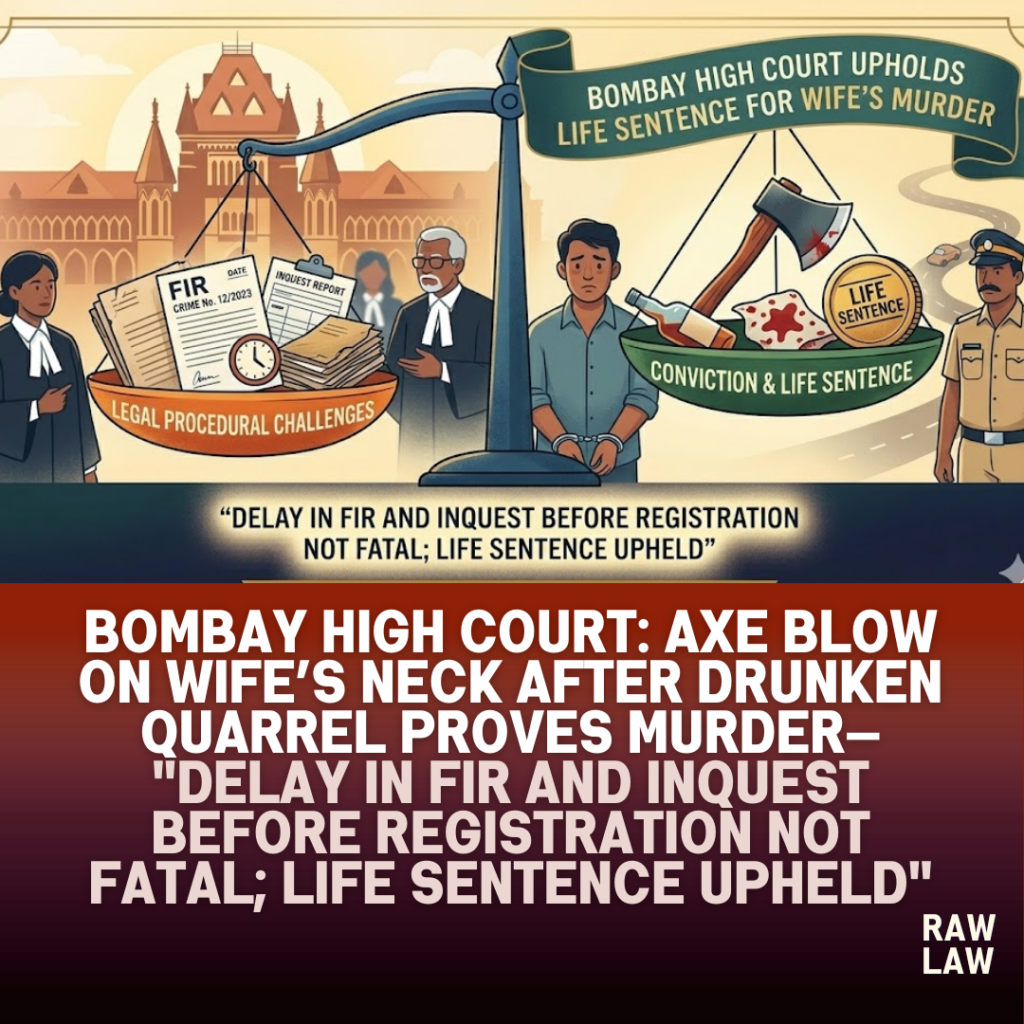
A Division Bench of the Bombay High Court dismissed a criminal appeal challenging the conviction of a husband for murdering his wife by striking her neck with an axe.
The Court confirmed the Sessions Court’s finding that the accused had committed murder under Section 302 of the Indian Penal Code, 1860 and upheld the sentence of life imprisonment along with a fine.
The Bench held that the prosecution had successfully established the guilt of the accused through reliable eyewitness testimony, medical evidence, motive arising from domestic disputes, and surrounding circumstances including the accused fleeing from the scene of the crime.
2. Facts
The prosecution case arose from an incident that occurred on the night of 31 March 2019 at a labour settlement in Mohammedwadi, Pune.
The deceased, a woman working as a labourer, was living with her husband (the accused) and their two minor children in a temporary hut. According to the prosecution, the accused frequently consumed alcohol and suspected the character of his wife, which led to frequent quarrels between them.
On the night of the incident, the accused allegedly quarrelled with the deceased and later slept with her outside the hut on a plastic sheet.
During the night, the deceased’s mother heard her grandchildren crying and went to the spot where the couple had been sleeping. She found her daughter lying in a pool of blood with a fatal injury below the left ear and saw the accused fleeing from the scene.
3. Issues
The High Court examined several key questions raised by the accused in appeal.
First, whether the prosecution case was vitiated because inquest proceedings and other steps were undertaken before the registration of the FIR.
Second, whether the delay in lodging the FIR created a possibility of false implication.
Third, whether reliance on the testimony of the deceased’s mother, who was a related witness, was safe without independent corroboration.
Fourth, whether the plea of alibi raised by the accused was credible.
4. Petitioner’s arguments
The appellant argued that he had been falsely implicated in the case and that the prosecution had failed to establish his presence at the scene of the crime.
It was contended that the FIR was lodged with considerable delay, creating the possibility that the deceased’s family members had deliberated before falsely naming him as the accused.
The appellant also argued that investigation had begun before the FIR was registered, which violated established criminal procedure and rendered the entire prosecution case doubtful.
Further, it was argued that the deceased’s mother was an interested witness due to strained matrimonial relations between the couple and therefore her testimony should not be relied upon without independent corroboration.
5. Respondent’s arguments
The prosecution contended that the conviction was based on reliable and consistent evidence which clearly established the guilt of the accused.
It was submitted that the deceased’s mother had witnessed the accused fleeing from the scene immediately after the incident and her testimony was trustworthy.
The prosecution further argued that the medical evidence corroborated the eyewitness account and proved that the death was caused by a fatal chop injury inflicted by a sharp weapon such as an axe.
The State also submitted that the steps taken by the investigating officer before FIR registration were limited to preliminary actions such as conducting inquest and sending the body for post-mortem, which did not amount to improper investigation.
6. Analysis of the law
The Court analysed the legal framework governing criminal investigation and evidentiary principles under Indian law.
It observed that inquest proceedings conducted under Section 174 of the Code of Criminal Procedure, 1973 are intended only to ascertain whether the death occurred under unnatural circumstances and the apparent cause of death.
Such proceedings are preliminary in nature and do not constitute substantive investigation.
Therefore, even if an inquest is conducted or the body is sent for post-mortem before the formal registration of the FIR, the prosecution case cannot be discarded solely on that ground if the overall evidence is credible.
7. Precedent analysis
The Court relied on several judgments of the Supreme Court of India to address the issues raised by the defence.
In Harijan Jivrajbhai Badhabhai v. State of Gujarat, the Supreme Court held that conducting an inquest and sending the body for post-mortem before registration of the FIR does not automatically invalidate the prosecution case.
The Court also relied on Ravinder Kumar v. State of Punjab, which clarified that delay in lodging an FIR is not fatal if the prosecution offers a reasonable explanation.
These precedents guided the High Court in evaluating the defence arguments regarding procedural irregularities.
8. Court’s reasoning
The Court found the testimony of the deceased’s mother to be credible and natural. She had explained that she woke up after hearing her grandchildren crying and saw the accused running away while her daughter lay injured in a pool of blood.
The Bench held that merely because the witness was related to the deceased did not make her testimony unreliable.
The Court also noted that the medical evidence confirmed the presence of a deep chop injury on the neck cutting vital structures, which was consistent with an axe blow.
Additionally, the accused failed to establish his plea of alibi through any credible evidence and offered no satisfactory explanation for leaving the scene after the incident.
9. Conclusion
The High Court concluded that the prosecution had proved the guilt of the accused beyond reasonable doubt.
The Court held that the delay in lodging the FIR was reasonably explained by the traumatic circumstances faced by the deceased’s mother, who had discovered her daughter’s body and was responsible for caring for two minor children.
Since the evidence of the eyewitness, medical testimony, and surrounding circumstances formed a coherent chain pointing to the accused’s guilt, the Court dismissed the criminal appeal and confirmed the conviction and life sentence imposed by the trial court.
10. Implications
The ruling reiterates key principles governing criminal trials, particularly regarding procedural objections raised by accused persons.
It clarifies that preliminary steps such as inquest proceedings conducted before FIR registration do not automatically invalidate a prosecution case.
The judgment also emphasises that testimony of related witnesses cannot be rejected solely due to their relationship with the victim, provided their evidence is credible and consistent with other material on record.
Case Law References
- Harijan Jivrajbhai Badhabhai v. State of Gujarat
The Supreme Court held that conducting an inquest and sending the body for post-mortem before registering the FIR does not automatically vitiate the prosecution case. - Ravinder Kumar v. State of Punjab
The Court held that delay in lodging the FIR is not fatal if it is satisfactorily explained and the prosecution evidence remains reliable. - Kamal Prasad v. State of Madhya Pradesh
The Supreme Court explained the principles governing the plea of alibi and held that the burden to establish such a plea lies on the accused.
FAQs
1. Is conducting an inquest before FIR registration illegal in criminal cases?
No. Courts have clarified that conducting an inquest or sending a body for post-mortem before FIR registration does not invalidate the prosecution case if the overall evidence remains reliable.
2. Can a relative of the victim be a reliable witness in a murder case?
Yes. Courts have consistently held that the testimony of related witnesses can be relied upon if it is credible, consistent, and supported by other evidence.
3. What is the legal burden when an accused raises a plea of alibi?
The accused must prove the plea of alibi with clear and convincing evidence showing that he was elsewhere at the time of the crime.


