

Court’s decision
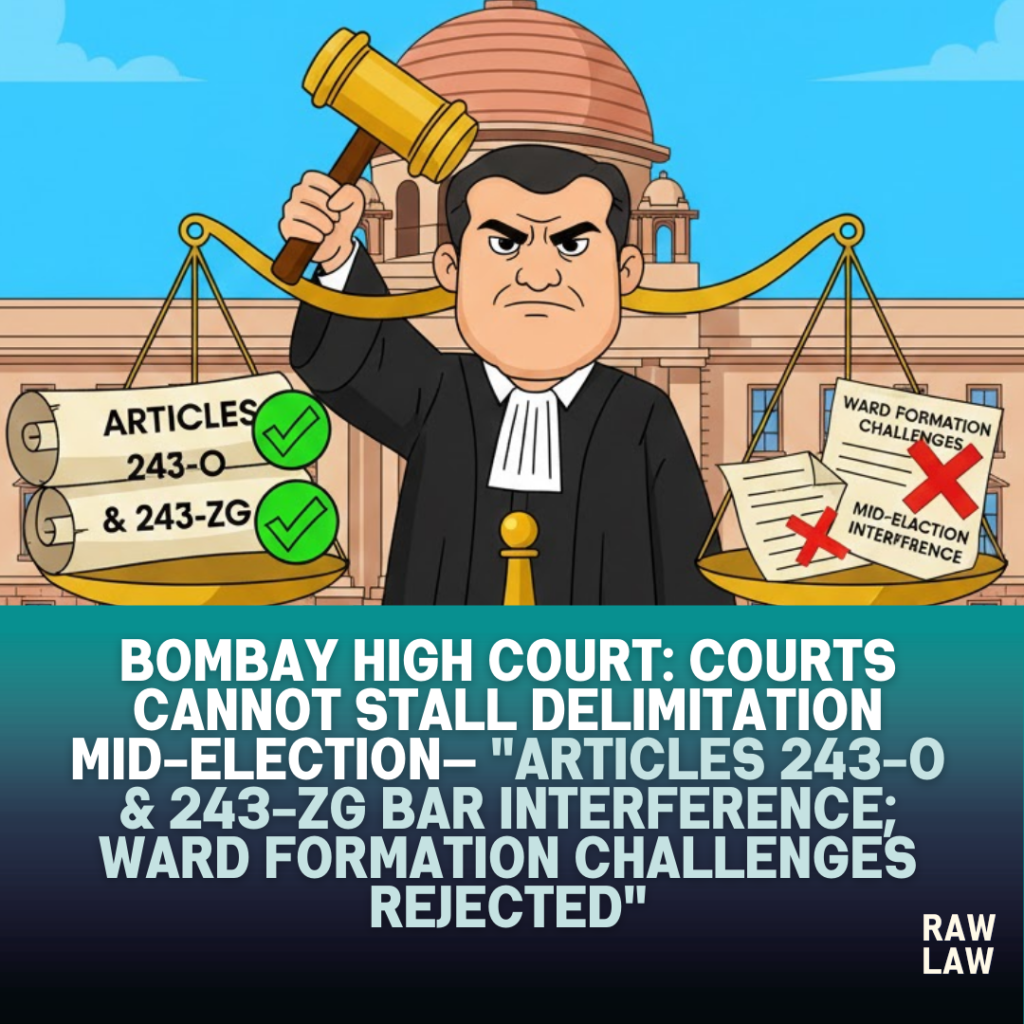
The Bombay High Court dismissed a batch of writ petitions challenging ward formation, reservation rotation, and delimitation notifications issued for Zilla Parishads, Panchayat Samitis and Municipal Councils across Maharashtra. The Division Bench led by the Chief Justice held that once the election process has commenced pursuant to Supreme Court timelines, constitutional bars under Articles 243-O and 243-ZG prohibit judicial interference in electoral matters.
The Court ruled that alleged violations of executive guidelines, minor population deviations, or dissatisfaction with reservation rotation cannot justify halting elections. Any grievance must be pursued through an election petition after completion of polls.
Facts
Multiple petitioners from various districts challenged ward formation notifications and reservation allocations issued in September 2025. The grievances included improper division of Enumeration Blocks, alleged violation of Urban Development Department guidelines dated 10 June 2025, population imbalance between wards, and irregular rotation of reserved seats.
Several petitioners contended that objections filed during the draft stage were either not considered or rejected without proper reasoning.
The backdrop to these petitions was the Supreme Court’s direction in Rahul Ramesh Wagh v. State of Maharashtra mandating completion of local body elections before 31 January 2026.
Fresh delimitation had been undertaken due to territorial changes in rural and municipal boundaries, affecting population distribution and ward composition.
Issues
- Whether writ petitions challenging ward formation and reservation rotation are maintainable once the election process has commenced.
- Whether alleged deviation from executive guidelines can invalidate delimitation notifications.
- Scope of judicial review under Articles 226 and 227 in electoral matters governed by Articles 243-O and 243-ZG.
- Validity of the Maharashtra Zilla Parishads and Panchayat Samitis (Manner and Rotation of Reservation of Seats) Rules, 2025, particularly Rule XII.
Petitioners’ arguments
The petitioners argued that delimitation exercises were carried out arbitrarily and contrary to government guidelines, particularly clauses relating to geographical contiguity, community interest, and integrity of Enumeration Blocks.
It was submitted that population ratios were disturbed beyond permissible limits and Scheduled Caste/Scheduled Tribe settlements were improperly divided.
Some petitioners challenged Rule XII of the 2025 Reservation Rules, contending that it disrupted the constitutional mandate of rotation under Article 243-D and treated the 2025 elections as a fresh cycle, thereby negating prior rotation cycles completed under earlier rules.
Reliance was placed on earlier Supreme Court orders to argue that the 2017 delimitation exercise should form the basis for current elections.
Respondents’ arguments
The State and State Election Commission opposed the petitions on grounds of non-maintainability. It was argued that Articles 243-O and 243-ZG expressly bar interference in electoral matters once the election process begins.
The State contended that significant territorial changes necessitated fresh delimitation and ward reconstitution.
The 2025 Rules were defended as a lawful exercise of rule-making power under Section 274 of the Maharashtra Zilla Parishads and Panchayat Samitis Act, 1961, and the proviso permitting dispensation with prior publication was invoked due to urgency created by Supreme Court deadlines.
It was emphasized that elections must be completed within the timeframe fixed by the Supreme Court and cannot be derailed by repeated litigation.
Analysis of the law
The Court undertook a detailed examination of Part IX and Part IX-A of the Constitution, particularly Articles 243-C, 243-D, 243-K, 243-O and 243-ZG.
Relying on Mohinder Singh Gill v. Chief Election Commissioner, the Court reiterated that the expression “conduct of elections” encompasses the entire electoral process from notification to declaration of results.
The Court cited Lakshmi Charan Sen v. A.K.M. Hassan Uzzaman, holding that elections cannot be postponed merely because objections or disputes remain unresolved.
It observed that delimitation and ward formation are integral steps in the election process and thus fall within the constitutional bar once the process is underway.
Precedent analysis
The Court referred to prior judgments of the Bombay High Court at Nagpur Bench upholding similar delimitation exercises. It also noted dismissal of Special Leave Petitions challenging such orders.
The principles from Mohinder Singh Gill and A.C. Jose v. Sivan Pillai were applied to underline the plenary powers of Election Commissions subject to statutory framework.
The constitutional bar doctrine was reinforced, emphasizing that electoral disputes must ordinarily be addressed through election petitions rather than writ jurisdiction.
Court’s reasoning
The Court observed that ward formation involves balancing multiple criteria: population equality, geographical contiguity, community interest, and Enumeration Block integrity. Marginal deviations within ±10% were permissible under guidelines.
It found that decisions such as shifting Enumeration Blocks were documented, certified, and aimed at preserving community interests.
Challenges based on executive guidelines did not demonstrate constitutional or statutory violation.
Importantly, the Court emphasized that entertaining such petitions at this stage would disrupt election timelines mandated by the Supreme Court.
The constitutional scheme prioritizes timely elections over pre-election adjudication of individual grievances.
Conclusion
The High Court dismissed the batch of writ petitions challenging delimitation and ward formation notifications.
It held that constitutional bars under Articles 243-O and 243-ZG prevent interference once election processes commence.
Petitioners were granted liberty to pursue remedies through election petitions, if so advised.
Implications
This judgment strongly reinforces judicial restraint in electoral matters. It clarifies that:
• Delimitation challenges must ordinarily await post-election remedies.
• Executive guideline deviations, unless egregious or unconstitutional, do not justify halting elections.
• Supreme Court timelines for conducting local body elections cannot be undermined by parallel litigation.
The ruling strengthens the autonomy of State Election Commissions and upholds constitutional commitment to uninterrupted democratic processes.
Case Law References
- Mohinder Singh Gill v. Chief Election Commissioner (1978) 1 SCC 405
- Lakshmi Charan Sen v. A.K.M. Hassan Uzzaman (1985) 4 SCC 689
- A.C. Jose v. Sivan Pillai (1984) 2 SCC 656
- Union of India v. Association of Democratic Reforms (2002) 5 SCC 294
- Rahul Ramesh Wagh v. State of Maharashtra (SLP (C) No. 19756 of 2021)
FAQs
1. Can courts interfere with ward formation once elections are notified?
Generally no. Articles 243-O and 243-ZG bar judicial interference in electoral matters once the election process has commenced.
2. Can delimitation guidelines be challenged under writ jurisdiction?
Yes, but only before the election process begins and only if there is a clear constitutional or statutory violation.
3. What remedy is available after elections?
Aggrieved parties may file an election petition under the relevant municipal or panchayat law.


