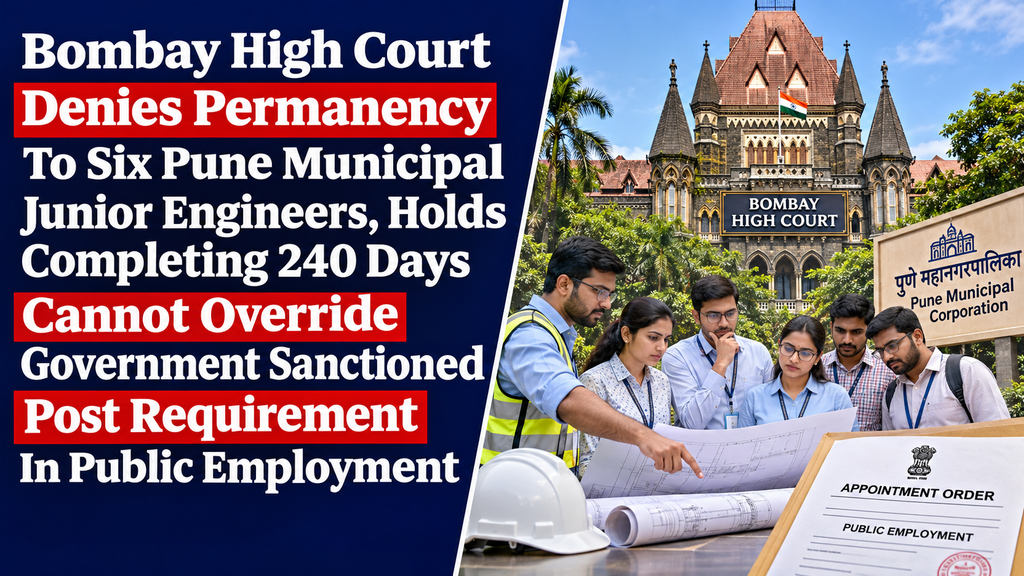
Bombay High Court Denies Permanency To Six Pune Municipal Junior Engineers, Holds Completing 240 Days Cannot Override Government Sanctioned Post Requirement In Public Employment

Bombay High Court Rejects Contract Engineers’ Regularisation Claim After Three Years Of Service, Clarifies Earlier Reinstatement Order Did Not Confer Any Automatic Permanent Employment Rights
Facts
Six engineers challenged a 9 March 2016 Industrial Court order rejecting their unfair-labour-practice complaints against Pune Municipal Corporation (PMC). Although they participated in a publicly advertised 2005–07 Junior Engineer selection, they were placed only on the waiting list, not among the 147 regularly selected candidates. PMC engaged them for Jawaharlal Nehru National Urban Renewal Mission (JNNURM) projects on renewable six-month contracts at consolidated wages from 2007–08. They sought permanency upon 240 days of service, but their services were terminated in March 2011 after approximately three years. A separate Bombay High Court judgment dated 8 May 2026 set aside their terminations and granted conditional reinstatement, limited compensation and specified continuity benefits. Following revival of the present writ petition in October 2026, their claim for permanency remained for determination.
Issues
Whether contractual Junior Engineers engaged from a waiting list for a project lacking sanctioned permanent posts could secure permanency or regularisation by completing 240 days of service; whether the Industrial Court wrongly refused unfair-labour-practice relief; and whether the separate reinstatement judgment altered their status.
Petitioner’s Arguments
The engineers argued that they were qualified and had participated in the advertised selection process rather than entering service through a back door. Repeated contracts, available work and completion of 240 days allegedly attracted Clause 4-C of the Model Standing Orders and Items 5, 6, 9 and 10 of Schedule IV to the MRTU & PULP Act. They pointed to the reservation roster as evidence of vacancies, invoked industrial adjudicators’ powers to remedy unfair labour practices, and relied on the 2026 reinstatement decision.
Respondent’s Arguments
PMC maintained that the engineers had not been selected for regular vacancies and were hired only as temporary project personnel under JNNURM. No permanent posts had been sanctioned for their engagements; municipal posts required State Government approval. It disputed an automatic right of regularisation, invoked the earlier rejection of similar claims and contended that the 2016 Industrial Court ruling was correct. PMC also stated that it had challenged the separate reinstatement judgment before the Supreme Court and had not yet reinstated the petitioners.
Analysis of the Law
Under the MRTU & PULP Act, industrial courts may redress established unfair labour practices, but they cannot indirectly create public-service posts by declaring temporary employees permanent. Clause 4-C of the Model Standing Orders, even where invoked after 240 days, operates subject to constitutional requirements of equal access to public employment under Articles 14 and 16 and the existence of legally sanctioned vacancies. Municipal establishments cannot dispense with the prescribed sanction and recruitment process. An exceptional case for regularisation may arise where eligible workers have served for at least ten years against sanctioned posts or where similarly situated employees have been regularised discriminatorily; neither basis followed merely from three years of project service.
Precedent Analysis
Secretary, State of Karnataka v. Umadevi (3), (2006) 4 SCC 1, bars routine regularisation of irregular public appointments and recognises a narrowly framed ten-year exception. Municipal Council Tirora v. Tulsidas Baliram Bindhade, 2016 (6) Mh.L.J. 867, holds that 240 days cannot justify permanency without sanctioned posts. Maharashtra SRTC v. Casteribe and Hari Nandan Prasad v. FCI, (2014) 7 SCC 190, preserve labour courts’ remedial powers where posts and unfair practice exist, not a power to create vacancies. Pandurang Sitaram Jadhav concerned substantially longer service, while Bhartiya Kamgar Karmachari Mahasangh v. Jet Airways involved private employment. The Court followed its recent public-employment analysis in University of Mumbai v. Sunil Tanda Pagare.
Court’s Reasoning
Justice Sandeep V. Marne emphasised that a waiting-list placement did not amount to regular selection. The petitioners were engaged for a centrally funded, temporary JNNURM project, had rendered only about three years of actual service, and had not proved that their appointments were against vacant sanctioned posts. A reservation roster showing category-wise backlog could not establish such posts. The Court found no unfair labour practice warranting permanency under Item 6 of Schedule IV. The 8 May 2026 judgment setting aside termination expressly confined continuity to possible retiral or pensionary benefits and excluded permanency, regularisation, seniority and promotion; the subsequent review merely permitted revival of this petition. The reinstatement order was separately under challenge.
Conclusion
The High Court dismissed Writ Petition No. 9668 of 2016, affirming the Industrial Court’s rejection of the six engineers’ permanency claims, without costs. Completing 240 days—or roughly three years—on renewable project contracts does not itself create a right to a permanent municipal post. The earlier reinstatement and limited continuity relief must not be confused with regularisation; the Supreme Court challenge to that separate relief was noted as pending.
Case: Sanjay Shamrao Bhor & Ors. v. Pune Municipal Corporation & Ors.
Court: High Court of Judicature at Bombay, Civil Appellate Jurisdiction
Case Number: Writ Petition No. 9668 of 2016; 2026:BHC-AS:44564
Judge: Justice Sandeep V. Marne
Date: 2 November 2026 (reserved 22 October 2026)
Result: Writ petition dismissed; permanency denied; no order as to costs.