


1. Court’s decision
The Bombay High Court partly allowed a batch of writ petitions involving a gratuity dispute between several employees and their employer company engaged in manufacturing power systems and industrial equipment.
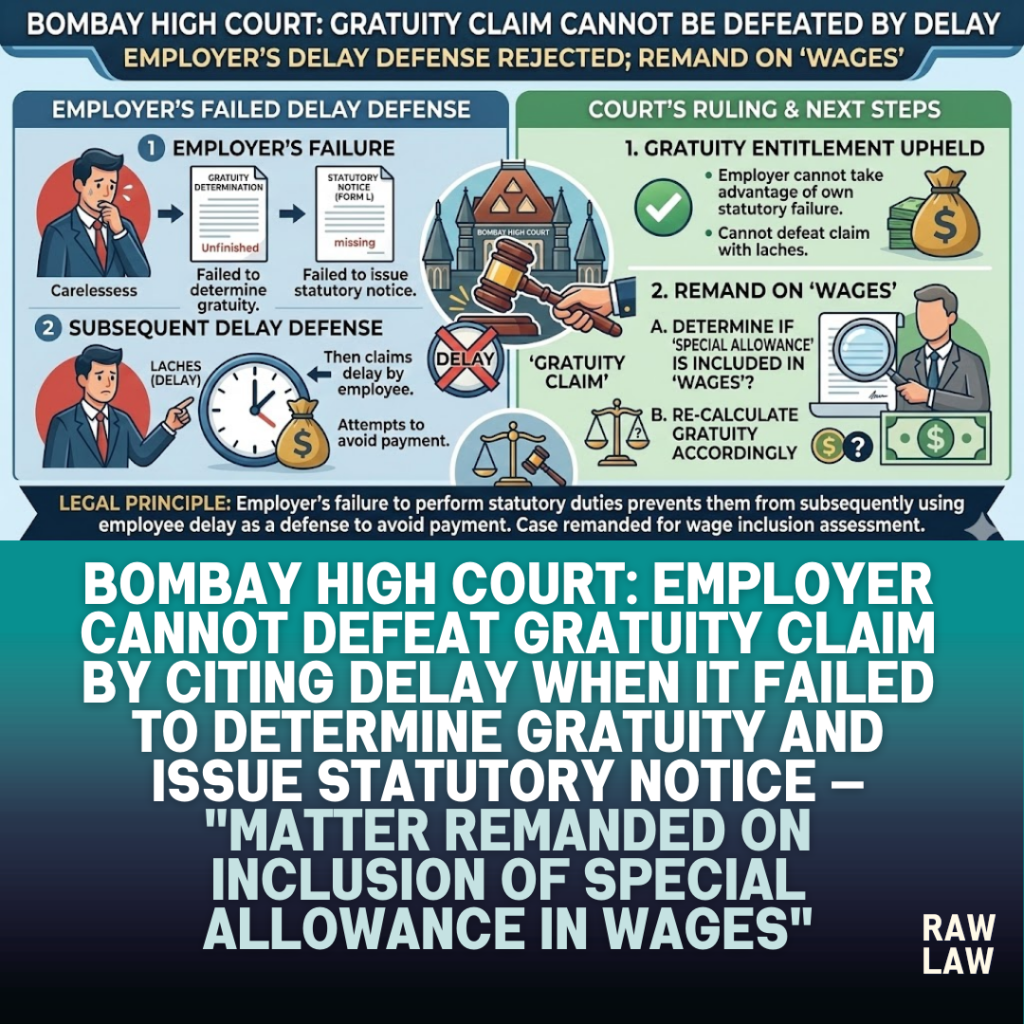
The Court upheld the entitlement of the employees to claim gratuity despite a significant delay in filing applications before the Controlling Authority. It ruled that the employer could not rely on limitation because it had failed to determine the gratuity amount and issue the statutory notice required under the Payment of Gratuity Act.
However, the Court remitted the matter to the Appellate Authority to reconsider whether the component described as “special allowance” forms part of wages for calculating gratuity.
2. Facts
The dispute arose after several employees resigned from a private company engaged in manufacturing UPS systems and industrial power units. One of the employees had served as Chief Regional Manager and had drawn a last basic salary of ₹36,500 per month.
Upon resignation in 2015, the employee did not submit the prescribed Form “I” claiming gratuity within the statutory period. Several years later, in 2022, he filed an application before the Controlling Authority under the Payment of Gratuity Act seeking payment of gratuity.
The employer argued that the claim was barred by limitation because the employee had not submitted the required application within thirty days as mandated under the Payment of Gratuity Rules. The employer also contended that the employee had authorised adjustments toward outstanding dues at the time of resignation.
3. Issues
The High Court examined several legal issues arising from the dispute.
The first issue was whether a delayed gratuity claim could be entertained when the employee had not filed the prescribed application within the time limit specified under the rules.
The second issue concerned whether the employer’s failure to issue a statutory notice determining gratuity under Section 7(2) of the Payment of Gratuity Act affected the limitation argument raised by the employer.
The third issue was whether the salary component described as “special allowance” should be treated as part of wages for computing gratuity under Section 2(s) of the Act.
4. Petitioner’s arguments
The employer argued that the employee’s claim was filed nearly six years after resignation and was therefore clearly barred by limitation.
According to the employer, the employee had never submitted Form “I” under the Payment of Gratuity Rules within the prescribed period. Since the statutory procedure was not followed, the employer contended that the Controlling Authority should not have entertained the application.
The employer also argued that gratuity should be calculated only on basic wages and dearness allowance. It submitted that the component labelled as “special allowance” represented various incentives and benefits and therefore could not be included in wages under Section 2(s) of the Payment of Gratuity Act.
5. Respondent’s arguments
The employees argued that the company had a policy allowing gratuity to be calculated on the basis of twenty-six days’ wages for employees who had completed more than fifteen years of service.
They also contended that in the salary structure of managerial employees, dearness allowance was effectively paid in the form of “special allowance”. Therefore, the said component should be treated as part of wages for calculating gratuity.
The employees further argued that the employer had never issued the statutory notice determining gratuity after their resignation. In such circumstances, the employer could not rely on limitation to defeat their claim.
6. Analysis of the law
The Court examined the statutory scheme under Section 7 of the Payment of Gratuity Act. The provision places obligations on both employees and employers once gratuity becomes payable.
While employees are required to submit a written application claiming gratuity, Section 7(2) also imposes a duty on the employer to determine the amount of gratuity and issue written notice to the employee and the Controlling Authority specifying the amount payable.
Importantly, the statute states that the employer must perform this duty whether or not the employee has submitted a formal application. This provision ensures that employers cannot remain passive and later rely on technicalities to defeat legitimate claims.
7. Precedent analysis
The Court emphasized that the Payment of Gratuity Act is a beneficial legislation intended to secure terminal benefits for employees after long years of service.
Courts interpreting such legislation must ensure that procedural requirements do not defeat substantive rights. The statutory scheme therefore requires employers to actively determine gratuity and communicate it to employees rather than wait for claims to be filed.
This interpretation ensures that employees are not deprived of gratuity merely because they failed to initiate formal proceedings within the prescribed period.
8. Court’s reasoning
The High Court noted that the employer had not produced any material showing that it had determined the gratuity amount or issued the statutory notice required under Section 7(2) of the Act after the employee’s resignation.
In the absence of such notice, the second proviso to Rule 10 of the Payment of Gratuity Rules becomes applicable. The proviso states that where the employer fails to issue the required notice, limitation will not apply to the employee’s application before the Controlling Authority.
The Court therefore held that the employer could not rely on delay to defeat the claim when the delay itself resulted from the employer’s failure to perform its statutory duty.
9. Conclusion
The High Court partly allowed the writ petitions and remanded the matter to the Appellate Authority for reconsideration of specific factual issues.
The authority was directed to determine whether the “special allowance” paid to employees was in substance dearness allowance and therefore part of wages under Section 2(s) of the Payment of Gratuity Act.
The authority was also directed to examine the evidentiary value of salary records and other documents relied upon by the parties and to recompute gratuity accordingly.
10. Implications
The judgment clarifies an important principle of gratuity law: employers cannot defeat gratuity claims by relying on limitation if they themselves fail to perform the statutory duty of determining gratuity and issuing notice.
The decision also highlights the significance of examining the real nature of salary components when computing gratuity. Courts may look beyond the nomenclature used in salary slips to determine whether certain allowances are effectively part of wages.
This ruling is likely to influence future disputes involving salary restructuring and gratuity computation in managerial employment contracts.
Case Law References
- Statutory interpretation of the Payment of Gratuity Act
Courts consistently treat gratuity as a statutory right and interpret procedural provisions liberally to ensure employees receive their terminal benefits. - Section 7 of the Payment of Gratuity Act, 1972
The provision imposes a duty on employers to determine and notify the amount of gratuity payable even if the employee has not filed a formal application.
FAQs
1. Can a delayed gratuity claim be rejected by the employer?
Not necessarily. If the employer fails to determine gratuity and issue the statutory notice required under the Payment of Gratuity Act, the employee’s delayed claim may still be entertained.
2. Is “special allowance” included in wages for gratuity calculation?
It depends on the nature of the allowance. If it is essentially dearness allowance in disguise, courts may treat it as part of wages for calculating gratuity.
3. What is the employer’s duty once gratuity becomes payable?
The employer must determine the gratuity amount and issue written notice to the employee and the Controlling Authority specifying the amount payable, regardless of whether the employee has filed an application.