

Court’s decision
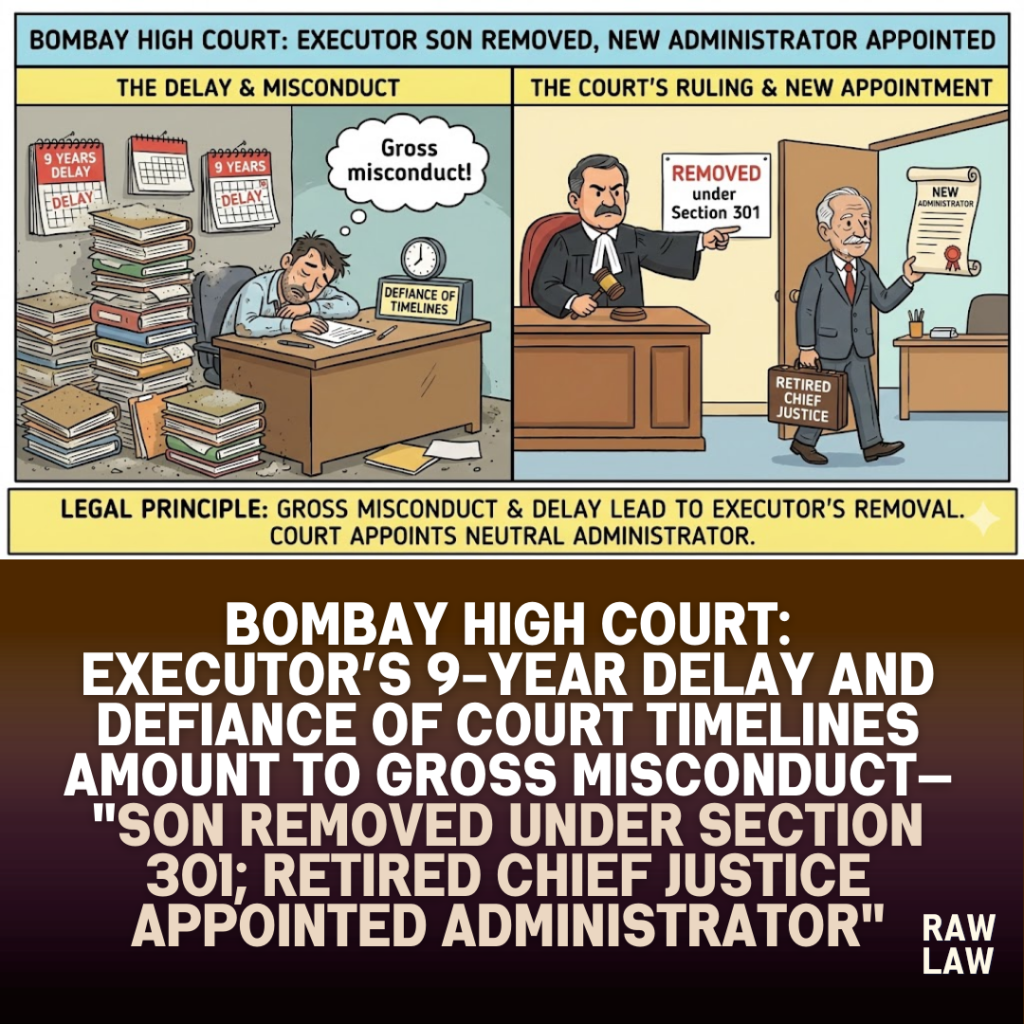
The Bombay High Court (Original Side) removed the named Executor of a 1997 Will under Section 301 of the Indian Succession Act, 1925, holding that persistent non-compliance with judicial directions and prolonged inaction constituted gross misconduct and breach of fiduciary duty. Justice Farhan P. Dubash found that despite probate granted in 2016 and a detailed time-bound order dated 29 January 2025, the estate remained largely unadministered. The Court appointed Justice Dilip Babasaheb Bhosale (Retd.) as Administrator and directed the removed Executor to hand over records and file a full inventory within strict timelines.
Facts
The dispute arose from the estate of Rajnikant Ambalal Kilachand, who passed away in 1997. Under his Will dated 27 March 1997, his elder son was appointed Executor. Probate was granted on 27 October 2016 after prolonged litigation.
However, administration of the estate did not follow. The Testator’s widow repeatedly approached the Court complaining that despite probate, the Executor failed to distribute movable and immovable assets. In 2019, interim directions were issued requiring updated disclosures and routing of dividends to her account.
In January 2025, the High Court passed a reasoned order directing time-bound distribution—two months for movables and six months for immovables—warning that default would render the Executor liable to removal. The order attained finality. Yet, compliance was not forthcoming. The widow passed away in 2024 without receiving full legacy, and her other son pursued removal proceedings.
Issues
The principal issue before the Court was whether the Executor’s conduct warranted removal under Section 301 of the Indian Succession Act.
Specifically, the Court examined whether:
- There was gross misconduct or mismanagement of the estate.
- Non-compliance with the 29 January 2025 order demonstrated willful disregard.
- Continued insistence on a Memorandum of Family Settlement was legally sustainable.
Petitioner’s arguments
The applicant contended that the Executor had persistently defied court directions and failed to administer the estate for nearly nine years post-probate. It was argued that insistence on execution of a Memorandum of Family Settlement as a pre-condition to distribution was already rejected by the Court in January 2025 and amounted to deliberate obstruction.
The applicant emphasized that the widow died waiting for her legacy and that the Executor’s conduct frustrated the testamentary intent of the deceased. Removal was sought on grounds of breach of fiduciary duty, mismanagement, and willful non-compliance.
Respondent’s arguments
The Executor contended that delays were due to circumstances beyond his control, including pending partition of HUF assets, refusal of share transfer agents to transmit jointly held shares, and transfer of certain dividends to the Investor Education and Protection Fund due to non-encashment.
He also relied on precedents including Dr. Subhada Mithilesh v. Prabhakar Deolankar and Bagchi v. Hrishikesh Sanyal to argue that removal is an extreme measure and should not be invoked absent clear detriment to the estate.
A chart titled “Status of Assets to be administered” was tendered to demonstrate substantial compliance and efforts undertaken.
Analysis of the law
The Court closely examined Section 301 of the Indian Succession Act, which empowers the High Court to remove an Executor and appoint a successor where necessary.
It reiterated that an Executor stands in a fiduciary capacity and is bound to administer the estate strictly in accordance with the Will and statutory obligations under Section 317. An Executor cannot impose extra-legal preconditions or seek indemnities inconsistent with testamentary intent.
The Court emphasized that once probate is granted, the Executor is duty-bound to act expeditiously. Persistent delay without cogent explanation can amount to misconduct justifying removal.
Precedent analysis
The Court considered Dr. Subhada Mithilesh, which held that removal requires clear material showing detriment to the estate. It found such material present here.
Similarly, in Bagchi, the Allahabad High Court held that removal is unwarranted where duties are duly performed. The Bombay High Court distinguished this precedent, observing that the present case involved sustained non-performance.
The Court held that these precedents, rather than assisting the Executor, underscored the legal threshold which stood satisfied.
Court’s reasoning
The Court rejected each justification offered by the Executor. It noted that delay between 1999 and 2016 (probate stage) was irrelevant, as removal was sought for post-probate conduct.
Insistence on a Family Settlement had already been conclusively rejected in the January 2025 order. Revival of the same ground was impermissible.
Alleged difficulties in share transmission and IEPF transfers were unsupported by documentary evidence and not pleaded on oath with specifics. The chart tendered during arguments lacked evidentiary foundation and was disregarded.
The Court held that repeated non-compliance—even after explicit warning in January 2025—demonstrated willful disregard. The Executor had been given multiple opportunities but failed to act.
Such prolonged inaction frustrated the Will and prejudiced beneficiaries, including the deceased widow who died awaiting distribution.
Conclusion
The High Court removed the Executor under Section 301. Justice Dilip Babasaheb Bhosale (Retd. Chief Justice of the Allahabad High Court) was appointed Administrator.
The removed Executor was directed to:
- Hand over all estate records within one month.
- File an affidavit within 21 days disclosing full inventory and accounts.
The Administrator was directed to complete distribution preferably within six months. Costs were not imposed. A request for stay was rejected.
Implications
This ruling reinforces the fiduciary rigour expected of Executors. It clarifies that probate is not a ceremonial appointment but a solemn trust.
Courts will intervene where delay frustrates testamentary intent. Insistence on extraneous conditions, non-compliance with statutory obligations, and disregard of judicial timelines can justify removal.
The judgment strengthens beneficiary protection and signals that the testamentary jurisdiction will not tolerate inertia or obstruction.
Case Law References
- Dr. Subhada Mithilesh v. Prabhakar Deolankar (2018 SCC OnLine Bom 21424)
- Bagchi v. Hrishikesh Sanyal (1948 SCC OnLine All 253)
- Section 301 & 317, Indian Succession Act, 1925
FAQs
1. When can an Executor be removed under Section 301?
An Executor may be removed where there is gross misconduct, breach of fiduciary duty, mismanagement, or conduct detrimental to the estate or beneficiaries.
2. Can an Executor delay distribution pending family settlement?
No. Once probate is granted, the Executor must administer the estate strictly in accordance with the Will and cannot impose additional conditions.
3. Does non-compliance with court timelines justify removal?
Yes. Persistent defiance of time-bound judicial directions can constitute sufficient ground for removal under Section 301.


