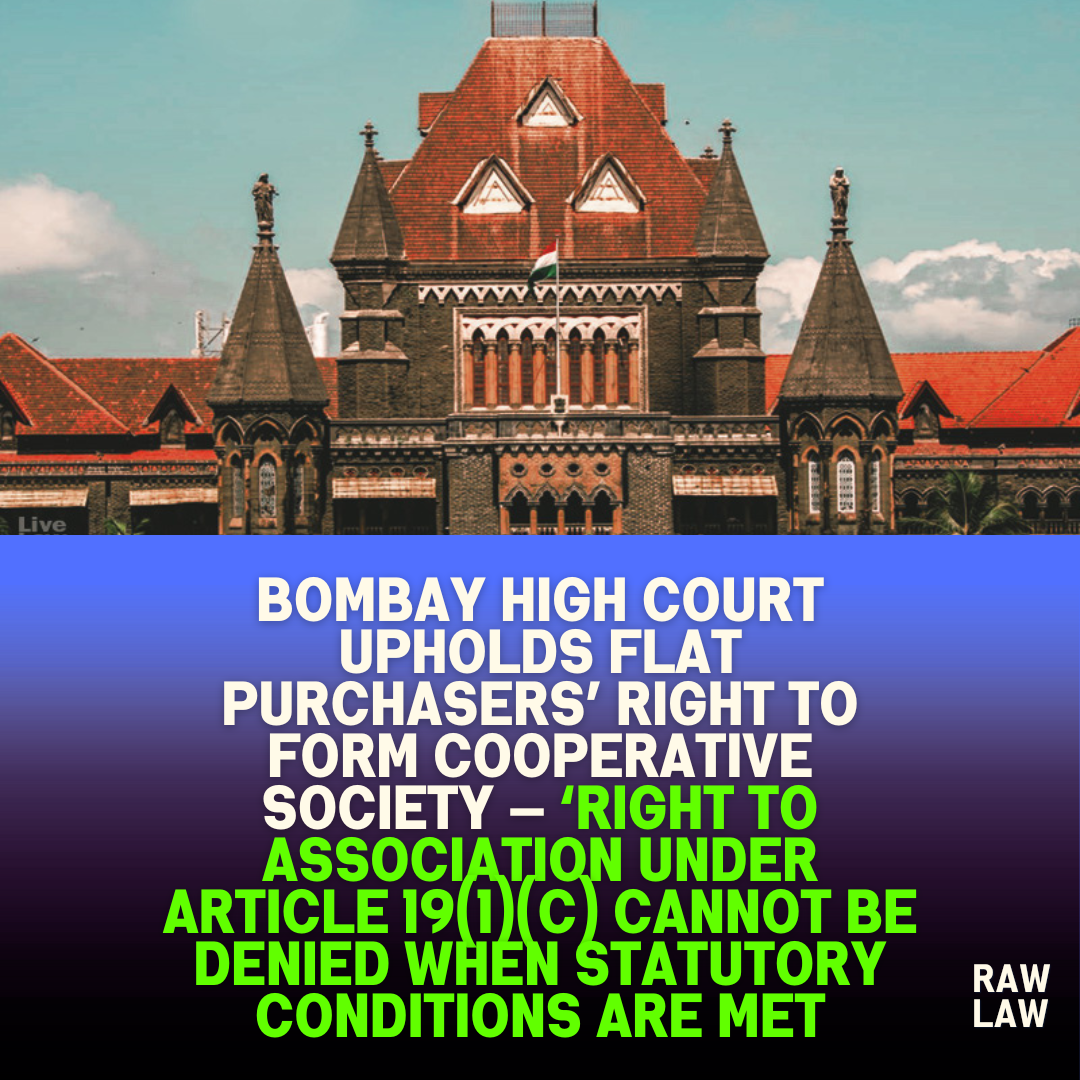
Bombay High Court Upholds Flat Purchasers’ Right to Form Cooperative Society — ‘Right to Association under Article 19(1)(c) Cannot Be Denied When Statutory Conditions Are Met

Court’s Decision
The Bombay High Court, through Justice Amit Borkar, quashed the order of the State Minister for Cooperation, which had refused registration of a proposed cooperative housing society formed by seven flat purchasers of “Vienna Apartments” at Juhu, Mumbai.
The Court restored the earlier order of the Divisional Joint Registrar granting registration, observing that the right to form a cooperative housing society is protected under Article 19(1)(c) of the Constitution. It held that the absence of a “No Objection Certificate” (NOC) from the parent society does not defeat the statutory right of flat purchasers to form their own society once all requirements under the Maharashtra Cooperative Societies Act, 1960 (MCS Act) and the Maharashtra Ownership Flats Act, 1963 (MOFA) are satisfied.
Justice Borkar remarked:
“The State may regulate the manner of registration but cannot altogether refuse registration when the statutory requirements are fulfilled. The right to form an association, including a cooperative society, is a protected constitutional freedom.”
Accordingly, the High Court directed the Registrar to complete formalities and issue the certificate of registration to the Vienna Apartments Cooperative Housing Society within four weeks.
Facts
The petitioner, chief promoter of a proposed housing society, represented seven of ten flat purchasers in “Vienna Apartments”, a residential building developed by a private developer (respondent no.1) on land owned by a larger parent society (respondent no.2) comprising 28 plots at JVPD Scheme, Juhu.
Under the lease agreement dated 15 August 2000, the developer was permitted by the parent society to construct a building for the personal use of its directors and was required to obtain the society’s prior written consent for sale of flats and to apply for the admission of purchasers as nominal members. The developer, however, sold all ten flats between 2003–2005 but failed to form a cooperative society as mandated by Section 10 of MOFA.
When repeated requests to form the society were ignored, the petitioner applied for registration of the “Vienna Apartments Cooperative Housing Society” in 2019. The District Deputy Registrar rejected the application, but the Divisional Joint Registrar allowed the appeal in 2020 and ordered registration. The State Minister for Cooperation (respondent no.3), however, set aside the registration in 2021, holding that:
- Purchasers could continue only as nominal members of the parent society;
- A “No Objection Certificate” from the parent society was required; and
- Formation of a “sub-society” within a tenant-ownership society was impermissibleo.
This order was challenged before the Bombay High Court.
Issues
- Whether registration of a cooperative society can be denied for want of a “No Objection Certificate” from the parent society.
- Whether formation of a “sub-society” within a tenant-ownership society is legally permissible.
- Whether purchasers who are nominal members can demand independent registration.
- Whether the principle of res judicata bars a second application after an earlier rejection.
Petitioner’s Arguments
The petitioner argued that the right to form a cooperative society is a fundamental right under Article 19(1)(c) and cannot be denied when statutory prerequisites are satisfied. He submitted that all sale agreements expressly incorporated the provisions of MOFA, under which the developer and land-owning society are both promoters bound to facilitate formation of a cooperative society of flat purchasers.
He contended that after registration, the new society would merely step into the shoes of the developer and become a member of the parent society under Section 22 and Section 154B-5 of the MCS Act, which allow one cooperative society to be a member of another.
It was further argued that nominal membership is obsolete under Chapter XIII-B of the amended MCS Act and cannot be used to deny ownership and management rights to purchasers. Other plots within the same layout had already formed independent cooperative societies, demonstrating administrative acceptance of such registrations.
Respondent’s Arguments
The developer (respondent no.1) contended that the petition was barred by res judicata, as an earlier application filed in 2017 had been rejected. It argued that no “sub-society” could be created within an existing registered society, and that the flat purchasers, having accepted nominal membership, were estopped from claiming an independent status.
It relied on Karvenagar G.R.S.M. v. State of Maharashtra (1989 Mh.L.J. 320), submitting that creation of new societies within a tenant-ownership society defeats the cooperative structure and that the State Minister’s decision under Article 227 should not be interfered with.
The parent society (respondent no.2) argued that MOFA’s proviso to Section 10(1) was not applicable since a society already existed. It maintained that the flat purchase agreements limited purchasers to nominal membership and that registration of a separate society without consent violated the lease terms and the bye-laws of the parent society.
Analysis of the Law
The Court analyzed Sections 8 and 22 of the MCS Act, Section 154B-5, and Sections 10 and 11 of MOFA. It noted that under the cooperative framework, registration can only be refused for statutory reasons — insufficient members, defective documentation, or ineligibility — and not because a parent society withholds consent.
Justice Borkar emphasized that “No Objection Certificates” are administrative conveniences, not legal preconditions. Once the Registrar is satisfied that statutory requirements are fulfilled — such as majority membership, compliance with MOFA, and proper documents — registration cannot be denied.
The Court further held that MOFA imposes a statutory obligation on the promoter to form a cooperative society and convey the property to it within a reasonable time. The developer’s failure to do so cannot defeat purchasers’ rights; on the contrary, it reinforces their claim for registration.
It also clarified that the MCS Act does not prohibit the formation of a new society within a larger layout, as Section 22 read with Section 154B-5 expressly allows one society to be a member of another. The so-called “sub-society” concept has no legal recognition — what matters is distinct identity and common interest.
Precedent Analysis
The Court relied upon several precedents to interpret the cooperative and housing law framework:
- Rameshwar Cooperative Housing Society Ltd. v. Divisional Joint Registrar (2025) – upheld registration of smaller housing societies within larger layouts, emphasizing statutory autonomy of flat purchasers.
- Karvenagar G.R.S.M. v. State of Maharashtra (1989 Mh.L.J. 320) – distinguished on facts; the case concerned state interference forcing a society to amend bye-laws, not voluntary formation by purchasers. Justice Borkar clarified that Karvenagar protects association autonomy but does not bar purchasers from exercising their own right to association.
- Meru Heights Cooperative Housing Society Ltd. v. State of Maharashtra (2023 SCC OnLine Bom 2612) – cited by the respondents but held inapplicable since that case involved non-existent statutory compliance.
- M/s Aakansha Construction Co. v. State of Maharashtra (2025) – applied to clarify limits of res judicata in quasi-judicial proceedings, but rejected here since the law had changed by statutory amendment reducing the minimum membership requirement.
The Court concluded that the precedents relied upon by the State were either inapplicable or misinterpreted.
Court’s Reasoning
Justice Borkar held that the State’s refusal to register the society violated both statutory mandate and constitutional principles. He observed that the right to association under Article 19(1)(c) includes the right to form a cooperative society to manage property collectively. The State cannot frustrate this right through non-statutory conditions like an NOC.
He rejected the argument that a “sub-society” was impermissible, explaining that such formation does not duplicate ownership but merely replaces the developer as member of the parent society. He further held that the doctrine of res judicata does not apply where subsequent applications are made under amended laws and changed circumstances.
Importantly, the Court noted that nominal membership is transitional and cannot substitute for ownership. Once purchasers have paid the full price and taken possession, they cannot be deprived of cooperative management rights merely to preserve developer control.
Conclusion
The High Court quashed the Minister’s order dated 23 June 2021 and restored the registration granted by the Divisional Joint Registrar on 18 December 2020. The Registrar was directed to issue the certificate of registration within four weeks.
Justice Borkar concluded:
“The right to form a cooperative society flows from Article 19(1)(c). When flat purchasers satisfy statutory conditions, the State cannot defeat that right by demanding a No Objection Certificate or by calling their society a ‘sub-society’.”
Implications
This ruling is a landmark in cooperative housing law. It clarifies that:
- Flat purchasers’ rights under MOFA override developer undertakings and lease restrictions.
- Formation of housing societies cannot be obstructed by the parent society’s inaction or refusal to issue NOC.
- Nominal membership is transitional; genuine purchasers are entitled to full membership and collective ownership.
- Section 22 and 154B-5 of the MCS Act enable smaller societies to exist within larger cooperative structures without legal conflict.
The judgment reinforces autonomy and self-governance for housing societies and curtails arbitrary state or developer interference.