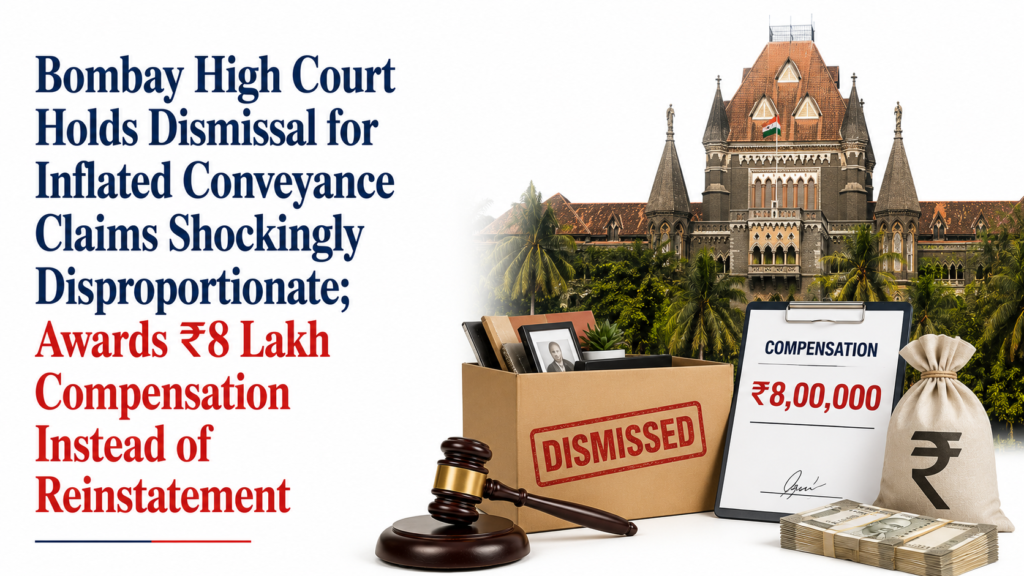
Employee Dismissed for Claiming Excess Conveyance Allowance; Bombay High Court Sets Aside Termination and Grants ₹8 Lakh Compensation
Facts
The petitioner, Ananta Rajaram Walunj, had been employed for nearly thirteen years with Grupo Antolin Pune (P) Ltd., a manufacturing company operating its factory at Ranjangaon, Pune. During the course of his employment, he was deputed to work at the company’s warehouse situated at Chakan. As part of its employment policy, the company reimbursed employees using two-wheelers for official travel by paying conveyance allowance at the rate of ₹3 per kilometre. The allowance depended upon the distance travelled between the employee’s residence and the warehouse.
Initially, the petitioner claimed conveyance allowance for a round-trip distance of 60 kilometres during January and February 2011. Subsequently, he reduced his claim to 48 kilometres between March 2011 and March 2012, and later to 44 kilometres from April to June 2012, stating that he had discovered shorter routes to reach the warehouse. The employer later conducted its own verification through one of its drivers, who reported that the actual one-way distance from the petitioner’s residence to the warehouse was only 16.5 kilometres using the shortest route. On this basis, the employer alleged that the petitioner had fraudulently inflated the travel distance and wrongfully received ₹17,868 as excess conveyance allowance.
A show-cause notice was issued to the petitioner in September 2012. In his reply, he denied any dishonest intention and explained that the discrepancy arose because multiple routes existed between his residence and the warehouse. He also expressed regret for the misunderstanding and requested that the company issue written guidelines regarding calculation of conveyance distance to avoid future disputes. Despite this explanation, a formal charge-sheet was issued in January 2013 alleging dishonest claims and financial loss to the employer.
A domestic enquiry followed, during which the petitioner participated and defended himself. The Enquiry Officer held the charges proved, leading to the petitioner’s dismissal from service on 9 August 2013. Challenging the dismissal, the petitioner raised an industrial dispute under Section 2A of the Industrial Disputes Act before the Industrial Tribunal, Pune, seeking reinstatement with continuity of service and back wages. The Tribunal first upheld the fairness of the enquiry and later rejected the reference on merits, concluding that the dismissal was justified. Aggrieved by these findings, the petitioner approached the Bombay High Court through a writ petition challenging both the Tribunal’s award and the punishment of dismissal.
Issues
The Bombay High Court considered the following principal questions:
- Whether the findings recorded by the Enquiry Officer were supported by the evidence on record.
- Whether the petitioner had in fact committed misconduct by dishonestly claiming excess conveyance allowance.
- Whether the misconduct established against the petitioner amounted to financial misappropriation.
- Whether dismissal from service was a proportionate punishment in the facts of the case.
- Whether the petitioner was entitled to reinstatement, back wages or any other consequential relief after setting aside the dismissal.
Petitioner’s Arguments
The petitioner argued that the Industrial Tribunal had committed a serious error in mechanically accepting the findings of the Enquiry Officer without properly appreciating the evidence. According to him, the allegation was founded on an incorrect assumption that only one route existed between his residence and the warehouse. In reality, multiple routes connected the two locations, and he had initially used a longer route. As he became aware of shorter alternatives, he voluntarily reduced the distance claimed from 60 kilometres to 48 kilometres, and later to 44 kilometres. This conduct, according to him, demonstrated his bona fides rather than any dishonest intention.
The petitioner further contended that every conveyance claim had been scrutinised and approved by his superior officers before reimbursement. If the employer itself had accepted varying claims over an extended period, it could not subsequently allege deliberate fraud solely on the basis of a later verification exercise. He also argued that the amount involved was relatively insignificant and arose from differing calculations of travel distance rather than any act of misappropriation or embezzlement.
It was further submitted that similarly situated employees accused of comparable misconduct had been let off after tendering apologies and were allowed to continue in service. The petitioner asserted that he too had expressed regret immediately after receiving the show-cause notice but had been singled out for the harshest punishment. He therefore argued that the dismissal violated the principle of proportionality and ignored his long, otherwise unblemished service record of approximately thirteen years.
Respondent’s Arguments
The employer supported both the domestic enquiry and the Industrial Tribunal’s findings. It contended that the petitioner had knowingly inflated the distance travelled and thereby obtained reimbursement to which he was not entitled. According to the employer, verification carried out by its driver conclusively established that the actual distance between the petitioner’s residence and the warehouse was substantially lower than the distance claimed by him.
The employer argued that the petitioner’s own apology following the show-cause notice demonstrated consciousness of wrongdoing. It further submitted that the domestic enquiry had been conducted fairly, full opportunity had been granted to the petitioner to defend himself, and the charges had been proved through documentary and oral evidence. Once dishonesty resulting in financial loss to the employer stood established, the employer had completely lost confidence in the petitioner, making dismissal the only appropriate punishment.
Relying upon Janatha Bazar (South Kanara Central Co-operative Wholesale Stores Ltd.) and U.P. State Road Transport Corporation v. Suresh Chand Sharma, the employer argued that courts should ordinarily refrain from interfering where an employee has been found guilty of financial misconduct or acts involving loss of trust. According to the employer, the punishment imposed was therefore neither arbitrary nor disproportionate.
Analysis of the Law
The principal legal question before the Bombay High Court was whether dismissal from service was a proportionate response to the misconduct actually proved against the petitioner. The Court did not treat the matter as a simple case in which an employee had admittedly diverted or appropriated the employer’s money. Instead, it examined the precise nature of the charge, the evidence regarding the available travel routes, the extent of the excess claim, the employer’s own conduct in approving the claims, and the petitioner’s service record.
In disciplinary proceedings, an employer ordinarily has considerable discretion to determine the appropriate punishment once misconduct is proved. Courts do not normally substitute their own view merely because a lesser penalty may also have been possible. Judicial interference becomes justified where the punishment is so excessive in relation to the proved misconduct that it shocks the conscience of the Court. This is the principle of proportionality: the penalty must bear a rational and reasonable relationship to the gravity of the wrongdoing.
The High Court first scrutinised whether the entire charge had in fact been established. The employer’s witness had verified that the shortest route was 16.5 kilometres one way. However, the same witness also admitted that an alternative longer route measured approximately 22 kilometres one way. This admission was significant because the petitioner’s claim of 44 kilometres for the round trip during April to June 2012 exactly corresponded with the longer route acknowledged by the employer’s own witness.
The Court therefore held that the Enquiry Officer could not have treated the entire charge as proved. The finding regarding the final period, when the petitioner claimed 44 kilometres, was inconsistent with the evidence placed on record. The Enquiry Officer’s report was described as sketchy and vague because it failed to meaningfully engage with the petitioner’s specific defence and the evidence supporting the existence of an alternate route.
The Court, however, did not completely absolve the petitioner. His earlier claims of 60 kilometres during January and February 2011 and 48 kilometres from March 2011 to March 2012 remained higher than the 44-kilometre route ultimately established. The petitioner could therefore be held responsible for making excess claims during those periods. The misconduct was thus partly proved, but its seriousness had to be assessed with reference to the actual excess rather than the entire amount alleged by the employer.
For the period from March 2011 to March 2012, the difference was only four kilometres per day. At the rate of ₹3 per kilometre, the excess claim worked out to approximately ₹12 per day. The Court also observed that a substantial portion of the conveyance amount would have been spent by the petitioner on fuel. This did not excuse the wrongful claim, but it reduced the gravity of the misconduct and weakened the employer’s attempt to characterise it as serious financial misappropriation.
Another relevant factor was that the employer itself had approved the varying claims over a considerable period. The company initially sanctioned 60 kilometres, later accepted 48 kilometres for more than a year, and subsequently accepted 44 kilometres. The Court observed that this conduct indicated that even the employer was uncertain about the exact distance to be reimbursed. The case was therefore materially different from a situation involving a deliberate and concealed diversion of company funds.
The petitioner had also completed approximately thirteen years of service with a clean and unblemished record. Past conduct is not always decisive in cases of grave dishonesty, but it is an important mitigating circumstance where the misconduct is relatively limited and does not involve proven embezzlement or theft. The Court accordingly held that dismissal, being the severest available punishment, was shockingly disproportionate to what had actually been proved.
Precedent Analysis
The employer relied principally upon Janatha Bazar (South Kanara Central Co-operative Wholesale Stores Ltd.) v. Secretary, Sahakari Noukarara Sangha. In that case, the employees were held responsible for shortages of goods and deliberate misappropriation by sending goods to sales counters without proper accounting. The Supreme Court had held that once serious dishonesty and misappropriation were established, reinstatement based on sympathy was not warranted.
The Bombay High Court distinguished that precedent on facts. In the present matter, the petitioner had not been accused of removing goods, falsifying accounts or directly appropriating the employer’s money. The dispute concerned the calculation of distance for conveyance reimbursement, and even the employer’s evidence acknowledged the existence of more than one route. Since the character and seriousness of the misconduct were fundamentally different, the principle applied in Janatha Bazar could not automatically justify dismissal.
The employer also relied on U.P. State Road Transport Corporation v. Suresh Chand Sharma, where a bus conductor was found carrying passengers without issuing tickets despite having collected fares from them. That conduct involved direct receipt and retention of the employer’s revenue and therefore constituted clear financial misappropriation.
The High Court again found the comparison inapposite. The petitioner’s case involved an inflated reimbursement claim, not the deliberate collection and diversion of money belonging to the employer. While the petitioner’s conduct remained blameworthy, it did not carry the same degree of dishonesty as the conduct involved in the authorities cited by the company. The precedents therefore did not prevent the Court from examining proportionality.
Court’s Reasoning
The Court’s reasoning proceeded in two stages. First, it examined whether the charge had been correctly proved. Second, it considered whether dismissal was justified even in respect of the misconduct that remained established.
On the first aspect, the Court found that the Enquiry Officer had failed to properly appreciate the evidence of the employer’s driver. The witness had accepted that the petitioner’s route measured 22 kilometres one way. Therefore, the petitioner’s later claim of 44 kilometres for the round trip could not be treated as false. The finding that misconduct continued through April to June 2012 was consequently unsupported by the evidence.
The Court nevertheless held that the earlier claims were excessive. The initial claim of 60 kilometres exceeded the ultimately established 44-kilometre route by approximately 16 kilometres, amounting to an excess of nearly 35%. This was a substantial difference, though it continued only for two months. The later claim of 48 kilometres involved a much smaller excess of four kilometres and continued for a longer period.
The Court considered the petitioner’s defence that he had used different routes and had reduced the distance whenever a shorter route became known or an objection was raised. This explanation did not entitle him to complete exoneration, particularly in relation to the 60-kilometre claim. However, it operated as a mitigating circumstance because it indicated that the dispute was not necessarily the result of a single calculated scheme to defraud the employer.
The company’s own conduct also weighed with the Court. Despite repeatedly approving claims for different distances, the employer later sought to characterise the entire difference as deliberate misappropriation. The Court held that the company had to accept some responsibility for failing to clearly determine and communicate the reimbursable route at the outset. Written rules or a fixed route could have avoided the controversy.
The High Court rejected the petitioner’s argument that he had been discriminated against because other workers were allegedly reinstated after tendering apologies. That plea had not been properly pleaded before the Tribunal, no names were given, and no evidence was led to prove comparable treatment. The Court therefore refused to base relief on alleged discrimination.
Even after holding the dismissal disproportionate, the Court had to determine the appropriate consequential relief. Ordinarily, setting aside an illegal dismissal may lead to reinstatement, continuity of service and back wages. However, such relief is not automatic. Courts may consider the passage of time, breakdown of the employer-employee relationship, the age of the workman, the nature of the misconduct and the feasibility of restoration to service.
The petitioner had remained out of service since August 2013, approximately thirteen years by the time the writ petition was decided. The Court noted that he had lost touch with the employer’s working environment and that prolonged litigation had soured the relationship between the parties. Further, the petitioner was not completely exonerated; a part of the misconduct remained proved. In these circumstances, reinstatement and back wages were considered neither practical nor equitable.
The Court therefore adopted a middle course. It set aside the dismissal as illegal and void but awarded ₹8,00,000 as lump-sum compensation in lieu of reinstatement and back wages. No additional service benefits were granted. The employer was directed to pay the compensation within two months, failing which the amount would carry interest at 8% per annum after expiry of the stipulated period.
Conclusion
The Bombay High Court partly allowed the writ petition and held that the punishment of dismissal was shockingly disproportionate to the misconduct proved against the petitioner. The Court found that the allegation concerning the 44-kilometre claim was contradicted by the employer’s own evidence, while the remaining excess claims involved mitigating circumstances, including multiple available routes, the employer’s prior approval of the claims, the relatively limited financial impact and the petitioner’s thirteen-year clean service record.
At the same time, the Court did not grant complete relief because the earlier claims of 60 and 48 kilometres were still excessive. Considering the petitioner’s long absence from service, the strained relationship between the parties and the fact that he was not fully exonerated, the Court declined reinstatement and back wages. Instead, it awarded ₹8,00,000 as compensation in full settlement of all service-related claims.
The judgment underscores that every wrongful monetary claim by an employee cannot automatically be equated with grave misappropriation. The nature of the misconduct, the evidence supporting it, the amount involved, the employer’s conduct, the employee’s past record and other mitigating circumstances must all be considered before imposing the extreme penalty of dismissal.
Case Details
Case Name: Ananta Rajaram Walunj v. Grupo Antolin Pune (P) Ltd.
Neutral Citation: 2026:BHC-AS:30741
Court: High Court of Judicature at Bombay, Civil Appellate Jurisdiction
Bench: Justice Sandeep V. Marne
Case Number: Writ Petition No. 12101 of 2019
CNR Number: HCBM010394802019
Date Reserved: 16 July 2026
Date Pronounced: 27 July 2026
Relevant Statute: Section 2A(2), Industrial Disputes Act, 1947
Impugned Awards: Awards dated 16 October 2018 and 19 June 2019 passed by the Industrial Tribunal, Pune in Reference (IT-2A/2) No. 46 of 2013.
Dismissal Order: 9 August 2013
Amount Allegedly Claimed in Excess: ₹17,868