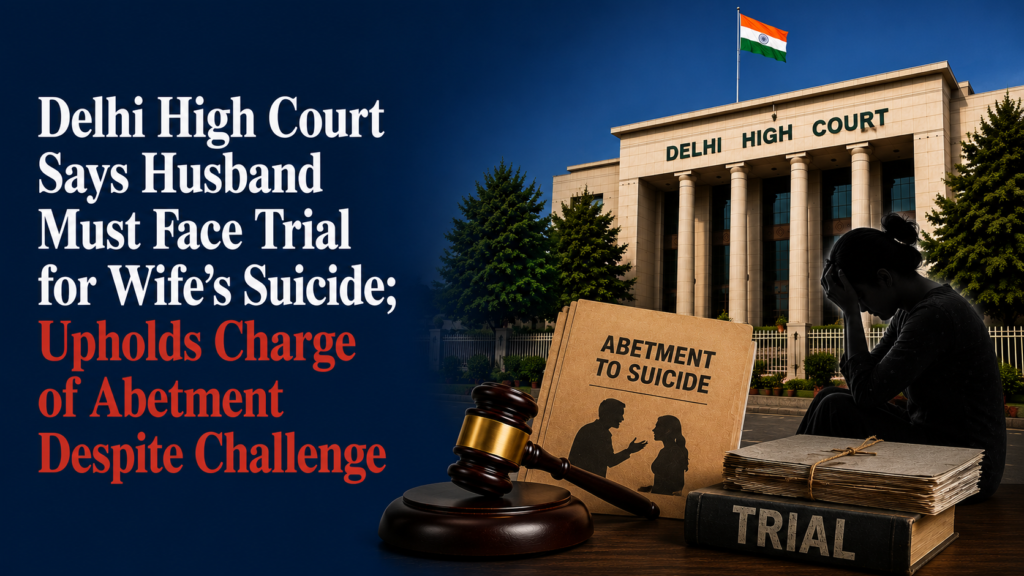
Delhi High Court Says Husband Must Face Trial for Wife’s Suicide; Upholds Charge of Abetment Despite Challenge

Wife Allegedly Endured Repeated Physical Assaults Before Her Suicide; Delhi High Court Refuses to Quash Abetment Charge Against Husband
Facts
The present case arose from the tragic suicide of Kamini @ Gudiya, who was married to the petitioner, Nitin Kumar. The parties had entered into a love marriage in June 2015 and had two children from the wedlock. According to the petitioner, despite facing financial hardship after the COVID-19 pandemic, the marriage continued without any formal complaint ever being lodged by his wife during her lifetime.
On 17 April 2024, Kamini was found hanging inside the matrimonial home at Jain Colony, Barwala, Delhi. The incident was immediately reported to the police by members of the petitioner’s family. The following day, her father lodged a complaint alleging that his daughter had been continuously subjected to physical assault, mental harassment and cruelty at her matrimonial home. Based on this complaint, FIR No. 323/2024 was registered at Police Station Shahbad Dairy under Sections 306 and 34 IPC.
During investigation, the police recovered a handwritten diary maintained by the deceased between 13 April and 17 April 2024, only days before her death. The investigating agency also recorded statements of the deceased’s parents and close relatives under Section 161 CrPC, who consistently alleged that she had repeatedly complained about physical assaults and mental harassment inflicted by the petitioner. These statements, coupled with the diary and other material collected during investigation, culminated in the filing of a charge-sheet against the petitioner and certain members of his family for the offence of abetment of suicide under Section 306 IPC.
When the matter reached the Sessions Court for consideration on charge, the Trial Court carefully evaluated the role of each accused separately. It found that the allegations against the petitioner’s relatives were either vague, omnibus or too remote in time to constitute abetment of suicide. Accordingly, the co-accused were discharged. However, insofar as the petitioner was concerned, the Trial Court found specific allegations of repeated physical assault and continuous mental harassment. It therefore directed that a charge under Section 306 IPC be framed against him. Formal charge was framed on 13 May 2026.
Aggrieved by this order, the petitioner approached the Delhi High Court by way of a criminal revision under Section 438 read with Section 528 BNSS, seeking quashing of the order framing charge.
Issues
The High Court considered the following questions:
- Whether the material collected during investigation disclosed the essential ingredients of abetment of suicide under Sections 306 and 107 IPC.
- Whether the Trial Court had correctly applied the settled principles governing framing of charge.
- Whether the High Court, while exercising revisional jurisdiction, should interfere with an order framing charge.
- Whether the diary recovered from the deceased exonerated the petitioner at the threshold stage.
Petitioner’s Arguments
The petitioner contended that the impugned order was contrary to settled principles governing framing of charge. According to him, neither the FIR nor the statements recorded during investigation disclosed any act amounting to “abetment” as defined under Section 107 IPC, which is an indispensable ingredient of the offence punishable under Section 306 IPC. Mere allegations of matrimonial discord or harassment, it was argued, cannot automatically amount to abetment of suicide unless there exists clear evidence of instigation, intentional aid or active participation.
The petitioner further argued that the allegations relied upon by the prosecution were vague and largely related to incidents said to have occurred during 2023, whereas the suicide took place in April 2024. Such allegations, according to him, lacked the necessary proximity required to establish a causal connection between the alleged acts and the commission of suicide.
Particular emphasis was placed upon the handwritten diary recovered during investigation. The petitioner submitted that the diary represented the most contemporaneous account left behind by the deceased and did not attribute any conduct amounting to instigation or intentional aid. Consequently, the diary itself demonstrated the absence of ingredients necessary to prosecute him under Section 306 IPC.
Reliance was placed upon Nipun Aneja v. State of Uttar Pradesh and Gurcharan Singh v. State of Punjab, wherein the Supreme Court emphasised that prosecution for abetment of suicide requires evidence of instigation or conduct having a proximate nexus with the suicide. The petitioner argued that those principles squarely applied and warranted his discharge.
Respondent’s Arguments
The State supported the Trial Court’s order and submitted that the material collected during investigation clearly disclosed a prima facie case. It argued that the Court was not required to conduct a meticulous examination of evidence or determine guilt at the stage of framing charge. Rather, it was sufficient if the available material raised grave suspicion warranting a full-fledged trial.
The prosecution submitted that the diary constituted only one piece of evidence. It could not be read in isolation while ignoring the statements of the deceased’s parents and other relatives, who consistently alleged repeated physical assaults and mental harassment. According to the State, the cumulative effect of the material collected during investigation justified the Trial Court’s decision to proceed against the petitioner while discharging the remaining accused.
Analysis of the Law
The High Court began by reiterating the settled principles governing revisional jurisdiction. A criminal revision is not intended to function as a second appeal. The revisional court does not reassess evidence or determine whether the prosecution will ultimately succeed. Its role is confined to examining whether the impugned order suffers from patent illegality, perversity or jurisdictional error. Unless such defects are apparent, interference is ordinarily unwarranted.
The Court then examined the legal standard applicable at the stage of framing charge. It observed that at this preliminary stage, the Court does not determine guilt beyond reasonable doubt. Instead, it merely evaluates whether the material collected during investigation raises a grave suspicion that the accused has committed the alleged offence. If such suspicion exists and cannot be readily explained away, the accused must face trial so that evidence can be tested through examination and cross-examination.
With respect to Section 306 IPC, the Court acknowledged that abetment necessarily requires satisfaction of the ingredients contained in Section 107 IPC, namely instigation, conspiracy or intentional aid. However, whether these ingredients ultimately stand proved is a matter for trial. At the stage of framing charge, the Court is only concerned with whether the investigation has produced sufficient material raising a prima facie inference of such conduct.
The High Court also emphasised that documentary evidence cannot be selectively examined in isolation. Although the petitioner heavily relied upon the diary, the Court held that its evidentiary value could only be assessed after considering it together with the remaining prosecution evidence. Selectively reading one document while ignoring witness statements and other material would amount to conducting a mini trial, which is impermissible at the stage of framing charge.
Precedent Analysis
The Court principally relied upon Amit Kapoor v. Ramesh Chander (2012), wherein the Supreme Court explained that interference with an order framing charge should be exercised sparingly and only where the allegations are patently absurd or fail to disclose the ingredients of the alleged offence. The High Court applied this principle to hold that it could not re-appreciate the evidence collected during investigation.
The petitioner relied upon Nipun Aneja v. State of Uttar Pradesh and Gurcharan Singh v. State of Punjab, both of which emphasise that conviction under Section 306 IPC requires proof of instigation, intentional aid or conduct having a proximate nexus with the suicide. The High Court accepted the correctness of these principles but clarified that those authorities primarily govern the ultimate determination of guilt. At the stage of framing charge, the Court is only required to determine whether the available material justifies proceeding to trial. Since such material existed, those precedents did not assist the petitioner.
Court’s Reasoning
The High Court found that the Trial Court had undertaken an independent assessment of the role attributed to each accused. The discharge of the petitioner’s relatives demonstrated that the Trial Court had not mechanically accepted the prosecution case but had carefully scrutinised the evidence against every accused separately. The petitioner alone was directed to face trial because the investigation disclosed specific allegations of repeated physical assaults and continuous mental harassment attributed to him.
The Court further observed that the prosecution case was not founded solely upon the diary. The statements recorded under Section 161 CrPC consistently alleged that the petitioner had subjected the deceased to repeated cruelty during the matrimonial relationship. These statements, when read alongside the diary and other investigative material, furnished sufficient grounds to raise grave suspicion against the petitioner.
Rejecting the petitioner’s reliance upon selected diary entries, the Court held that the evidentiary significance of the diary can only be assessed after a complete trial. Whether the diary supports or weakens the prosecution case, how it should be interpreted, and whether it negates the allegations of abetment are all questions that require appreciation of evidence during trial and cannot be conclusively decided in revisional proceedings.
Ultimately, the Court concluded that the petitioner’s submissions substantially related to appreciation of evidence and possible defences. Those matters fall squarely within the province of the trial court after evidence is led and tested. Since the material presently available disclosed sufficient grounds to proceed, no interference was warranted.
Conclusion
The Delhi High Court dismissed the revision petition and upheld the Trial Court’s order framing charge under Section 306 IPC against the petitioner. It held that the investigation disclosed sufficient material raising a prima facie case of repeated physical assault and mental harassment, warranting a full trial. The Court reiterated that the stage of framing charge is not meant for a detailed appreciation of evidence or determination of guilt, but only for assessing whether the material creates grave suspicion requiring the accused to face trial. The judgment reinforces the limited scope of revisional jurisdiction and cautions against converting proceedings challenging an order on charge into a mini trial.
Case Details
Case Name: Nitin Kumar v. State (NCT of Delhi) & Anr.
Court: Delhi High Court
Case Number: CRL.REV.P. 405/2026 & CRL.M.A. 20718/2026
Judge: Hon’ble Ms. Justice Madhu Jain
Date Reserved: 13 July 2026
Date Pronounced: 27 July 2026
Date Uploaded: 27 July 2026