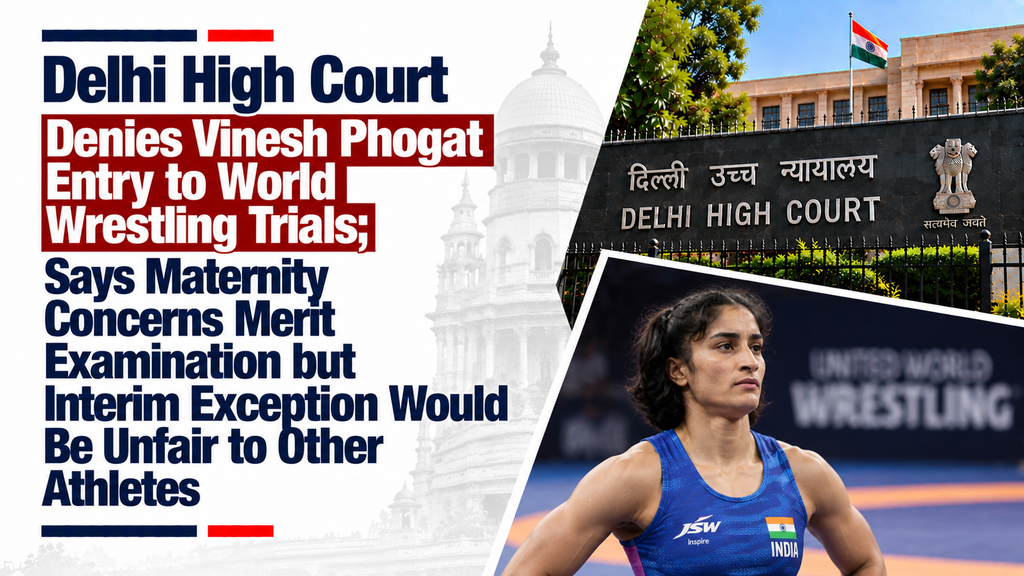
Delhi High Court Denies Vinesh Phogat Entry to World Wrestling Trials; Says Maternity Concerns Merit Examination but Interim Exception Would Be Unfair to Other Athletes

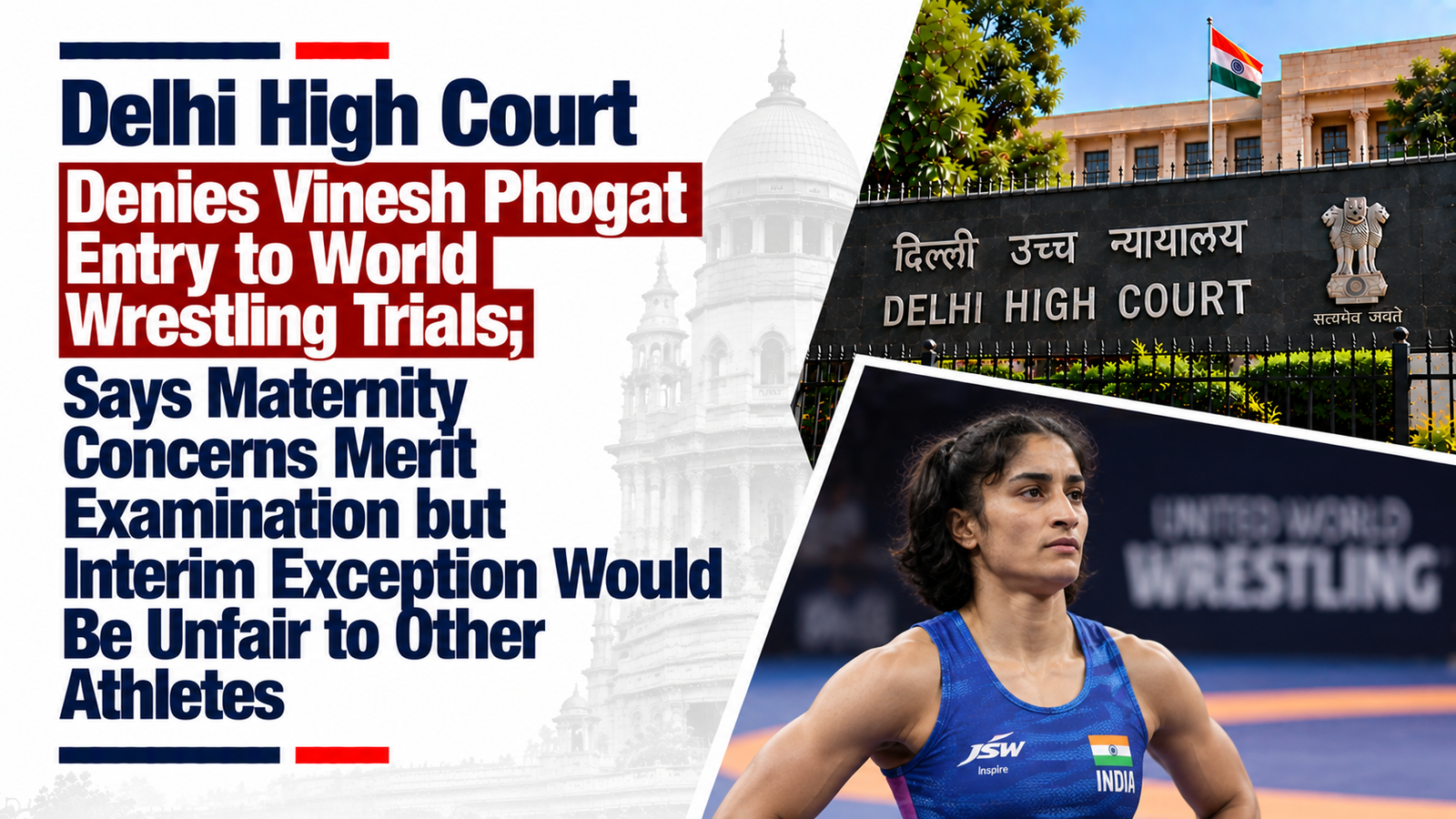
Delhi High Court Refuses Vinesh Phogat Interim Entry to World Championship Wrestling Trials; Says Pregnancy-Related Absence Does Not Automatically Override Uniform Eligibility Criteria
Facts
The petition was filed by Vinesh Phogat against the Wrestling Federation of India (WFI) and others. The present order concerned CM Application No. 61231/2026 seeking permission to participate in the selection trials for the 2026 Senior World Wrestling Championships.
The larger writ petition seeks directions requiring WFI to formulate a fair, transparent and structured framework for women athletes returning to competitive sport following pregnancy, childbirth and post-partum recovery, so that maternity-related absence does not itself disadvantage them in competitions or selection opportunities.
Phogat had remained away from active competition during 2024–2025 because of pregnancy, childbirth and post-partum recovery. The International Testing Agency, acting for United World Wrestling, confirmed that she would be eligible to compete from 1 January 2026.
WFI subsequently prescribed qualifying competitions for the Asian Games trials. Phogat had missed several because of her maternity-related absence. She registered for the Senior Open Ranking Tournament at Gonda scheduled for 10–12 May 2026, but WFI issued a show-cause notice on 9 May and declared her ineligible for WFI events until 26 June 2026, preventing her participation.
A Division Bench of the Delhi High Court thereafter permitted her to participate in the Asian Games Selection Trials, having prima facie observed that the earlier policy appeared arbitrary, discriminatory and exclusionary and that motherhood could not operate to prejudice a woman in her career. Phogat competed in the 53 kg category and reached the semi-final but was not ultimately selected.
WFI subsequently issued a second show-cause notice dated 17 June 2026, alleging misconduct during those trials. Both disciplinary proceedings remained pending without a final order.
The immediate dispute arose when WFI issued a fresh Circular dated 7 September 2026 prescribing eligibility for the Senior World Wrestling Championship trials scheduled for 14 September 2026 at Indira Gandhi Stadium, New Delhi. The Championships themselves were scheduled for 24 October to 1 November 2026 at Astana, Kazakhstan.
Issues
The immediate issue was whether Vinesh Phogat should be granted an interim exemption from WFI’s eligibility criteria and provisionally permitted to participate in the 14 September 2026 selection trials.
The larger issue, which the Court expressly left open for final adjudication, is whether a sporting selection policy must provide an appropriate mechanism for athletes returning after pregnancy and childbirth, and whether failure to provide such accommodation renders the policy arbitrary or discriminatory.
The Court also considered whether the earlier Division Bench order permitting Phogat to participate in the Asian Games trials created any continuing exemption from subsequent WFI selection policies.
Petitioner’s Arguments
Phogat argued that the 7 September Circular perpetuated the same exclusionary framework that had earlier attracted prima facie criticism from the Division Bench.
The qualifying events were drawn from a closed list of competitions without making any provision for athletes who had been absent because of pregnancy, childbirth and post-partum recovery.
She stressed that she was not seeking automatic selection for the World Championships. She sought only an opportunity to compete in the selection trials and demonstrate her sporting merit. Her participation in the earlier Asian Games trials, where she reached the semi-final, was relied upon as evidence of her return to competitive wrestling.
She further argued that WFI could not rely on her absence from the Gonda tournament as a disqualification when WFI itself had prevented her from participating by issuing the first show-cause notice after initially accepting her registration.
As regards disciplinary proceedings, Phogat submitted that the Circular referred to wrestlers who had been “found guilty” of indiscipline, whereas no final finding of guilt or operative disqualification order existed against her.
Finally, she pleaded urgency: unless provisionally allowed to compete on 14 September, the selection process and Championships would conclude before the substantive challenge could be decided, making effective relief largely infructuous.
Respondent’s Arguments
WFI argued that Phogat had no vested right to participate without satisfying the eligibility criteria under the 7 September Circular.
The criteria applied uniformly to all wrestlers and could not be relaxed solely because she had been unable to participate in some qualifying events.
WFI maintained that the Division Bench’s earlier relief concerned the peculiar circumstances surrounding the Asian Games policy and did not grant Phogat a continuing exemption for future competitions.
It also pointed out that some qualifying competitions under the new Circular took place after her sabbatical had ended, but she did not participate in them.
WFI further relied upon her alleged failure to avail the first three opportunities to appear before its Disciplinary Committee and argued that a special interim dispensation would prejudice athletes who had complied with the eligibility requirements.
Analysis of the Law
Earlier Relief Created No Continuing Exemption
The Court distinguished the Division Bench’s May 2026 order.
That relief was granted in the specific context of the Asian Games Selection Policy dated 25 February 2026 and the first show-cause notice. It could not be construed as giving Phogat a general or continuing exemption from WFI’s eligibility requirements for future competitions.
Maternity-Based Challenge Remains a Live and Serious Issue
Importantly, the Court did not reject the merits of Phogat’s maternity discrimination challenge.
It expressly recognised that her inability to participate in some qualifying competitions resulted from pregnancy, childbirth and post-partum recovery and said those circumstances would be considered when examining the validity of WFI’s selection framework.
The Court further held that the broader question whether selection policies should contain an appropriate mechanism for athletes returning after childbirth, and whether the absence of such a mechanism is arbitrary or discriminatory, requires detailed consideration at final adjudication.
Thus, the order is an interim-relief ruling, not a final rejection of maternity accommodation in sport.
Uniform Eligibility Criteria Could Not Be Relaxed for One Athlete at Interim Stage
The decisive consideration was that the 7 September Circular applied uniformly to all athletes and was not specifically framed against Phogat.
The Court held that maternity-related circumstances may be highly relevant when ultimately examining the validity of the policy, but they did not automatically entitle Phogat, at the interim stage, to participate contrary to its existing eligibility criteria.
Participation Itself Requires Eligibility
The Court rejected the distinction Phogat sought to draw between participation and final selection.
Although she sought only an opportunity to compete rather than automatic selection, participation in the selection trials itself was governed by eligibility criteria. Therefore, asking only for trial participation did not eliminate the requirement to qualify under the Circular.
Special Dispensation Could Open a “Pandora’s Box”
The Court considered the broader effect on athletes who were not before it.
Allowing Phogat to participate despite not meeting the eligibility criteria would effectively create an individual exception from rules applicable to athletes throughout the country.
The Court observed that such an exception could be unfair to similarly situated athletes and might open a “Pandora’s box”, with others seeking comparable exemptions.
Precedent Analysis
The order does not substantially analyse external judicial precedents.
Its most significant prior judicial reference is the Division Bench judgment dated 22 May 2026 in LPA No. 399/2026, arising from Phogat’s earlier challenge.
There, the Division Bench had prima facie described the Asian Games Selection Policy as “completely arbitrary, discriminatory and exclusionary in nature” and observed that motherhood could not operate to prejudice a woman in her career. It consequently permitted Phogat to participate in the Asian Games Selection Trials.
The present Single Judge, however, distinguished that relief as fact-specific. The earlier order concerned a different policy and the first show-cause notice and therefore could not operate as a standing exemption from future WFI eligibility rules.
Court’s Reasoning
The Court considered the case to have materially evolved since the earlier Division Bench intervention.
Following the Asian Games trials, WFI had issued a second show-cause notice alleging misconduct during those very trials. The Court expressly refrained from deciding whether those allegations were true but held that the subsequent disciplinary developments could not be completely ignored while deciding whether another interim participation order should be granted.
The record also showed that Phogat had been given repeated opportunities to appear before WFI’s Disciplinary Committee but did not avail the first three, instead objecting to non-disclosure of the Committee’s composition.
More fundamentally, the Court emphasised the national dimension of sports selection. Selection to represent India at an international championship involves considerations beyond the claim of an individual athlete. A fair, uniform and performance-based selection process was considered of paramount importance.
At the same time, the Court expressly recognised the deeper issue raised by Phogat:
how motherhood and maternity are to be balanced against the demands of a sporting career, and whether an athlete should have to choose between motherhood and her career.
The Court held that this question merits careful consideration, but must be decided upon substantive adjudication of the policy rather than by creating an interim exception for one athlete.
Conclusion
The Delhi High Court refused Vinesh Phogat interim permission to participate in the selection trials scheduled for 14 September 2026 for the Senior World Wrestling Championships.
It declined to create an individual exemption from eligibility requirements that presently apply uniformly to all athletes, particularly before deciding the legality of the policy itself.
Crucially, the Court did not finally uphold the Circular, nor did it reject Phogat’s maternity-discrimination challenge. It expressly refrained from expressing a final opinion either on the validity of the 7 September 2026 Circular or on the merits of the pending disciplinary proceedings.
The interim application was dismissed, while arguments in the main writ petition remained part-heard, with the matter listed for 29 September 2026.
Case Details
Case: Vinesh Phogat v. Wrestling Federation of India & Ors.
Court: Delhi High Court
Case Number: W.P.(C) 12674/2026; CM APPL. 61231/2026
CNR: DLHC010410212026
Judge: Dr. Justice Swarana Kanta Sharma
Date: 10 September 2026
Result: Interim application seeking participation in the 14 September 2026 World Wrestling Championship selection trials dismissed; validity of WFI’s policy, maternity-related exclusion challenge and pending disciplinary proceedings left open for final adjudication