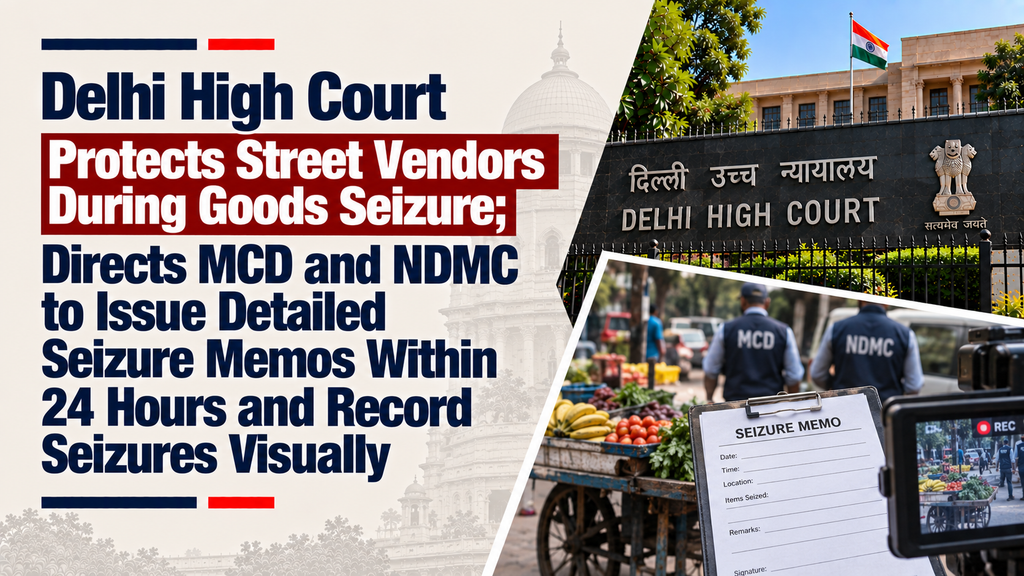
Delhi High Court Protects Street Vendors During Goods Seizure; Directs MCD and NDMC to Issue Detailed Seizure Memos Within 24 Hours and Record Seizures Visually

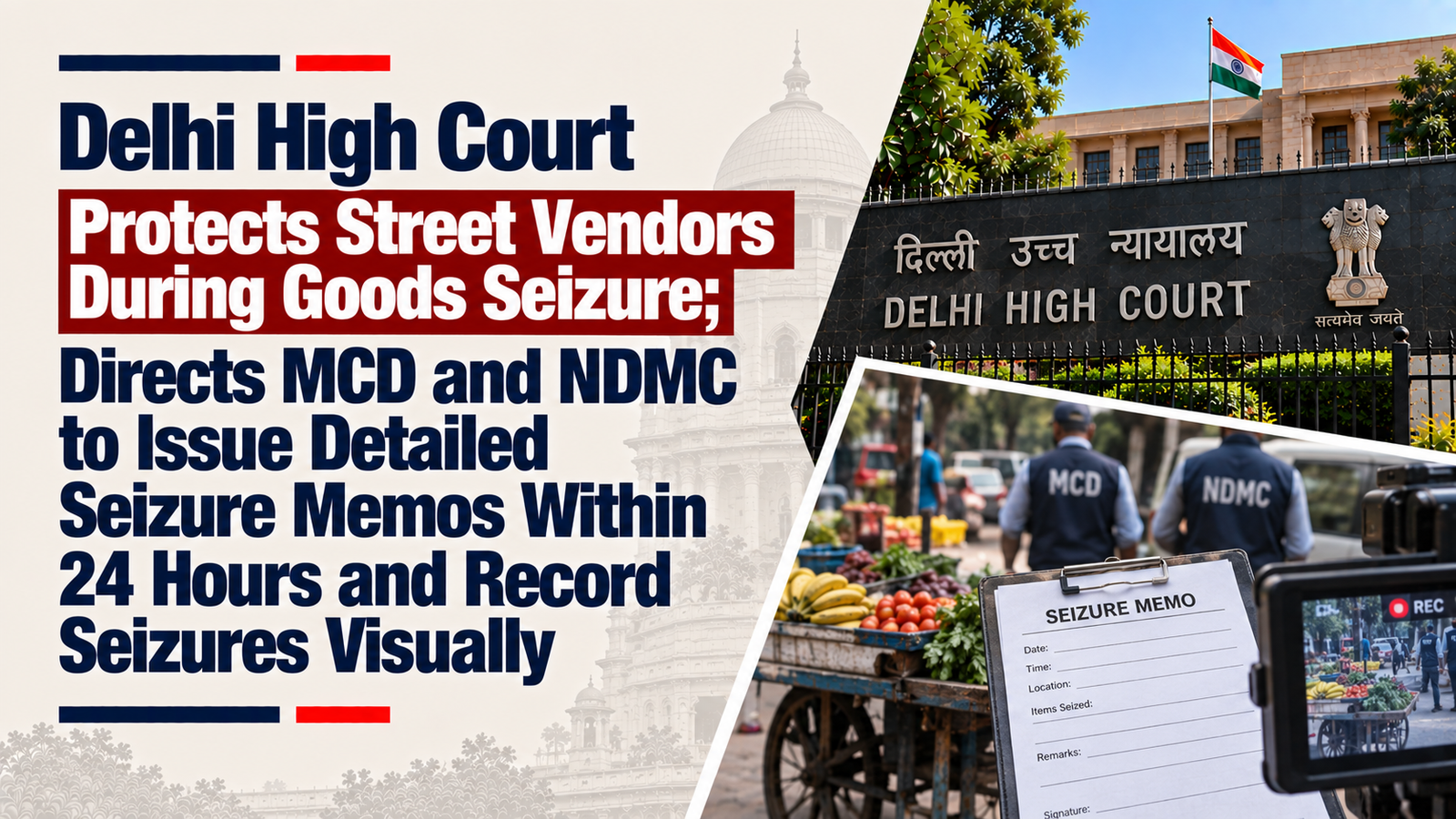
Delhi High Court Orders MCD and NDMC to Give Street Vendors Seizure Memos Within 24 Hours; Directs Photography and Videography of Enforcement Actions
Facts
The Public Interest Litigation was filed by Rehri Patri Ekta Manch, through its General Secretary Anil Bakshi, seeking to represent the rights and interests of street vendors across Delhi. The Association stated that it had no personal interest in the litigation and had approached the Court in the larger interest of street vendors.
The dispute concerned the practice followed by the Municipal Corporation of Delhi (MCD) and the New Delhi Municipal Council (NDMC) while seizing goods belonging to street vendors for alleged violations.
The petitioner’s grievance was that when municipal officials seized vendors’ goods, no seizure memo was prepared at the time of seizure and no list of the seized articles was supplied to the vendor. According to the petition, vendors received only a receipt relating to payment of the fine later in the evening.
Issues
The principal issue was whether MCD and NDMC could seize goods belonging to street vendors without contemporaneously providing them with a proper inventory or seizure memo.
The Court specifically examined the municipal authorities’ obligations under Section 19 of the Street Vendors (Protection of Livelihood and Regulation of Street Vending) Act, 2014.
It also considered the practical difficulty raised by MCD and NDMC that preparing seizure memos immediately at the spot alerts other vendors in the vicinity, enabling them to remove their goods and avoid enforcement action.
A further issue concerned the pending constitution of Town Vending Committee-II (TVC-II).
Petitioner’s Arguments
The petitioner’s essential grievance was that the existing seizure procedure lacked basic documentation and transparency.
Whenever goods were seized, the concerned street vendor was allegedly not provided with a seizure memo or a list identifying the goods taken into municipal custody. Instead, only a fine receipt was provided later.
This practice was inconsistent with the statutory protection afforded to street vendors under Section 19 of the 2014 Act, which expressly requires preparation of a list of seized goods and supply of a duly signed copy to the affected vendor.
Respondents’ Arguments
MCD and NDMC explained that seizure operations ordinarily take place at a particular point in time and that preparing the seizure memo immediately at the spot creates an operational difficulty.
According to the authorities, once other vendors become aware that enforcement officials are preparing seizure records, they are alerted to the operation and may leave the area, thereby escaping action despite violations.
Their existing practice was therefore to conduct the seizure first and prepare the seizure memo later in the evening along with the fine receipt.
NDMC additionally informed the Court that it maintained a proper warehouse for seized goods. The articles belonging to individual vendors were placed on identified shelves, and the relevant shelf number was mentioned in the receipt. Goods were released upon payment of the prescribed fine.
NDMC further stated that its officials undertake videography or photography of seizure operations, depending upon the resources available at the time.
Analysis of the Law
Section 19 Mandates an Inventory of Seized Goods
The High Court treated Section 19 of the Street Vendors Act, 2014 as governing the procedure.
The provision permits the local authority, in the circumstances contemplated by Sections 18 and 19, to seize a street vendor’s goods. However, whenever seizure takes place, a list of the goods seized must be prepared, and a copy duly signed by the authorised officer must be issued to the street vendor.
The Court therefore made clear that both MCD and NDMC are expected to comply with this statutory requirement.
Court Balances Statutory Protection With Enforcement Practicalities
The Court nevertheless accepted the practical concern raised by the municipal authorities.
If officials were compelled to stop and prepare detailed seizure memos at the very spot where enforcement was underway, other vendors might become aware of the operation and leave before action could be taken.
The Court therefore adopted a middle course.
MCD and NDMC were permitted to prepare and issue the seizure memo after the actual seizure, but they must do so within an outer limit of 24 hours from the seizure.
This preserved the effectiveness of municipal enforcement while ensuring that vendors were not left indefinitely without documentary proof of what had been taken from them.
Mandatory Contents of Seizure Memo
The High Court prescribed specific information that every seizure memo must contain:
- date of seizure;
- list of goods seized;
- shelf number, if any;
- penalty or fine payable, if any; and
- name, signature and designation of the concerned officer.
This direction gives the vendor an identifiable official record linking the seized goods to the enforcement action and the officer responsible for it.
Photography and Videography
The Court also extended NDMC’s stated documentation practice to MCD.
Since NDMC informed the Court that its officials photograph or videograph seizure operations depending upon available resources, the Court directed that MCD should similarly undertake videography/photography while carrying out seizures.
Precedent Analysis
No judicial precedent was cited or analysed in the judgment.
The Court’s decision was based directly upon Section 19 of the Street Vendors (Protection of Livelihood and Regulation of Street Vending) Act, 2014 and the practical submissions made by MCD and NDMC.
The statutory text itself was reproduced in the judgment, including the proviso mandating preparation and supply of a signed list of seized goods.
Accordingly, the ruling is principally an implementation of an express statutory safeguard rather than an extension or reinterpretation of an earlier precedent.
Court’s Reasoning
The High Court recognised that the municipal bodies have statutory authority to undertake enforcement action against street vendors in appropriate circumstances.
At the same time, seizure of a vendor’s merchandise cannot remain undocumented. Section 19 expressly protects vendors by requiring an inventory of what has been taken into municipal custody.
The Court therefore reconciled the competing considerations by permitting municipal authorities to complete the immediate seizure operation without stopping to prepare the memo on the spot, while imposing a strict maximum period of 24 hours for issuance of the documentation.
The requirement of photography/videography adds an additional evidentiary safeguard concerning the manner and contents of the seizure.
Town Vending Committee-II
The Court also considered the status of TVC-II.
MCD informed the Court that 23 members had already been elected. The list of nominated/designated members from various zones was awaited, after which the names would be forwarded to the GNCTD for notification of TVC-II.
The Court directed that this process be expedited as quickly as possible.
Conclusion
The Delhi High Court disposed of the PIL with concrete safeguards governing municipal seizure of street vendors’ goods.
MCD and NDMC were directed to comply with Section 19 of the Street Vendors Act, 2014 and issue seizure memos within a maximum of 24 hours from seizure.
Every memo must identify the date and goods seized, shelf number where applicable, penalty or fine and the name, signature and designation of the responsible officer. MCD was additionally directed to photograph or videograph seizure operations in the manner stated to be followed by NDMC.
The process for constitution of Town Vending Committee-II was also directed to be expedited.
The petition and all pending applications were accordingly disposed of.
Case Details
Case: Rehri Patri Ekta Manch v. Govt. of NCT of Delhi & Ors.
Court: Delhi High Court
Case Number: W.P.(C) 10490/2026
CNR: DLHC010336412026
Bench: Justice Prathiba M. Singh and Justice Vikas Mahajan
Date: 10 September 2026
Result: PIL disposed of with directions requiring MCD and NDMC to issue detailed seizure memos within 24 hours; MCD directed to photograph/videograph seizures; TVC-II constitution process ordered to be expedited