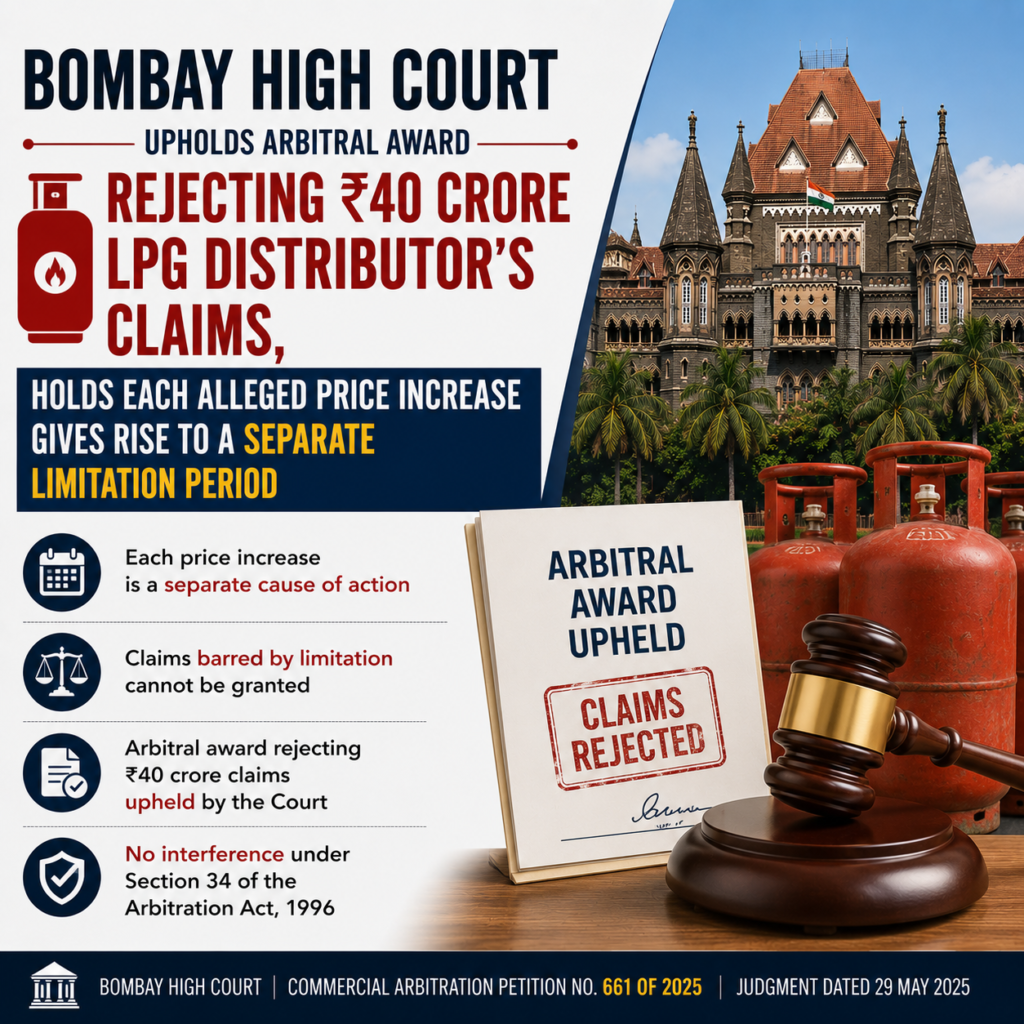
Bombay High Court Upholds Arbitral Award Rejecting ₹40 Crore LPG Distributor’s Claims, Holds Each Alleged Price Increase Gives Rise to a Separate Limitation Period
Each Alleged Contractual Breach Starts a Fresh Limitation Period, Not a Continuing Cause of Action, Bombay High Court Upholds Arbitral Award
Facts
Zawar Sales Corporation entered into three successive Distribution Agreements with Reliance Petro Marketing Limited dated 1 August 2002, 1 August 2007 and 1 August 2012 for the supply and distribution of LPG cylinders.
The petitioner alleged that the respondent had arbitrarily and excessively increased the prices of LPG cylinders and refills, allegedly from about ₹25–₹35 in 2002 to nearly ₹400 by 2008, without following any disclosed pricing policy. It further alleged that the respondent suddenly stopped supplying cylinders, causing substantial business losses.
By an advocate’s notice dated 28 July 2016, the petitioner raised claims and sought appointment of an arbitrator. The 2012 Distribution Agreement expired by efflux of time on 31 March 2017.
On 11 February 2019, the petitioner filed an application under Section 11 of the Arbitration and Conciliation Act, 1996. An arbitrator was appointed on 13 August 2019. The respondent thereafter filed an application under Section 16 challenging the tribunal’s jurisdiction over claims arising from the 2002 and 2007 Agreements.
By an order dated 28 November 2019, the arbitrator held that the 2007 and 2012 Agreements were in continuation of the 2002 Agreement and dismissed the jurisdictional objection. That order attained finality.
A substituted sole arbitrator later continued the proceedings from the stage already reached. By an award dated 25 March 2021, the arbitrator granted ₹5,62,500 in relation to the respondent’s failure to supply cylinders during the subsistence of the 2012 Agreement but rejected the petitioner’s remaining claims of approximately ₹40 crore.
The petitioner challenged the award under Section 34 of the Arbitration and Conciliation Act on the grounds of patent illegality, perversity, erroneous rejection of claims on limitation, improper appreciation of evidence and inadequate award of damages.
Issues
- Whether the arbitrator’s earlier order under Section 16, holding that the three Distribution Agreements were in continuation, barred reconsideration of limitation under the principle of internal res judicata.
- Whether the claims arising under the 2002 and 2007 Distribution Agreements constituted a continuing cause of action under Section 22 of the Limitation Act.
- Whether each price increase or alleged contractual breach gave rise to a separate cause of action with an independent period of limitation.
- Whether the arbitrator’s findings on pricing, contractual interpretation and evidence suffered from patent illegality or perversity warranting interference under Section 34.
- Whether the arbitrator ought to have awarded substantial damages on the basis of reasonable estimation or “honest guesswork” despite the alleged absence of precise evidence.
Petitioner’s Arguments
The petitioner argued that the arbitrator had wrongly restricted the effective consideration of its claims to the 2012 Distribution Agreement and had improperly rejected the claims under the 2002 and 2007 Agreements as barred by limitation.
It submitted that the earlier order dated 28 November 2019 under Section 16 had conclusively held that all three Agreements formed part of a continuous contractual arrangement. The arbitrator was therefore barred by internal res judicata from subsequently holding that the earlier claims were time-barred.
According to the petitioner, the respondent’s repeated price increases and continuing contractual defaults constituted a continuing cause of action under Section 22 of the Limitation Act. The claims could therefore not be treated as stale merely because some price increases occurred more than three years before invocation of arbitration.
The petitioner contended that the respondent had increased prices arbitrarily and without producing the pricing policy contemplated under Clauses 6 and 7 of the Agreements. The burden was allegedly upon the respondent to establish that the price increases were contractually justified.
It was also alleged that the arbitrator selectively relied upon parts of the oral evidence while ignoring material admissions and contradictions in the respondent’s evidence. The petitioner challenged the reliance upon certain documents, including Exhibit R-19, on the ground that their contents had not been formally proved.
The petitioner argued that these errors amounted to patent illegality because the award disregarded contractual provisions, settled principles concerning burden of proof and material evidence.
On damages, the petitioner submitted that once the respondent’s breach had been established, the arbitrator could not deny compensation merely because the precise amount of loss was difficult to calculate. The arbitrator ought to have applied reasonable estimation or honest guesswork to award realistic compensation for loss of business, earnings and goodwill.
Respondent’s Arguments
The respondent argued that the petition was an attempt to convert proceedings under Section 34 into an appeal on facts and evidence.
It submitted that the scope of interference under Section 34 is narrow. Where the arbitrator’s view is plausible and based on the contractual provisions and evidence, the Court cannot substitute its own interpretation merely because another view is possible.
The respondent contended that the Section 16 order dealt only with the tribunal’s jurisdiction to entertain disputes under all three Agreements. It did not determine whether each individual monetary claim was within limitation. Limitation had neither been argued nor finally adjudicated at that stage.
It pointed out that the arbitrator subsequently framed a specific issue regarding limitation. The petitioner raised no objection, participated in the proceedings and led evidence on that issue. It could therefore not later contend that the issue had already been conclusively decided.
According to the respondent, each price revision, invoice or alleged breach constituted a separate and completed cause of action. Arbitration was invoked only on 28 July 2016, and therefore claims arising more than three years earlier were barred by limitation.
The respondent further submitted that there was a long gap between the petitioner’s grievance raised in May 2008 and the arbitration notice issued in July 2016. Despite the alleged grievance, the petitioner continued to accept supplies, entered into further Agreements and allowed the earlier Agreements to expire without reserving its rights.
On the merits, the respondent argued that the Agreements expressly permitted it to determine and revise prices. The petitioner knew that the respondent was a private parallel marketer and was not governed by the subsidy regime applicable to public sector oil companies.
It was also submitted that the petitioner’s own witness admitted that the Agreements contained no clause requiring the respondent to consult the distributor before increasing prices.
Regarding damages, the respondent contended that the petitioner failed to produce basic financial evidence such as certified books of accounts, income-tax returns, customer records or other primary documents. The arbitrator therefore correctly rejected speculative claims of approximately ₹40 crore and awarded only the amount that could be supported by available material.
Analysis of the Law
Scope of interference under Section 34
The Court reiterated that proceedings under Section 34 are supervisory and not appellate. A court cannot reassess evidence, reinterpret contractual provisions or substitute its own factual conclusions merely because it may have reached a different view.
An award may be interfered with only where the alleged illegality is apparent on the face of the award, goes to the root of the matter, or renders the award perverse or contrary to public policy.
Errors in appreciation of evidence or the existence of another possible interpretation do not by themselves amount to patent illegality.
Internal res judicata and limitation
The Court distinguished between a jurisdictional determination under Section 16 and an adjudication on the merits of limitation.
The earlier Section 16 order only held that the tribunal had jurisdiction over disputes arising from all three Agreements because the Agreements were connected or in continuation. It did not hold that every claim under those Agreements was within limitation.
The arbitrator had subsequently framed a specific issue concerning limitation. Both parties participated in that adjudication and led evidence without objection. The petitioner’s plea of internal res judicata was therefore rejected.
Continuing cause of action
The Court held that a continuing wrong exists only where the wrongful act itself creates a continuing source of injury.
Where an act is complete, the mere continuation of its consequences does not convert it into a continuing wrong.
Each price increase or alleged breach under the Distribution Agreements was a distinct and completed event. Each such breach therefore generated its own cause of action and attracted a separate period of limitation.
The execution of later Agreements did not revive claims that had already become time-barred under the earlier Agreements.
Contractual interpretation
The interpretation of Clauses 6 and 7 and the respondent’s power to revise LPG prices were matters falling within the arbitrator’s domain.
The arbitrator had considered the petitioner’s continued acceptance of supplies and revised prices over several years, as well as the renewal of the contractual relationship on two occasions.
The finding that the petitioner had, by its conduct, accepted or waived objections to the pricing mechanism was regarded as a plausible view based on the contract and evidence.
Proof and quantification of damages
The Court distinguished between difficulty in quantifying an established loss and complete failure to prove that loss occurred.
Honest guesswork may be used where the fact of loss is established but its exact monetary value cannot be calculated. It cannot be used where the claimant has failed to produce reliable evidence proving the existence of the alleged loss itself.
Damages cannot be awarded solely on speculation. Some foundational evidence connecting the breach to the claimed financial injury is essential.
Precedent Analysis
Ssangyong Engineering & Construction Co. Ltd. v. NHAI
The Court relied on this decision for the principle that patent illegality must be apparent on the face of the award and must go to the root of the dispute.
Section 34 does not permit reappreciation of evidence or interference merely because the Court considers another interpretation preferable.
Associate Builders v. Delhi Development Authority
This decision was referred to in explaining that perversity or patent illegality must be fundamental and not merely an alleged factual or legal error.
The Court found that the petitioner’s objections effectively sought reconsideration of evidence, which was impermissible.
UHL Power Co. Ltd. v. State of Himachal Pradesh
The Supreme Court held that where an arbitrator adopts a plausible view based on the contract and record, the award must ordinarily be upheld.
The Bombay High Court applied this principle to the arbitrator’s interpretation of the pricing clauses and the petitioner’s conduct.
Dyna Technologies Pvt. Ltd. v. Crompton Greaves Ltd.
This judgment emphasised that Section 34 jurisdiction is supervisory and not appellate.
The Court relied upon it to reject the petitioner’s attempt to reopen factual findings and contractual interpretation.
State of Gujarat v. Kothari and Associates
The Supreme Court held that successive breaches give rise to separate causes of action and that limitation runs independently from each breach.
The Court applied this principle to hold that every price revision or alleged breach had to be examined separately for limitation.
Balkrishna Savalram Pujari Waghmare v. Shree Dnyaneshwar Maharaj Sansthan
This judgment explained the distinction between a continuing wrong and the continuing effect of a completed wrong.
The Court relied on it to hold that the alleged price increases were completed breaches rather than a single continuing wrong.
Geo Miller & Co. Pvt. Ltd. v. Chairman, Rajasthan Vidyut Utpadan Nigam Ltd.
This decision addressed the point from which limitation runs for invoking arbitration.
The Court applied the principle that stale contractual claims cannot be revived merely by issuing a later arbitration notice.
Nusli Neville Wadia v. Ivory Properties
The Supreme Court distinguished questions of jurisdiction from adjudication of rights on merits.
The Court relied upon this decision to hold that the Section 16 order did not decide limitation and therefore did not operate as internal res judicata.
Urban Infrastructure Real Estate Fund v. Neelkanth Realty Pvt. Ltd.
The Court referred to this judgment for the proposition that limitation is ordinarily a mixed question of law and fact requiring adjudication on pleadings and evidence.
It supported the conclusion that limitation could not be treated as finally decided in the preliminary jurisdictional order.
Kanchan Udyog Ltd. v. United Spirits Ltd., Maula Bux v. Union of India and Kailash Nath Associates v. DDA
These decisions established that compensation cannot be awarded without proof that actual loss was suffered.
The Court relied on them to reject the petitioner’s plea for substantial damages based solely on estimation.
Sineximco Pte Ltd. v. MMTC Ltd. and related damages cases
The petitioner relied upon these cases to argue that courts may use honest guesswork where precise calculation is difficult.
The Court distinguished them by holding that estimation is permissible only after the fact of loss is proved. Since the petitioner had not established the foundation of its alleged ₹40 crore loss, those authorities did not assist it.
Court’s Reasoning
The Court found that the arbitrator had considered all three Distribution Agreements and had not ignored the earlier contractual periods merely because of the Section 16 ruling.
The Section 16 order only confirmed jurisdiction. It did not conclusively determine limitation. The petitioner had also participated without objection in the subsequent adjudication of the limitation issue.
The Court accepted the arbitrator’s finding that each alleged arbitrary price increase was a separate breach. Claims relating to events occurring more than three years before the arbitration notice dated 28 July 2016 were therefore barred.
The petitioner’s long silence was also significant. It had raised an objection in 2008 but continued to accept supplies, entered into subsequent Agreements and did not reserve earlier claims. This conduct undermined the argument that there was a continuous and unresolved breach.
On pricing, the arbitrator’s interpretation was held to be plausible. The Agreements permitted price revision, and the petitioner’s own evidence did not establish a contractual obligation requiring consultation before any increase.
The petitioner’s allegations concerning selective appreciation of oral evidence, burden of proof and reliance on documents were found to be attempts to secure reappreciation of evidence. Such reconsideration was beyond the Court’s jurisdiction under Section 34.
Regarding damages, the Court held that the petitioner had failed to produce reliable financial records proving the alleged loss of business, goodwill or infrastructure expenditure. The arbitrator had nevertheless awarded ₹5,62,500 for loss of earnings during the proven period of non-supply based on the available material.
The Court held that the award was reasoned, evidence-based and founded on a plausible interpretation of the Agreements. No patent illegality, perversity or conflict with public policy was established.
Conclusion
The Bombay High Court dismissed the petition challenging the arbitral award dated 25 March 2021.
It upheld the arbitrator’s findings that:
- claims relating to breaches occurring more than three years before invocation of arbitration were barred by limitation;
- the Section 16 order did not finally decide limitation;
- the alleged price revisions constituted separate breaches rather than a continuing wrong;
- the interpretation of the pricing provisions was plausible;
- the petitioner had failed to prove its claims of approximately ₹40 crore; and
- the award of ₹5,62,500 for the established period of non-supply was supported by the available evidence.
The Court held that the petition was essentially an impermissible attempt to reargue the merits and seek reappreciation of evidence under Section 34.
Case: Zawar Sales Corporation v. Reliance Petro Marketing Limited
Court: High Court of Judicature at Bombay, Ordinary Original Civil Jurisdiction
Case Number: Commercial Arbitration Petition (L) No. 14180 of 2021
Judge: Justice Kamal Khata
Date: 30 June 2026
Result: Petition dismissed; arbitral award dated 25 March 2021 upheld, with no order as to costs.