
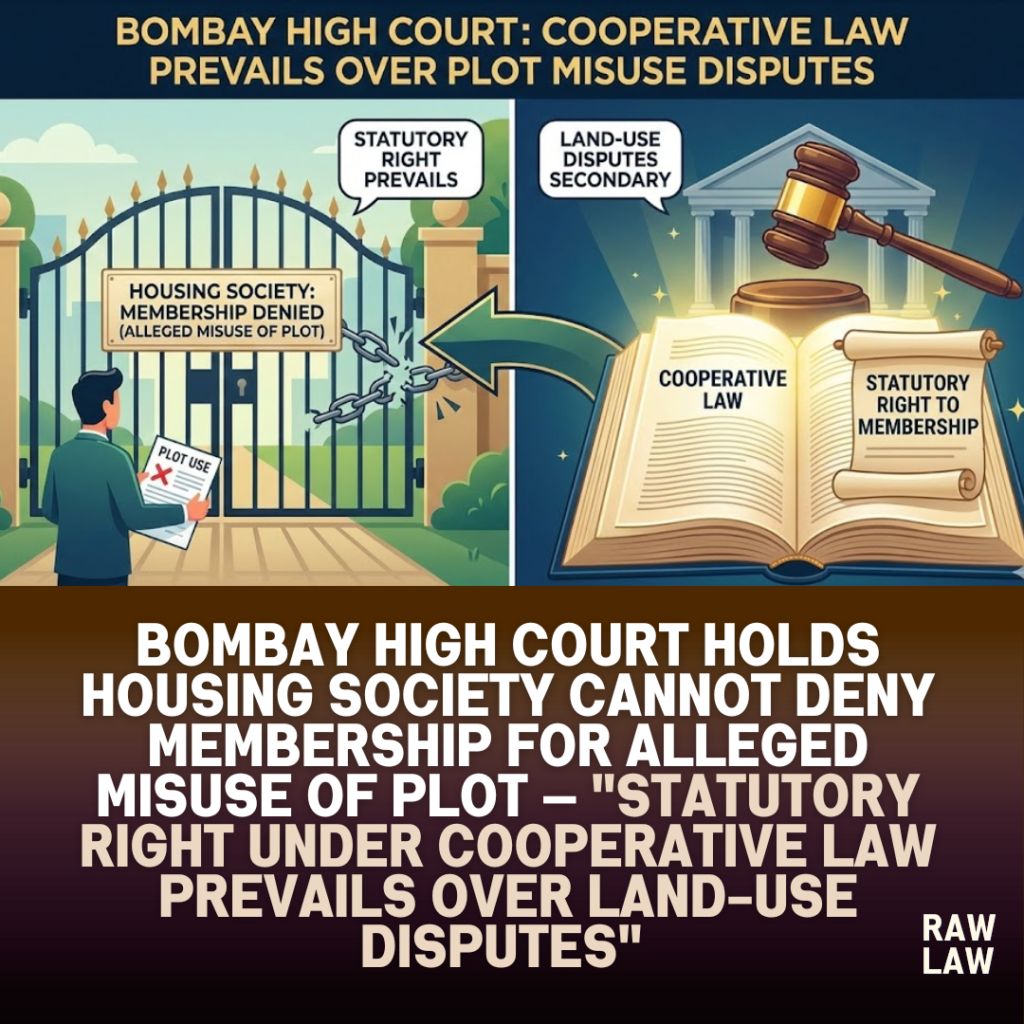

1. Court’s decision
The Bombay High Court dismissed a writ petition filed by a tenant-ownership housing society challenging orders of cooperative authorities directing admission of an applicant as a member. The Court held that alleged non-residential use of the plot, unauthorised construction, or breach of lease conditions cannot constitute valid grounds to refuse membership under Section 23 of the Maharashtra Co-operative Societies Act, 1960, unless such disqualifications are expressly provided in the Act or the society’s bye-laws.
2. Facts
The petitioner is a registered tenant-ownership cooperative housing society. A residential plot within the society was originally allotted on leasehold basis in 1985. The respondent acquired rights in the plot through a registered deed of assignment executed in 2014 and thereafter applied for membership of the society. The society rejected the application, citing alleged unauthorised construction in the compulsory open space, proposed educational use of the premises, and lack of prior consent for transfer as required under a clause in the lease deed. The respondent invoked Section 23(2) of the Maharashtra Co-operative Societies Act before the Deputy Registrar, who directed the society to grant membership. This order was affirmed in revision by the Divisional Joint Registrar, leading to the present writ petition.
3. Issues
The principal issues were whether a cooperative housing society can refuse membership on grounds of alleged non-residential use of premises, unauthorised construction, or breach of lease conditions requiring prior consent for transfer, and whether such factors amount to “sufficient cause” under Section 23 of the Maharashtra Co-operative Societies Act.
4. Petitioners’ arguments
The society argued that the respondent intended to use the plot for educational purposes in a purely residential society, contrary to land-use permissions and earlier revenue orders. It was contended that unauthorised construction had been carried out, attracting municipal demolition notices. The society further relied on a lease condition mandating prior consent for transfer, asserting that the respondent’s failure to obtain such consent invalidated his claim to membership. It was submitted that cooperative authorities failed to appreciate these violations, warranting interference under Articles 226 and 227 of the Constitution.
5. Respondent’s arguments
The respondent contended that proceedings under Section 23 are confined to statutory eligibility under the Act, Rules, and registered bye-laws. He argued that alleged misuse of land or planning violations fall under separate statutory regimes and cannot justify refusal of membership. It was emphasized that the respondent acquired the plot through a valid registered instrument, applied for membership with all requisite documents, and that the society’s bye-laws did not treat non-residential use, unauthorised construction, or absence of prior consent as disqualifications. Reliance was placed on earlier resolutions of the society permitting educational use and on judicial precedents limiting the society’s discretion.
6. Analysis of the law
The Court undertook a detailed analysis of Section 23 of the Maharashtra Co-operative Societies Act, which confers a statutory right to seek membership and restricts the society’s discretion to refuse admission except for “sufficient cause” traceable to the Act, Rules, or bye-laws. The Court underscored that a cooperative society, being a statutory body, must exercise its powers strictly within the legislative framework and cannot invent additional disqualifications outside the statute.
7. Precedent analysis
The Court relied on earlier decisions holding that, in proceedings under Section 23, societies cannot question the validity of registered conveyances or impose conditions not found in the Act or bye-laws. Precedents were referred to emphasize that contractual clauses in lease deeds or disputes relating to land-use regulation cannot override statutory rights of membership unless expressly incorporated into the cooperative law framework.
8. Court’s reasoning
The Court drew a clear distinction between membership rights and land-use regulation. Membership determines the legal relationship between an individual and the society, whereas land use is governed by planning and municipal laws. Unless the society’s bye-laws specifically declare non-residential use or unauthorised construction as disqualifications, these factors cannot be used to deny membership. The Court held that a lease clause requiring prior consent for transfer remains a contractual matter and cannot, by itself, defeat a statutory right under Section 23. Similarly, alleged breaches of revenue or municipal regulations may invite action by competent authorities but do not extinguish title or eligibility for membership.
9. Conclusion
The Court found no legal infirmity in the orders of the cooperative authorities directing admission of the respondent as a member. It held that the society’s refusal was based on grounds extraneous to the statutory scheme and therefore unsustainable. The writ petition was dismissed, and the revisional order was upheld.
10. Implications
This judgment reinforces the limited scope of a housing society’s discretion in membership matters and clarifies that statutory rights under cooperative law cannot be curtailed by invoking land-use disputes, alleged building violations, or contractual stipulations unless expressly recognised by the Act or bye-laws. It provides significant guidance for cooperative societies and members across Maharashtra on the separation between membership rights and regulatory compliance.
Case Law References
- Poonam v. Alok – Held that cooperative societies cannot question validity of registered conveyances in Section 23 proceedings; applied to limit society’s objections.
- Snehasadan v. State of Maharashtra – Ruled that, absent a bye-law requiring prior permission, refusal of membership on that ground is unsustainable; relied upon to reject the society’s consent argument.
FAQs
Q1. Can a housing society refuse membership for non-residential use of a flat or plot?
No. Unless the Act or the society’s bye-laws expressly treat such use as a disqualification, non-residential use cannot justify refusal of membership.
Q2. Does unauthorised construction bar admission to a cooperative society?
Not by itself. Building violations may attract municipal action, but they do not disqualify an applicant from membership unless the bye-laws specifically provide so.
Q3. Is prior consent of the society mandatory for transfer of property to claim membership?
Only if the Act or the registered bye-laws mandate such consent. A contractual clause in a lease deed alone cannot defeat the statutory right to membership.


