
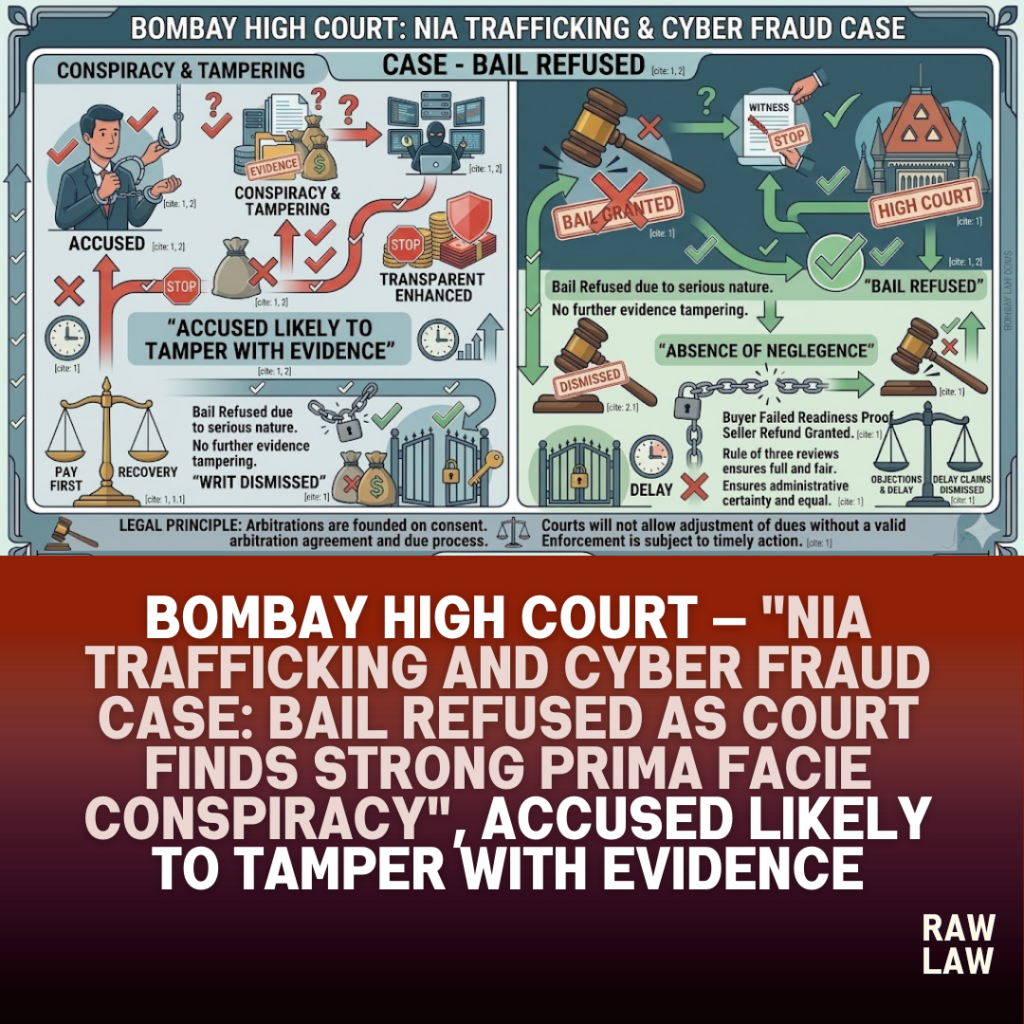

1. Court’s decision
The Bombay High Court refused bail to an accused arrested in connection with an alleged human trafficking and international cyber fraud racket. The Court held that the material on record prima facie established a criminal conspiracy involving trafficking of young job seekers to foreign countries and compelling them to participate in fraudulent online schemes.
The Court observed that the alleged offence under Section 371 of the Penal Code, which relates to trafficking, carries punishment up to life imprisonment. Given the seriousness of the allegations and the likelihood of the accused influencing witnesses or tampering with evidence if released, the Court dismissed the appeal challenging the order of the Special Court under the National Investigation Agency Act.
2. Facts
The prosecution case arose from allegations that between December 2022 and March 2023 the accused and his associates trafficked unemployed youths abroad under the false promise of lucrative employment opportunities.
According to the complaint, several individuals were taken to Southeast Asian countries with assurances that they would be employed in legitimate call centre or technology jobs. However, after reaching the destination country, the victims were forced to participate in fraudulent cyber activities intended to deceive foreign citizens and generate unlawful financial gains.
The victims alleged that when they resisted participation in the illegal activities, they were subjected to threats, physical abuse, and coercion. Their passports and travel documents were allegedly withheld, and they were compelled to pay money in order to secure their return to India.
The complaint was registered in March 2024 and the accused was arrested shortly thereafter. Following investigation by state police agencies, the case was transferred to the National Investigation Agency and charge sheets were filed against multiple accused persons.
3. Issues
The primary issue before the High Court was whether the accused was entitled to bail after filing of the charge sheet in a case involving allegations of human trafficking, extortion, and cyber fraud.
The Court also examined whether the evidence on record established a prima facie case of criminal conspiracy and trafficking, and whether continued detention of the accused was necessary to ensure the integrity of the investigation and prosecution.
4. Petitioner’s arguments
The defence argued that the accused had been wrongly implicated and that the individuals who travelled abroad had done so voluntarily after being informed about the nature of the employment. It was contended that each individual had been provided with employment contracts before leaving India and had exercised their own choice in accepting the job opportunities abroad.
The accused also claimed that he himself held an employment contract and work permit in the foreign country, placing him in a position similar to the alleged victims rather than that of an organizer of trafficking activities. The defence further argued that there was no reliable evidence of cheating or fraudulent conduct attributable to the accused.
The defence maintained that the charge of human trafficking had been improperly invoked and that the investigation did not involve offences under any special anti-terror or national security statutes. It was therefore argued that the ordinary principle of criminal law—“bail is the rule and jail is the exception”—should apply.
5. Respondent’s arguments
The prosecution opposed the bail application and argued that the evidence collected during investigation established a strong prima facie case against the accused.
According to the prosecution, the accused operated a recruitment network that targeted unemployed youths in India with promises of well-paying overseas employment. Once the individuals travelled abroad, they were taken to locations where they were forced to engage in cyber fraud schemes.
The prosecution also alleged that the victims’ passports were confiscated and that they were subjected to threats and coercion when they attempted to refuse participation in the fraudulent operations. It was further argued that the victims were required to pay money as a condition for securing their return to India.
The prosecution therefore submitted that the gravity of the offence and the organized nature of the criminal activity warranted denial of bail.
6. Analysis of the law
The Court examined the allegations in light of the provisions of the Penal Code relating to cheating, criminal conspiracy, extortion, and human trafficking.
Human trafficking offences under the Penal Code are treated as grave offences because they involve exploitation and coercion of vulnerable individuals. Courts are therefore required to carefully consider the seriousness of the offence and the potential impact on victims when deciding bail applications.
The Court also considered the established legal principles governing bail, including the seriousness of the offence, the possibility of the accused absconding, and the likelihood of interference with the investigation or trial.
7. Precedent analysis
While the judgment primarily relied on the facts of the case, the Court reaffirmed general bail jurisprudence that courts must consider the gravity of the offence and the strength of the prosecution’s prima facie case when determining bail applications.
The Court also reiterated that offences involving organized criminal networks, exploitation of victims, and international dimensions require stricter scrutiny at the stage of bail.
8. Court’s reasoning
The High Court found that the investigation revealed a coordinated recruitment network operated by the accused and his associates. Evidence indicated that the accused ran a recruitment agency that sent Indian youths to Southeast Asian countries under the promise of legitimate employment.
The Court observed that once the victims reached the destination country, they were instructed to create fake social media profiles and engage with individuals from other countries. These profiles were used to establish contact with potential victims and persuade them to invest in fraudulent cryptocurrency schemes.
According to the evidence, the victims were instructed to persuade foreign individuals to download mobile applications related to cryptocurrency investments and deposit funds. The applications falsely displayed profits, while the deposited funds were diverted to accounts controlled by the accused or associated entities.
The Court noted that the victims were effectively coerced into participating in the fraud schemes and were subjected to threats and extortion when they resisted. The victims were rescued only after contacting the Indian Embassy for assistance.
The Court concluded that the material on record demonstrated a prima facie case of trafficking and conspiracy involving organized cyber fraud activities.
9. Conclusion
The High Court held that the allegations disclosed serious offences involving trafficking of Indian citizens and their exploitation in international cyber fraud operations.
Considering the gravity of the offence, the potential punishment, and the possibility of the accused interfering with the prosecution evidence, the Court found no grounds to grant bail.
Accordingly, the criminal appeal challenging the denial of bail was dismissed.
10. Implications
The judgment highlights the increasing judicial scrutiny of human trafficking linked with international cyber fraud operations, particularly those involving recruitment of Indian youths for illegal online scam networks abroad.
The ruling signals that courts are likely to adopt a strict approach in bail matters involving trafficking, organized cybercrime, and cross-border exploitation. It also reflects the judiciary’s concern about emerging global fraud networks operating through deceptive employment schemes.
For law enforcement agencies, the judgment reinforces the legitimacy of coordinated investigations targeting transnational recruitment networks that exploit job seekers and compel them into cybercrime activities.
Case Law References
The judgment primarily relied on factual evaluation of the evidence and general principles governing bail in serious offences involving trafficking, criminal conspiracy, and organized crime.
The Court emphasized established bail jurisprudence that serious offences involving exploitation and organized criminal activity require cautious judicial assessment before granting bail.
FAQs
1. Can bail be denied in human trafficking cases under Indian law?
Yes. Courts may deny bail if the allegations disclose a serious offence such as trafficking, criminal conspiracy, or organized crime, especially where there is a risk of the accused absconding or influencing witnesses.
2. What factors do courts consider when deciding bail in serious criminal cases?
Courts consider the gravity of the offence, the strength of the prosecution’s prima facie case, the likelihood of the accused absconding, and the possibility of tampering with evidence or influencing witnesses.
3. What is cyber fraud trafficking?
Cyber fraud trafficking refers to situations where individuals are recruited or transported—often under false promises of employment—and then forced to participate in online scams or fraud operations.


