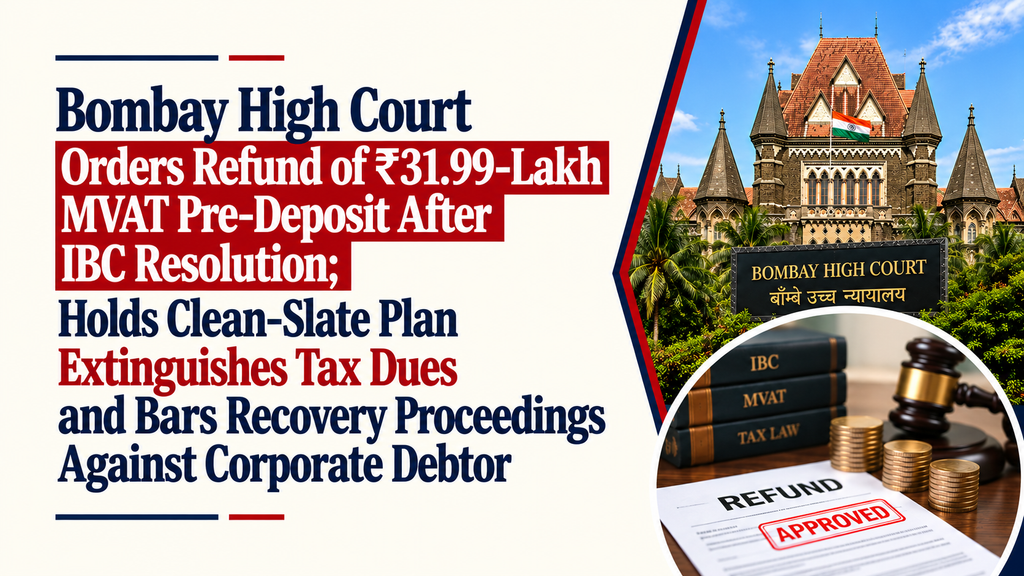
Bombay High Court Orders Refund of ₹31.99-Lakh MVAT Pre-Deposit After IBC Resolution; Holds Clean-Slate Plan Extinguishes Tax Dues and Bars Recovery Proceedings Against Corporate Debtor

Bombay High Court Quashes ₹6.20-Crore MVAT Assessment Recovery After IBC Resolution; Directs Refund of ₹31.99-Lakh Statutory Pre-Deposit With Applicable Interest
Facts
Aarem Insights Pvt. Ltd., formerly known as Shop CJ Network Pvt. Ltd., operated the 24×7 home-shopping television channel “Shop CJ”. It was assessed under the Maharashtra Value Added Tax Act, 2002 for Assessment Year 2016-17, culminating in an assessment order dated 26 February 2021.
The assessment raised a demand of approximately ₹6.20 crore. To maintain its statutory appeal under Section 26(6A)(c) of the MVAT Act, the petitioner deposited ₹31,99,174 on 22 April 2021.
Thereafter, CIRP proceedings were initiated against the company under Section 9 of the Insolvency and Bankruptcy Code, 2016 by an NCLT order dated 19 January 2022.
The State Tax Department’s claims for Assessment Years 2011-12 through 2016-17 were considered in the Resolution Plan dated 15 September 2022. The NCLT approved the plan on 21 March 2023 on a “clean slate” basis.
A rectification order dated 18 April 2023 clarified that ₹1 crore was allocated proportionately in full satisfaction of disputed government dues, including VAT claims. Pursuant thereto, ₹58,58,444 was paid to the Maharashtra GST Department in full and final settlement of claims aggregating approximately ₹27.91 crore.
Despite being informed of the approved Resolution Plan, the First Appellate Authority passed an order dated 31 May 2023, confirming the original assessment and directing recovery of the balance tax liability.
The petitioner subsequently requested refund of the ₹31.99-lakh statutory pre-deposit on the ground that the underlying tax liability stood extinguished under the Resolution Plan. As no refund was granted, it approached the Bombay High Court under Article 226.
Issues
The principal issues were:
- whether the MVAT authorities could continue or confirm recovery proceedings relating to pre-CIRP tax liabilities after approval of the Resolution Plan under Section 31 IBC;
- whether the approved Resolution Plan bound the Maharashtra State Tax Department;
- whether claims not preserved under the Resolution Plan stood extinguished under the clean-slate principle;
- whether the First Appellate Authority possessed jurisdiction to confirm the assessment and direct recovery after NCLT approval; and
- whether the petitioner was entitled to refund of the ₹31,99,174 statutory pre-deposit, together with applicable interest.
Petitioner’s Arguments
The petitioner contended that approval of the Resolution Plan under Section 31 IBC extinguished all pre-resolution liabilities except to the extent specifically recognised in the plan.
The State’s tax claims had already been dealt with under the approved plan and a specific amount had been paid in full settlement.
Accordingly, the Tax Department could neither continue the pending MVAT appellate proceedings to confirm additional liability nor retain the statutory pre-deposit in excess of what the Resolution Plan permitted.
The petitioner relied principally upon the Supreme Court’s decisions in Ghanashyam Mishra and Sons Pvt. Ltd. v. Edelweiss Asset Reconstruction Co. Ltd. and Ruchi Soya Industries Ltd. v. Union of India, together with Bombay High Court decisions applying the IBC clean-slate doctrine to statutory dues.
Respondents’ Arguments
The State Tax Department opposed the petition.
The learned AGP argued that the appellate authority possessed jurisdiction to pass the impugned order and that the MVAT Department’s claim was not extinguished or covered by the Resolution Plan.
The High Court rejected both contentions.
Analysis of the Law
1. Section 31 IBC Binds Government Tax Authorities
The Court relied upon Section 31 of the IBC, under which an approved resolution plan becomes binding upon:
- the corporate debtor;
- employees and members;
- creditors;
- the Central Government;
- State Governments;
- local authorities; and
- other stakeholders having statutory dues.
The Court therefore held that the Maharashtra Tax Department was not outside the binding effect of the Resolution Plan merely because its claim arose under the MVAT Act.
2. Clean-Slate Principle Extinguishes Pre-Resolution Claims
The Court treated Ghanashyam Mishra as squarely governing the controversy.
Once a Resolution Plan is approved under Section 31(1):
- claims recognised in the plan stand frozen according to its terms;
- claims not included in the plan stand extinguished;
- neither the State nor any other creditor can initiate or continue proceedings for such extinguished claims; and
- statutory dues owed to Central, State or local authorities are subject to the same principle.
The successful resolution applicant must therefore know the exact liabilities it is taking over and cannot subsequently be confronted with additional historical demands.
3. Appellate Authority Lacked Jurisdiction to Continue Recovery
The Court noted that the Resolution Plan had already been approved when the First Appellate Authority passed its order on 31 May 2023.
Once the plan came into force, the prior tax claims stood governed exclusively by its terms.
Consequently, the appellate authority lacked jurisdiction to direct recovery of the earlier MVAT demand, because continuing such proceedings was directly contrary to the binding statutory scheme under the IBC.
4. Statutory Pre-Deposit Could Not Be Retained
This was an important additional holding.
The ₹31,99,174 had been deposited solely as a statutory condition for maintaining the MVAT appeal.
Once the underlying tax demands were extinguished and the Resolution Plan fixed the amount payable to the Tax Department in full settlement, there was no lawful basis for retaining the pre-deposit in addition to the resolution amount.
The Court held that retention of the pre-deposit would permit the Tax Department to recover more than the amount sanctioned under the Resolution Plan, contrary to the clean-slate principle.
The amount therefore had to be refunded with applicable interest.
Precedent Analysis
Ghanashyam Mishra and Sons Pvt. Ltd. v. Edelweiss Asset Reconstruction Co. Ltd.
This was the principal precedent.
The Supreme Court held that after approval of a Resolution Plan under Section 31 IBC, all claims not forming part of the plan stand extinguished and no proceedings concerning them can thereafter be initiated or continued.
The Bombay High Court held that the present controversy was squarely covered by this judgment.
Committee of Creditors of Essar Steel India Ltd. v. Satish Kumar Gupta
The Court relied upon Essar Steel for the fundamental rationale of the IBC resolution process: a successful resolution applicant must be able to take over the corporate debtor on a fresh slate, without unexpected undecided historical liabilities surfacing afterwards.
Srei Equipment Finance Ltd. v. Assistant Commissioner, CGST
The Bombay High Court had earlier quashed analogous proceedings sought to be pursued after approval of a Resolution Plan.
The Court held that this precedent also directly supported the petitioner.
Murli Industries Ltd. v. Assistant Commissioner of Income Tax
This case reiterated that the objective of the IBC is to revive the corporate debtor by bringing finality to historical claims and providing certainty to the successful resolution applicant.
Uttam Value Steels Ltd. v. Assistant Commissioner of Income Tax and Principal Commissioner of Income Tax v. Patanjali Foods Ltd.
These decisions similarly applied the clean-slate doctrine to pre-resolution statutory claims.
Ruchi Soya Industries Ltd. v. Union of India
The Supreme Court reiterated that once a Resolution Plan receives NCLT approval, claims are frozen and claims not forming part of the plan cannot survive.
The Bombay High Court relied upon Ruchi Soya particularly while directing refund of the statutory pre-deposit.
Dalmia Cement (Bharat) Ltd. v. Union of India
The Court referred to Dalmia Cement as authority for refunding a pre-deposit following extinguishment of the underlying liability pursuant to insolvency resolution.
Court’s Reasoning
The Court considered the chronology decisive.
The NCLT approved the Resolution Plan on 21 March 2023.
The rectification order of 18 April 2023 expressly clarified the amount payable toward disputed government dues.
The petitioner then notified the appellate authority of these developments on 19 May 2023.
Nevertheless, on 31 May 2023, the appellate authority purported to confirm the earlier assessment and direct recovery of approximately ₹5.88 crore after adjusting the ₹31.99-lakh pre-deposit.
That course was incompatible with Section 31 IBC.
Once the tax authority’s pre-resolution claims had been dealt with under the approved Resolution Plan, it could not proceed as though the insolvency resolution had never occurred.
The pre-deposit also could not be converted into an additional recovery mechanism. It had been deposited only to satisfy the statutory condition for filing the appeal and therefore had to follow the fate of the underlying tax liability.
Conclusion
The Bombay High Court allowed the writ petition.
It quashed the First Appellate Authority’s order dated 31 May 2023 and all consequential proceedings.
The Court further issued a writ of mandamus directing the State Tax authorities to refund ₹31,99,174 together with applicable interest.
The judgment reinforces two important consequences of an approved IBC Resolution Plan:
- government tax claims are fully bound by the clean-slate principle; and
- statutory pre-deposits cannot be retained over and above the amount payable to the tax authority under the Resolution Plan.
Case Details
Case: Aarem Insights Pvt. Ltd. (formerly known as Shop CJ Network Pvt. Ltd.) v. Joint Commissioner of State Tax (Appeals)-VII & Ors.
Citation: 2026:BHC-OS:19859-DB.
Court: High Court of Judicature at Bombay, Ordinary Original Civil Jurisdiction.
Case Number: Writ Petition (L) No. 36803 of 2025.
Bench: Justice M. S. Karnik and Justice Sandesh D. Patil.
Judgment by: Justice M. S. Karnik.
Date: 7 September 2026.
Impugned Order: Appeal Order dated 31 May 2023 passed by the Joint Commissioner of State Tax (Appeals)-VII, confirming the MVAT assessment for Assessment Year 2016-17.
Subject: MVAT Act, statutory appeal pre-deposit, Section 31 Insolvency and Bankruptcy Code, approved Resolution Plan, clean-slate principle, extinguishment of government tax dues and refund of pre-deposit.
Result: Writ petition allowed. The appellate order and consequential recovery proceedings were set aside, and the State Tax Department was directed to refund ₹31,99,174 with applicable interest.