

Court’s decision
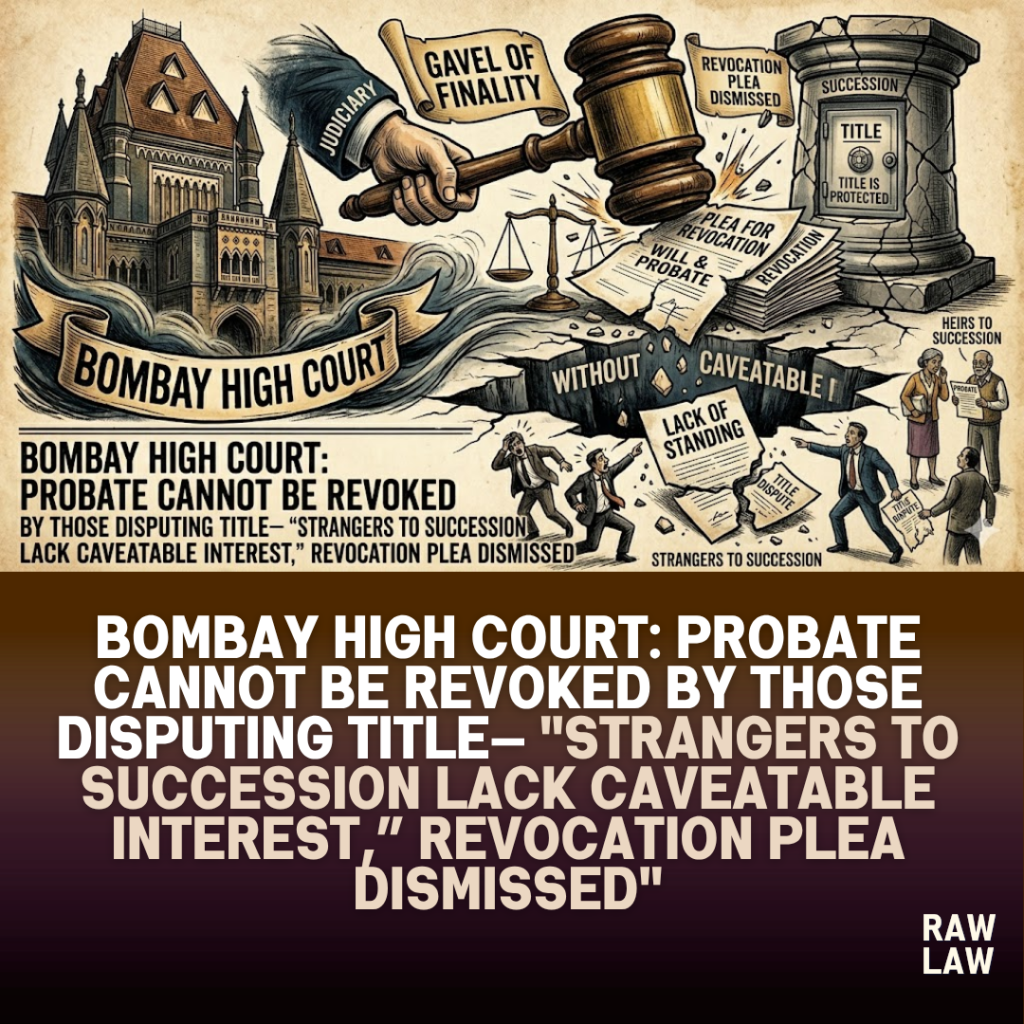
The Bombay High Court allowed the civil revision application and set aside the Trial Court’s order, holding that an application for revocation of probate is not maintainable when the applicants merely challenge the title of the testator. The Court ruled that such persons are “strangers to probate proceedings” and lack caveatable interest. Consequently, the revocation application was dismissed in its entirety.
Facts
The dispute arose from a Will executed in 2005 by a testator who bequeathed certain immovable properties in Satara partly to her son-in-law and partly to her children. Probate was granted in 2011 by the Civil Judge, Senior Division, Pune.
Subsequently, the testator’s brother and nephew filed an application in 2013 seeking revocation of probate under Section 383 of the Indian Succession Act.
Their primary contention was that the testator did not possess valid title to the properties, as earlier wills executed by their mother allegedly revoked the testator’s interest.
The applicant (beneficiary under the Will) challenged the maintainability of the revocation proceedings, leading to the present revision before the High Court.
Issues
The central issue was whether probate can be revoked at the instance of persons who challenge the title of the testator rather than claiming succession through the testator.
The Court also examined whether such applicants possess “caveatable interest” necessary to maintain revocation proceedings.
Another issue was whether probate proceedings can adjudicate disputes relating to title of property.
Petitioner’s arguments
The applicant argued that the revocation application was not maintainable as the respondents lacked caveatable interest.
It was contended that probate proceedings are confined to examining the genuineness of the Will and do not extend to questions of title.
The applicant relied on Supreme Court precedent to argue that persons disputing the testator’s ownership are strangers to probate proceedings.
It was further argued that the respondents had already filed a separate civil suit on title, and probate proceedings cannot be converted into a title dispute.
Respondent’s arguments
The respondents argued that the probate itself was unnecessary and invalid, as the Will was executed outside the jurisdiction where probate is mandatory.
They contended that the testator had no authority to execute the Will due to lack of ownership, and therefore the probate deserved revocation.
It was further submitted that even a slight interest in the estate is sufficient to maintain a challenge to probate.
The respondents also argued that the Trial Court had correctly held the revocation application to be maintainable.
Analysis of the law
The Court undertook a detailed analysis of probate law under the Indian Succession Act.
It emphasized that probate proceedings are limited to determining whether the Will was validly executed by a competent testator in a sound state of mind.
The Court clarified that questions of title, ownership, or competing property rights fall outside the jurisdiction of probate courts.
It further examined the concept of “caveatable interest,” holding that only those who stand to inherit the estate upon intestacy or invalidation of the Will can maintain objections.
Persons asserting independent title adverse to the testator do not qualify.
Precedent analysis
The Court relied on key Supreme Court judgments:
- Krishna Kumar Birla v. Rajendra Singh Lodha
Held that persons questioning title of the testator are strangers to probate proceedings and lack caveatable interest. - G. Gopal v. C. Bhaskar
Recognized caveatable interest where parties could inherit through the testator; distinguished on facts. - Saroj Agarwalla v. Yasheel Jain
Reaffirmed the “line of succession” test for caveatable interest. - Kanwarjit Singh Dhillon v. Hardyal Singh Dhillon
Held that probate courts cannot adjudicate title disputes.
The Court reconciled conflicting precedents and preferred the reasoning in Krishna Kumar Birla.
Court’s reasoning
The Court found that the respondents were not claiming inheritance through the testator but were instead asserting that the testator had no title to the properties.
It held that such a challenge falls outside the scope of probate proceedings.
The Court emphasized that probate does not determine ownership of property but only validates the Will.
It further observed that even if probate were revoked, the respondents would not inherit through the testator, as their claim was based on independent title.
Thus, they lacked caveatable interest.
The Court also rejected the argument that probate was invalid due to territorial considerations, holding that probate may still be granted even if not mandatory.
Accordingly, the Trial Court’s reliance on a broader interpretation of caveatable interest was held to be erroneous.
Conclusion
The Bombay High Court held that the revocation application was not maintainable and dismissed it, restoring the validity of the probate.
Implications
This judgment significantly clarifies the scope of probate jurisdiction and the doctrine of caveatable interest.
It reinforces that probate proceedings cannot be used as a forum to litigate title disputes.
The ruling also limits the category of persons entitled to challenge probate, ensuring that only those with a direct succession-based interest can intervene.
It provides clarity on reconciling conflicting Supreme Court precedents and strengthens procedural discipline in succession litigation.
Case law references
- Krishna Kumar Birla v. Rajendra Singh Lodha (2008)
Caveatable interest must arise from succession; title challengers excluded. - G. Gopal v. C. Bhaskar (2008)
Slight interest sufficient where inheritance through testator is possible. - Saroj Agarwalla v. Yasheel Jain (2017)
Affirmed succession-based test for caveatable interest. - Kanwarjit Singh Dhillon v. Hardyal Singh Dhillon (2007)
Probate court cannot decide title disputes.
FAQs
1. Who can challenge a probate in India?
Only persons with a caveatable interest—those who would inherit the estate if the Will is invalid—can challenge probate.
2. Can probate courts decide property ownership disputes?
No. Probate courts only examine validity of the Will, not title or ownership of property.
3. Can someone challenge probate by claiming the testator had no title?
No. Such persons are considered strangers to probate proceedings and must pursue a separate civil suit.


